Showing posts with label carbon emissions. Show all posts

Friday, March 2, 2012

Current rate of ocean acidification may be unprecidented

The current issue of Science includes The Geological Record of Ocean Acidification, the first summary of the geologic record for evidence of ocean acidification over the past 300 million years. The article suggests the world's oceans may be turning acidic faster today from human carbon emissions than they did during four major extinctions in the last 300 million years, when natural pulses of carbon sent global temperatures soaring. The complex set of processes examined in the article are summarized in the diagram below.


The press release has a nice summary:
The oceans act like a sponge to draw down excess carbon dioxide from the air; the gas reacts with seawater to form carbonic acid, which over time is neutralized by fossil carbonate shells on the seafloor. But if CO2 goes into the oceans too quickly, it can deplete the carbonate ions that corals, mollusks and some plankton need for reef and shell-building.

That is what is happening now. In a review of hundreds of paleoceanographic studies, a team of researchers from five countries found evidence for only one period in the last 300 million years when the oceans changed even remotely as fast as today: the Paleocene-Eocene Thermal Maximum, or PETM, some 56 million years ago. In the early 1990s, scientists extracting sediments from the seafloor off Antarctica found a layer of mud from this period wedged between thick deposits of white plankton fossils. In a span of about 5,000 years, they estimated, a mysterious surge of carbon doubled atmospheric concentrations, pushed average global temperatures up by about 6 degrees C, and dramatically changed the ecological landscape.

The result: carbonate plankton shells littering the seafloor dissolved, leaving the brown layer of mud. As many as half of all species of benthic foraminifers, a group of single-celled organisms that live at the ocean bottom, went extinct, suggesting that organisms higher in the food chain may have also disappeared, said study co-author Ellen Thomas, a paleoceanographer at Yale University who was on that pivotal Antarctic cruise. "It's really unusual that you lose more than 5 to 10 percent of species over less than 20,000 years," she said. "It's usually on the order of a few percent over a million years." During this time, scientists estimate, ocean pH—a measure of acidity--may have fallen as much as 0.45 units. (As pH falls, acidity rises.)

In the last hundred years, atmospheric CO2 has risen about 30 percent, to 393 parts per million, and ocean pH has fallen by 0.1 unit, to 8.1--an acidification rate at least 10 times faster than 56 million years ago, says Hönisch. The Intergovernmental Panel on Climate Change predicts that pH may fall another 0.3 units by the end of the century, to 7.8, raising the possibility that we may soon see ocean changes similar to those observed during the PETM.

Saturday, September 3, 2011

Budget Smog

A recent graph from the Congressional Budget Office (below) puts the US budget situation in an interesting light. Once you take the cost of running multiple wars off the books (the decade long decline in the green line) the spending side of the budget is pretty much in a steady state -- except for the cost of healthcare, which is rising dramatically.

So, you would think that environmental regulations that would limit air pollution and save billions in healthcare costs would be a good idea. Instead, as described in detail in Obama pulls back proposed smog standards in victory for business, the Obama administration has crumpled in the face of political pressure. Afraid of being labeled as responsible for "job killing regulation" during a period of high unemployment, the move effectively leaves in place 1997 era standards which even the Bush administration  admitted were lax and out of date. (The 1997 regulations were based on science showing that low-level ozone and other atmospheric pollutants contributed to various lung disease but not to death. Subsequent research has unequivocally tied such pollutants to both disease and death.)

Significantly, the regulations are, from a macro-economic perspective, effectively neutral. They would cost industry somewhere between $19 and 90 billion per year by 2020 (depending on the precise standard implemented) and would result in between $13 and 100 billion in healthcare savings. In other words, the total level of economic activity would remain the same, there would just be a shift from government expenditures on healthcare to private sector expenditures on pollution control.

Ominously,
The ozone standard is one of several air-quality rules the administration is in the process of adopting or has already finalized that are under attack. Others include new limits on mercury and air toxins, greenhouse gases from power plants, and a range of emissions from industrial boilers, oil refineries, cement plants and other sources.
This was the easy one. So the likelihood of action on the others is even less. Inaction on smog turns the big club of unilateral action on carbon emissions that the US courts gave the EPA when they ruled carbon was a pollutant into a plush toy. It is looking more and more like US environmental policy is another casualty of the divisive political culture. Return to slow and costly litigation in the courts may be the necessary path


Sunday, April 3, 2011

Greenhouse gas emissions: You say tomayto, I say tomaato

There are a variety of different ways of talking about greenhouse gas emissions. Each makes sense within its own context, but unlike different pronunciations, you need to take them all into account to make sense of the situation. It isn't a simple matter of choice.

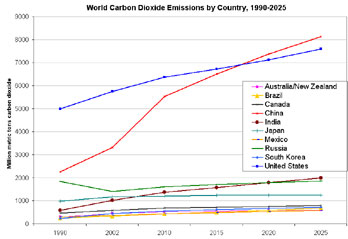
One way, as in the chart to the left looks at total emissions by country. Given the current political arrangements of the planet -- where policy implementation is made at the level of the nation-state, this view gives a sense of the overall 'contribution' of each country to the problem. This view has the practical benefit of pointing out that the two countries most responsible for the increasing level of emissions (the US and China) are also the main players currently outside the Kyoto process. And, as discussed in some earlier posts, the ones most at odds with each other over the next step; the development of a policy framework to replace Kyoto.


To view this graph, please install Adobe Flash Player.


Another way of viewing emissions, as shown above, is on a per capita (per person) basis. Viewed in this light, we see that China's contribution remains comparatively small -- the total contribution is large because of the massive population of the country, the average contribution per person remains substantially less than in the developed world. While a bit dated (the information only goes up to 2004) the above chart is dynamically connected to a data set that allows you to play around and look at it in different ways. Try it out!

For more on carbon emissions by person, see this article.

Sunday, March 27, 2011

Physicist Richard Muller on Climate Change

Richard Muller, Prof. of Physics at UC Berkeley, who teaches the famous “Physics for Future Presidents,” is leading an independent group of researchers at Berkeley, the Berkeley Earth Surface Temperature Study, to review and analyze climate change data. How “independent” is questionable, considering his group is receiving funding from the Charles G. Koch Foundation. His group is analyzing global temperature data and will present its findings at the end of this year. The group is computing all global temperature data, not a subset, and will make this data available on the web for anyone to view and analyze.


Muller contends that IPCC global temperature data is generally reliable, and its overall conclusions are correct: the average global temperature is rising and a continued rising temperature could have devastating consequences for human life. He states that the global average temperature increased 2 degrees Celsius since the mid 1800s, and has increased an additional 1 degree Celsius since 1957; furthermore, the one degree rise since 1957 is caused in part by human activity.


Mulller contends that many of the assertions in the 2007 IPCC report on climate change is anecdotal or conjecture—except for the temperature data. He claims that the only reliable indicator of global warming is global temperature data. The data and conclusions that are questionable are claims that there has been an increase in glacial melt (such as the Himalayan glaciers), Arctic and Antarctic polar melt, melt of permafrost in Alaska, forest fires, hurricanes (both frequency and severity), and tornadoes. He asserts these are not reliable indicators of global warming. Muller does not mention anything about increased rainfall or extreme rain events. However, more significantly, he argues that increased warming has caused increased evaporation of moisture from the earth’s surface and increased vapour in the atmosphere, which may—or may not—cause increased cloud cover. The greatest uncertainty with regard to predicting climate change is that it cannot be determined as yet whether global warming caused by increased C02 will or will not cause increased cloud cover. Muller asserts that if in fact cloud cover is increased by 2 percent, there will be no global warming, and he says that the IPCC report also states that.


Muller’s presentation shows that all the growth in emissions from this point on will be generated by developing nations, particularly China and India, and primarily because of coal-burning power plants. He states without reservation that if developing nations are allowed to continue their current rate of growth of carbon emissions that global warming will happen and that the effects will be disastrous.


Muller states that the IPCC Report and other climate change studies “cherry pick” the data they want to present and suppress other data. However, if you watch the video to the end of the question period, you will hear Muller admit that he failed to present graphs showing that carbon dioxide in the atmosphere has increased 36% and that the increase is “due to humans.”


Most tellingly, he states that climate change remedies must be “profitable to be sustainable.” He avoids the challenge by an audience member to define what “profitable” is or why climate measures must be profitable. He fails to qualify that “profitability” is a political objective, not an objective of scientific research.


Despite my reservations about Muller's nod to capitalism (profitability) and funding by the Koch Foundation, I believe that Muller's critique of climate change science is a valuable perspective. Furthermore, the Berkeley Earth Surface Temperature Study's analysis of global temperature data could be an important contribution to the science.

Tuesday, January 18, 2011

TEQs: UK Gov't Tradable Energy Quotas

The UK Parliament's All Parliamentary Group on Peak Oil, which began in 2007, is backing a TEQ scheme, or Tradable Energy Quotas. TEQ is a system of energy accounts for each adult that both sets a price on energy and quantifies the amount of carbon emissions per energy unit. It links the two major energy issues together: peak oil and carbon emissions. The price floats depending on scarcity/price, and the carbon units change, depending on the emissions level of the energy source. The scheme is designed to price fuel according to its scarcity and emissions, but also make sure that no one is "energy poor", that energy distribution is fair.

I can't vouch for the fairness of the scheme because I haven't read a critique on exactly how it would price and distribute energy in the real world. However, one has to begin with the presumption that the wealthy can buy as much fuel and carbon emissions as they would like, causing scarcity that both raises the price of fuel and reduces the amount of carbon emissions the less-than-wealthy can have. The scheme merely says that each adult is given an equal share of TEQs at the start of the year. If you use less than your share, you can sell your surplus; if you need more, you can buy more. Industry and Government bid for their units at a weekly Tender (auction). It appears that there are no limits on the amount of units that a wealthy person would be allowed to buy, although there is an annual "budget of units" that is projected until 2020. The story in the Energy Bulletin gives a bit more detail on the policy.

Even as a possibly flawed scheme, I would rather see one government move ahead and implement the policy as an experiment, to see how it actually plays out. We won't really know what the issues are until somebody tries it.

UPDATE: One question I had about the TEQ scheme was how energy and emissions would be counted in embodied forms: the purchase of consumer goods. TEQ has a scheme to count those energy and emissions units by requiring the producer to pay those TEQs. From The Oil Drum:

"The purchase of goods other than energy would not require the surrender of TEQs units, since the producers of those goods would have already surrendered units for the energy used in the production of the goods. Producers would then pass on the cost of buying these units to consumers, who would simply find that certain goods (those produced in a more energy-intensive manner) cost more."

However, this scheme hides the fact that a significant portion of goods in OECD countries (in some countries, the majority) are produced outside the country in places like China. The TEQ scheme, therefore, externalizes the energy and emissions costs associated with buying consumer goods to the country of production, where energy and emissions are not counted. This scheme gives consumers a free-pass to consume as much "cheap goods from China" as they can, since they will not have to surrender TEQs for those purchases. Furthermore, it gives a free ride to major retailers, like Walmart, who won't have to surrender TEQs for selling foreign-produced goods. It also penalizes the local production of goods, which may be producing such goods with lower energy and emissions and under stricter environmental laws. Consumer tendency would be to purchase foreign goods that don't reduce one's TEQs. This discourages the local production of consumer goods.

1.

TEQs (Tradable Energy Quotas) is an energy rationing system to enable nations to reduce their emissions of greenhouse gases along with their use of oil, gas and coal, and to ensure fair access to energy for all.

2.There are two reasons why such a scheme may be needed:

1. Climate change: to reduce the greenhouse gases released into the air when oil, gas and coal are used.

2. Energy supply: to maintain a fair distribution of oil, gas and electric power during shortages.

3.TEQs (pronounced "tex") are measured in units.

4.Every adult is given an equal free Entitlement of TEQs units. Industry and Government bid for their units at a weekly Tender.

5.At the start of the scheme, a full year's supply of units is placed on the market. Then, every week, the number of units in the market is topped up with a week's supply.

6.If you use less than your Entitlement of units, you can sell your surplus. If you need more, you can buy them.

7.All fuels (and electricity) carry a "rating" in units; one unit represents one kilogram of carbon dioxide, or the equivalent in other greenhouse gases, released when the fuel is used.

8.When you buy energy, such as petrol for your car or electricity for your household, units corresponding to the amount of energy you have bought are deducted from your TEQs account, in addition to your money payment. TEQs transactions are automatic, using credit-card or (more usually) direct-debit technology.

9.The number of units available on the market is set out in the TEQs Budget, which looks 20 years ahead. The size of the Budget goes down year-by-year - step-by-step, like a staircase.

10.The Budget is set by the Energy Policy Committee, which is independent of the Government.

11.The Government is itself bound by the scheme; its role is to find ways of living within it, and to help the rest of us to do so.

12.TEQs are a national scheme, enabling nations to keep their promises, guaranteeing their carbon reduction commitments within whatever international framework applies at the time.