Wednesday, June 27, 2012
Politics and Economics or Political Economy?
The fascinating figure below shows that for the past 60 years there has been a very strong link between the extent of income inequality (as the difference between the rich and the poor increases, so does the gini coefficient) and the extent of political polarization within the US House of Representatives.
Obviously, no single piece of evidence can unequivocally answer such a broad question. But, the figure below certainly suggests a very tight coupling between the Gini index (economy) and polarization within the House (politics); a scenario more straightforwardly consistent with Marx than with Luhmann
Those interested in the details of the research that produced the above graph will want to check out Polarized America.
Monday, February 20, 2012
Transformation, Vulnerability and Resilience
Tuesday, January 17, 2012
Design in Nature
In this groundbreaking book, Adrian Bejan takes the recurring patterns in nature—trees, tributaries, air passages, neural networks, and lightning bolts—and reveals how a single principle of physics, the Constructal Law, accounts for the evolution of these and all other designs in our world.There are lots of similarities between Bejan's ideas and Geoffrey West's work on scaling laws. At its heart, as argued here, Bejan wants to replace explanations of form based on processes of growth with an explanation that emphasizes flow.His website has an interesting set of resources and his TedX talk is below.
Everything—from biological life to inanimate systems—generates shape and structure and evolves in a sequence of ever-improving designs in order to facilitate flow. River basins, cardiovascular systems, and bolts of lightning are very efficient flow systems to move a current—of water, blood, or electricity. Likewise, the more complex architecture of animals evolve to cover greater distance per unit of useful energy, or increase their flow across the land. Such designs also appear in human organizations, like the hierarchical "flowcharts" or reporting structures in corporations and political bodies.
All are governed by the same principle, known as the Constructal Law, and configure and reconfigure themselves over time to flow more efficiently. Written in an easy style that achieves clarity without sacrificing complexity, Design in Nature is a paradigm-shifting book that will fundamentally transform our understanding of the world around us.
Wednesday, December 14, 2011
Economics and shifting stability states
"For a long time the perception was that the creation of the euro meant sovereign risk was effectively the same across all countries. That of course proved to be wrong. The Lehman's crisis and financial meltdown that followed affected the deficits and debt levels of different countries in different ways. Interestingly it is much the same countries now with very high yields as it was pre-euro, suggesting little has changed fundamentally in a decade." VICKY PRYCE, SENIOR MANAGING DIRECTOR FTI
Seems like a classic example of shifting stability states with interesting implications for managing socio-ecological systems if you think of the adoption of the euro as the creation of a meso-level institutional structure (larger than the individual participating states, but not encompassing the entire global economy). Conceived that way, the new institutional structure temporarily managed to equalize risk, but a distant disturbance in the larger system (the Lehman bankruptcy) undid it and shifted system control back to the higher (global) level.
Monday, August 8, 2011
Bodies, Big Brains and Regulatory Reform
- A Body Fit for a Freaky-Big Brain, summarizing research on the anatomical adaptations necessary to accommodate our over sized brains -- which use 20 times as much energy per pound as muscle tissue. Among the factors identified: reduction in the amount of gut tissue (also very energy intensive); shifting of diet to a higher energy cuisine based on seeds, tubers and meats; and a genetic adaptation in glucose transporters that resulted in extra molecular pumps to funnel sugar into the brain, while starving muscles by giving them fewer transporters.
- Individuals interested in takes on the financial collapse will want to check out Capital Inadequacies The Dismal Failure of the Basel Regime of Bank Capital Regulation. Put out by the libertarian Cato Institute, the paper provides 40 pages or so of analysis aimed at a) documenting that regulatory solutions to financial matters are misplaced because regulatory apparatus is subject to capture and b) advocating a solution based on financial laissez faire.
The solution is free banking or financial laissez faire. The state would withdraw entirely from the financial system and, in particular, abolish capital adequacy regulation, deposit insurance, financial regulation, and the central bank, as well as repudiate future bailouts (and especially the doctrine of Too Big to Fail). ... Such systems have worked well in the past, and reforms along these lines would take the United States a long way back to its banking system of a century ago, in which banks were tightly governed and moral hazards and risk taking were well controlled because those who took the risks bore their consequences.
Now we can debate the empirical validity of these claims -- the individuals who lost all their savings in the bank runs of the Great Depression probably wouldn't agree that "those who took the risks bore their consequences" -- but that isn't the point.
Compare the view of systems and adaptation in the two scenarios. In the first article the "system" is the human body. The basic argument is that modification of one major subsystem (the brain) necessitated modification to other parts of the system in order for the "big brained" version of humans to survive. Contrast this with the view of the economic system advanced in the Cato Institute analysis. Over the past century the economy has changed dramatically. The growth of financial services as the mainstay of many advanced economies is the equivalent of the emergence of big brains -- one particular part of the system is becoming unusually important. A century ago, advanced economies were based on manufacturing and agriculture. Today, these sectors play a comparatively minor role and financial services (conventionally rendered as Wall Street) rule. But, rather than recognizing that change in one part of the system requires an adjustment in other parts of the system, the Cato paper argues for stability in the other aspects of the system (as expressed in the desire for a banking system similar to what was in place in 1910).
There is also a confusion Cato Institute paper about the role of organization (regulation) as it characterizes complex systems, but getting into that would be another (lengthy and necessarily technical) post.
Tuesday, July 26, 2011
Padgett, Part II: Emergence of Partnership
Tuesday, January 11, 2011
Integrating Economic Gain in Biosocial Systems
A recently published article by Timothy Allen, Joseph Tainter and others (Integrating Economic Gain in Biosocial Systems in Systems Research and Behavioral Science Syst. Res. 27, 537-552 2010) develops a model that has relevance to this situation, though its more explicit focus is on how systems evolve. Specifically, they note that observed hierarchies change their level structure and organization as they pass through time. Think, for example, of the European Union. This is an attempt to reorganized a social system through the insertion of an intermediate hierarchical level (the EU) that sits between the existing hierarchical levels of socio-economic organization at the level of the state and at the global scale. This idea is consistent with the work of Holling and other panarchy theorists who argue that the number of levels in a panarchical hierarchy can increase through time.
Allen et al argue that "The concept of gain and profit is introduced into ecology as a way of summarizing strategies of biological and social structures. High gain systems can be predicted by flux as they take in fuel at a rate. Low gain systems must refine low-quality materials in order to acquire fuel. Low gain systems are predictable from their plans and coded behaviour. Changes from high to low gain mode and vice versa represent a reordering of a hierarchy over time." The model of socio-ecological systems they utilize is described below.
Figure 1 "There are two basic parts to biological and social systems: thermodynamic happenings and coded limitations. The coded information amounts to plans which are executed in some sort of construction process. In biological systems the codes might be embodied in DNA, hormones or even mating dances. The construction might be protein synthesis, but could equally be making a nest for a bird. In social systems, there are many modes of construction, all involving plans. The whole constructed material system is an update on the narrative that the whole tells its mates, predators and prey. The scientist observes the updated whole with its extended story. The scientists tell stories about those stories amongst themselves. The construction may not live up to the plans such that the system must become something else more efficient by creating a new plan. Economists let their systems continue to tell their respective stories as they watch adjustments in plans as the system repeatedly becomes more economical, more flexible or bigger. Ecologists and biologists in general do not wait for their systems to update, and merely note that the old plan fails to work as resources are used up. Economists expect adjustments to be only temporary and simply note that scarcity increases costs that demand ever more efficiency."
Note the role of the observer in the above model. Definition of a system as high gain or low gain is dependent on the level of analysis. Thus, if the boundary of the system is the fuel entering the car, then the system is high gain. But if the system is bounded to include oil drilling, transportation and refinement, with crude oil as the original input, then it is low gain.
And the manner in which work gets done is dependent on whether the system is low or high gain. "High gain takes in high quality material and degrades it without effort put into being efficient: profligate consumption. Low gain efficiently degrades inputs to get more work out of them. The option may then be open for taking in lower quality of inputs. There is not only more quantity of raw lower quality inputs, but they also contain potential for producing a greater quantity of refined material that is of the same quality as the high gain inputs used directly as fuel. Degradation is separate from dissipation, which is input quantity times degradation. Low gain in the end gets more work done by increased degradation opening the door to greatly increased dissipation."The article ends with a discussion of termites aimed at illustrating the processes of system evolution.
Termites make a very good example of how shifts over evolutionary time follow the patterns of high and low gain. Primitive termites eat good wood in which they live. In the end they literally eat themselves out of house and home. These high gain termites are forced to reproduce and move to a new site where new good wood prevails (Thorne and Traniello, 2003). The forced move amounts to a high gain collapse. More advanced termites eat a wide range of organic materials from the environs (Wilson, 1971). As opposed to the moderate colonies of high gain termites, the large low gain termite colonies live in huge ventilated mounds built of saliva cemented feces. They still eat woody material but they do so by gathering dead and rotting wood from the landscape around them. The large size of these colonies is characteristic of low gain systems. Lower quality woody remains exist in larger quantities over an area than does good wood. Good wood is a local resource, focused on individual chunks. Gathering woody material that is diffuse is clearly low gain and offers economies of scale.
The figure to the left shows "termite evolution from high to low gain on a pleated surface. Starting up in the top left of the surface, high gain termites eat themselves out of house and home, collapsing at point A where the colony must reproduce and move. The shift to low gain always occurs only as the instability is imminent. The course correction at the last minute avoids collapse of the resource base by becoming suddenly much more efficient. The correction may avoid collapse by reaching the continuous surface at point B. The alternative route to B is the dotted line of prudent planning. No system ever does that because it is out-competed by high gain rivals, and there is no incentive to economize anyway. Point B is transitional. It leads to low gain efficiency and increase in size due to economies of scale at point C. Burdened with much infrastructure the low-gainers at C can become too large and demanding, in which case they fall over the front side of the surface. The super low gain strategy of the soil eaters goes to point D with deep adaptation and energy limiting super low gain resources."This article is both deep and abstract. As I've only started to seriously work my way through it, I've focused more on expanded quotes rather than summary and exposition. Any thoughts?
Friday, October 8, 2010
Jason Moore, World Systems and Agriculture
It provided a fascinatingly detailed and historically rich description of the relationship between developments in Spain (leading to a need for silver) and those in Bolivia (where silver production was declining). At the core of the paper was a description of how Latin American agricultural practices were changed in order to free up the labor necessary to increase silver production through the implement new, labor intensive silver extraction and smelting techniques. While the bulk of the paper deals with the silver industry, it was the shift in agriculture that fascinated me. It went from a labor intensive vertical model that exploited the variety of ecological niches present in the narrow space between the Pacific and the Andes -- where different crops were grown and livestock raised at different altitudes with guano from the coast used as fertilizer -- to a labor efficient horizontal model -- combining agriculture and livestock into a single ecological zone and using the livestock to plow the fields. It remains one of the best historical scale accounts of the operation of social-ecological systems that I know. Unbeknown to me, Moore had already received several awards for his work (including a best graduate student paper award and an Honourable Mention for the Rheinhard Bendix prize offered by the Historical Sociology Section).
Moore, like Hornborg who's writing I've discussed here, is a world systems theorist. Indeed, one of his earliest pieces was a critique of Hornborg. I had originally intended to post material about Moore's work as a follow-up to the Hornborg posts, but things intervened.
And now Moore is back with another great piece "The End of the Road? Agricultural Revolutions in the Capitalist World-Ecology, 1450–2010". Here is the abstract:
Does the present socio-ecological impasse – captured in popular discussions of the ‘end’ of cheap food and cheap oil – represent the latest in a long history of limits and crises that have been transcended by capital, or have we arrived at an epochal turning point in the relation of capital, capitalism and agricultural revolution? For the better part of six centuries, the relation between world capitalism and agriculture has been a remarkable one. Every great wave of capitalist development has been paved with ‘cheap’ food. Beginning in the long sixteenth century, capitalist agencies pioneered successive agricultural revolutions, yielding a series of extraordinary expansions of the food surplus. This paper engages the crisis of neoliberalism today, and asks: Is another agricultural revolution, comparable to those we have known in the history of capitalism, possible? Does the present conjuncture represent a developmental crisis of capitalism that can be resolved by establishing new agro-ecological conditions for another long wave of accumulation, or are we now witnessing an epochal crisis of capitalism? These divergent possibilities are explored from a perspective that views capitalism as ‘world-ecology’, joining together the accumulation of capital and the production of nature in dialectical unity.
While Moore's analysis, from my perspective, places a bit too much emphasis on capitalism and, correspondingly, too little emphasis on the consequences of industrialization, he provides a significantly more nuanced view of the social portion of socio-ecological systems than most individuals working with the concept.
Finally, for those wanting more Moore, Jason has graciously posted many of his papers to the web.
Saturday, September 11, 2010
Tipping points and critical slowing down
One such phenomena has been labeled 'critical slowing down,' the decreasing rate of recovery from small disturbances to a system as it approaches a tipping point. In other words, when a system is close to a tipping point, it can take a long time to recover from even a very small disturbance. John M. Drake & Blaine D. Griffen recently reported the first experimental demonstration of such a process in a biological system "Early warning signals of extinction in deteriorating environments" (doi:10.1038/nature09389). Here is a summary of the key points from ScienceDaily:
The paper, published in the early online edition of the journal Nature, describes a study of the fluctuations in experimental populations of water fleas (Daphnia magna) undergoing environmental stress until they reach a tipping point beyond which they do not remain viable. The study is unique in its careful comparison of these stressed populations with other, healthy populations in the context of new theories about dynamic systems undergoing transitions at a tipping point. ...The experiment featured populations of water fleas that were assigned to either deteriorating environments (in this case, declining levels of food) or stable environments (the control group). The experiment lasted for 416 days, when the last population in the deteriorating environment group became extinct. Depending upon the amount of food they received, populations in the deteriorating environment group reached the population viability tipping point after approximately 300 days. Populations in the control group never reached it; those populations persisted.
The researchers next looked at a variety of statistical indicators, early warning signals that could detect the onset of CSD and thereby predict the approach to a tipping point. They compared the indicators with the timing of the decrease in food and with the achievement of the tipping point, mathematically referred to as a "transcritical bifurcation." They found that each of the indicators -- some more strongly than others -- showed evidence of the approaching tipping point well before it was reached.
According to Drake, what is even more important is the generality such statistical indicators are expected to exhibit. That is, although precise quantitative models are required to predict most natural phenomena -- in any domain of science -- with any degree of accuracy, the theory of critical slowing down applies qualitatively anytime a bifurcation is in the vicinity. "You don't have to know the underlying equations to use the theory," Drake said, "and this is important in biology, where the dynamics are typically sufficiently complex that we often do not know which equations to use. In fact, we may never come to such a complete understanding, given the range of biodiversity out there and the fact that species are evolving all the time."
Tuesday, September 7, 2010
Environmentalist's Paradox
The question comes from the juxtaposition of two different data sets. On the one hand, there is good evidence, from the UN human development index (shown at the left) that the average quality of life for individuals, irrespective of where they live, has increased over the past 35 years.On the other hand, the influential Millennium Ecosystem Assessment and a variety of other studies of the biosphere have concluded that the capacity of ecosystems to produce many services for humans is now low.
The study assesses four explanations of these divergent trends: (1) We have measured well-being incorrectly; (2) well-being is dependent on food services, which are increasing, and not on other services that are declining; (3) technology has decoupled well-being from nature; (4) time lags may lead to future declines in well-being.
The findings discount the first hypothesis, but elements of the remaining three appear plausible. A tabular summary of the findings is shown below. For better viewing, click on the figure to expand it to full screen.
The article goes on to argue that, although ecologists have convincingly documented ecological decline, science does not adequately understand the implications of this decline for human well-being. Untangling how human well-being has increased as ecosystem conditions decline is critical to guiding future management of ecosystem services. To this end, they propose four research areas to help achieve this goal: 1) how ecosystem services produce multiple aspects of human well-being, 2) ecosystem service synergies and trade-offs, 3) technology for enhancing ecosystem services, and 4) forecasting the provision of and demand for ecosystem services.
Sunday, August 8, 2010
In Defense of Difference
Experts have long recognized the perils of biological and cultural extinctions. But they’ve only just begun to see them as different facets of the same phenomenon, and to tease out the myriad ways in which social and natural systems interact. Catalyzed in part by the urgency that climate change has brought to all matters environmental, two progressive movements, incubating already for decades, have recently emerged into fuller view. Joining natural and social scientists from a wide range of disciplines and policy arenas, these initiatives are today working to connect the dots between ethnosphere and biosphere in a way that is rapidly leaving behind old unilateral approaches to conservation. Efforts to stanch extinctions of linguistic, cultural, and biological life have yielded a “biocultural” perspective that integrates the three. Efforts to understand the value of diversity in a complex systems framework have matured into a science of “resilience.” On parallel paths, though with different emphases, different lexicons, and only slightly overlapping clouds of experts, these emergent paradigms have created space for a fresh struggle with the tough questions: What kinds of diversity must we consider, and how do we measure them on local, regional, and global scales? Can diversity be buffered against the streamlining pressures of economic growth? How much diversity is enough? From a recent biocultural diversity symposium in New York City to the first ever global discussion of resilience in Stockholm, these burgeoning movements are joining biologist with anthropologist, scientist with storyteller, in building a new framework to describe how, why, and what to sustain.
....
It’s the ability of a system — whether a tide pool or township — to withstand environmental flux without collapsing into a qualitatively different state that is formally defined as “resilience.” And that is where diversity enters the equation. The more biologically and culturally variegated a system is, the more buffered, or resilient, it is against disturbance. Take the Caribbean Sea, where a wide variety of fish once kept algae on the coral reef in check. Because of overfishing in recent years, these grazers gradually gave way to sea urchins, which continued to keep algae levels down. Then in 1983 a pathogen moved in and decimated the urchin population, sending the reef into a state of algal dominance. Thus, the loss of diversity through overfishing eroded the resilience of the system, making it vulnerable to an attack it likely could have withstood in the past.
....
“There is an underlying assumption in much of the literature that the world can be saved from these problems that we face — poverty, lack of food, environmental problems — if we bring consumption levels across the world up to the same levels [of] North America and Europe.” But this sort of convergence, says Pretty, would require the resources of six to eight planets. “How can we move from convergence to divergence, and hence diversity?”
Traditional environmentalism, with its tendency to erect impermeable theoretical barriers between nature and culture, between the functions of artificial and natural selection, hasn’t been able to accommodate the perspective necessary to see larger patterns at work. Its distinction — as the writer Lewis Lapham recently put it — “between what is ‘natural’ (the good, the true, the beautiful) and what is ‘artificial’ (wicked, man-made, false)” has obscured their profound interrelatedness. Whether expressed as biocultural diversity or as diverse social-ecological systems, the language of these new paradigms reframes the very concept of “environment.” Explicit in both terms is a core understanding that as human behavior shapes nature in every instant, nature shapes human behavior. Also explicit is that myth, legend, art, literature, and science are not only themselves reflections of the environment, passed through the filter of human cognition, but that they are indeed the very means we have for determining the road ahead.
If you read the whole article you will find that biocultural diversity is, to my mind, too simplistically treated as equivalent to linguistic diversity -- a problem also found in an earlier (and similar) argument made by Thomas Homer-Dixon in We Need a Forest of Tongues. Linguistic diversity isn't important in and of itself but, rather, because it acts as a buffer that slows the homogenization process. If you don't communicate with the dominant group, then you are less likely to be consumed by it. But there are other factors, like the growth of transportation and communication technologies and the economics of globalization, that underpin the homogenization process. The trick is to discover how to be connected without being assimilated.
Sunday, July 4, 2010
5 Books that will change how you think
1. Thomas Homer-Dixon, The Ingenuity Gap: Can we solve the problems of the future?
2. Lance Gunderson and Buzz Holling (eds.), Panarchy: Understanding Transformations In Human And Natural Systems
3. E.A. Wrigley, Continuity, Chance & Change: The character of the Industrial Revolution in England
4. Joseph Tainter, The Collapse of Complex Societies
5. Bill McKibbon, The Age of Missing Information.
Sunday, May 23, 2010
Hornborg, Part 4: Power in Resilience Theory
Hornborg's book is titled The Power of the Machine. In the book he uses the word power in two different senses; to reference both political/social power and mechanical power. The underlying claim is that these two forms of power are manifestations of the same thing; that the capacity of machines to do work is a product of power in the social world.
Hornborg's focus on power led to a rather interesting, if ultimately unproductive, series of exchanges between himself and the posters at Resilience Science. Like ships passing in the night, Hornborg critiqued resilience theory for its lack of attention to power while the resilience researchers offered up references to papers done within the resilience tradition that they claimed explicitly incorporated the analysis of power into the work. Ironically, both have a point.
Hornborg appears 1) to ground his critique of the perspective on a reading of the conceptual material describing the resilience framework (e.g. Holling) rather than a familiarity with the empirical studies employing the framework and 2) to mistakenly interpret the resilience framework as sharing a view of systems similar to functionalism and, hence, subject to some of the same critiques. Putting aside Hornborg's misunderstanding of the notion of system embedded in panarchy/resilience approach, the root of the argument turns on the distinction between a theory and a framework.
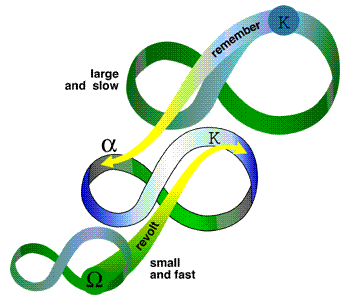
Holling, in "Understanding the Complexity of Economic, Ecological and Social Systems" develops the concept of panarchy as a means to elegantly account for the empirical behaviour of complex adaptive systems (i.e., by postulating a structure that allows a relatively small number of factors to generate the observed complexities rather than treating complexity as the product of a very large number of interacting factors). The concept of a panarchy involves three essential elements as diagrammed below: 1) a set of adaptive cycles (the sideways figure 8's in the diagram) that are 2) hierarchically ordered (from processes that are small scale and short duration to processes that are large scale and of long duration) and involve 3) processes of cross-scale interaction (the links labeled revolt and remember on the diagram).
Visual Representation of Panarchy as Framework and Metaphor
Visual Representation of Panarchy as Theory for a Specific System
Controlling factors for Adaptive Cycle A -->
Controlling factors Cycle B -->
Controlling factors Cycle C -->
Seen in this light, Hornborg is correct. The panarchy framework does not theorize power. However, the resilience researchers are also correct. Many empirical studies drawing on the panarchy framework have paid attention to power relations when attempting to 'fill in the blanks' and specify the factors responsible for the operation of the adaptive cycles in particular systems.
But, even if Hornborg read the specific empirical studies, I suspect he would still dispute the claim that the resilience researcher's had incorporated an analysis of power. The reason for this is that Hornborg advocates not just the incorporation of power into the analysis, but the incorporation of power theorized in a specific manner. To the extent that the resilience researchers incorporate power into their research they do it in relation to the specifics of the particular case and the theoretical proclivities of the individual researchers. Thus, viewed across the different empirical studies, the concept of power is not used in a consistent manner. Power means one thing in one study and another thing in a second study. In contrast, following Marx, Hornborg sees power as a very specific phenomena -- there is one dominant type of power (economic) to which all others are subservient. Thus, for example, he would recognize the coercive power held by the military but would argue that it is exercised in accordance with the interests of the ruling economic class.
This is where I part company with Hornborg. Historical analysis has showed that Weber had a better grasp on the concept of power than did Marx. Non-economic forms of power (military, bureaucratic, ideological, etc.) are often, but not always, subservient to the interests of the dominant economic elite. Thus, to preserve their explanatory utility in those situations where economic power does not trump all other forms, it is necessary to conceptualize power as consisting of a variety of independent dimensions rather than, as Marx does, as one dominant dimension that subsumes all other facets. For a concise discussion of this issue, see Chapter 1 of Michael Mann, The Sources of Social Power Volume 1.
Thursday, May 20, 2010
Hornborg, Part 3: Machine Fetishism
If this is so, why isn't it readily apparent to us? Why is technology generally viewed as liberating rather than enslaving? Hornborg answers this question by borrowing from Marx's notion of commodity fetishism, to develop a case for machine fetishism.
To illustrate how the process operates, Hornborg draws a parallel between the situation of the Inca Emperor and the concept of machine ferishism. The Inca emperor was understood to be the son of Sun god and, as such, was responsible for the wealth of the Inca people. The Emperor was viewed as generous, giving and the source of cornicopian benefits. According to Hornborg, the office of the Inca emperor was fetischized, a mystification of the unequal power relations necessary for his apparent productivity.
Hornborg views industrial technology in the same way. We think of it as productive in itself, but this depends on not thinking about the inputs and flows that make technology possible. Technology is, he argues, a fetishization of unequal exchange. Interest on money is mystification of unequal exchange. We invest material objects with magical qualities in order to hide this fact.
Hornborg isn't arguing that machines don't work or provide benefits but, rather, that like Inca ritual they do so through unequal relations of social exchange.
Monday, April 5, 2010
Hornborg, Part 2: Technomass
Hornborg treats satellite images like the one above as the visible manifestation of technomass, his term for the infrastructure of industrial technology and its products. As the phrasing suggests, Hornborg is interested in the parallels between technomass and biomass. Thus, technomass refers to the aggregate amount of technological infrastructure, not to individual local elements. Similarly, Hornborg sees local technologies as residing within the equivalent of an ecological niche composed of the features necessary for the effective operation of the technology (raw materials, fuels, labor). When the flows necessary to sustain the technomass stop, the technological infrastructure will disappear.
Hornborg, following world systems theory, is interested in the differences between the light and dark areas, that is the differences between the industrially developed regions of the globe and those less developed. What does the accumulation of technomass mean for the dark areas? Drawing on works like Cronon's Nature's Metropolis (which treats Chicago as linked to the West through a network of resource and commodity flows) and Wilkenson's Poverty and Progress (which argues that British industrial development resulted from exploitation of other areas, notably the shift in cloth production from native wool to US cotton that allowed British land to be liberated for industrial uses and the importation of iron from Sweden), Hornborg argues that the growth of local infrastructure is a result of accumulation.
Imagine that the lights on the satellite image are technomass. For a structure to reproduce itself, it must draw in exergy (potential to conduct work inherent in energy). Here is where Hornborg develops his thermodynamics of imperialism. According to the first law of thermodynamics energy can't be created or destroyed and, as a result, it is erroneous to speak of the consumption of energy. What gets consumed is exergy -- the quality in the energy that allows work to be done -- not the energy itself; energy is still there going out as heat into space, etc. Complex systems of any type, whether it be the human body or industrial technology, persist by inputting high quality energy into the system relative to the quality of energy outputted. Humans, for example, eat high quality molecules and dissipate low quality energy (heat). It is the constant input of high quality energy into the system that allows local complexity to survive in the face of entropy. But, as empirical studies such as those of Cronon and Wilkinson show, it is the net transfer of both energy and matter to the center from the periphery that allows industrial infrastructure to persist. It is the manner in which the inherent inequality of this physical process leads to social inequalities that leads Hornborg to label it the 'thermodynamics of imperialism.'
Sunday, April 4, 2010
Ecological World Systems: Hornborg, Part 1
But how do you measure exploitation? Traditional economics argues that exchanges between the core and the periphery are accurately measured by market prices and, hence, there is no exploitation; the core country pays $100 to the periphery country for each $100 worth of raw material it receives. Traditional world-systems theory builds on Marxist economic principals to argue that market prices aren't an accurate representation of the exchange and to show how such exchanges are economically unequal. Hornborg notes, correctly, that economics as a discipline finds the Marxist accounts wanting. Thus, he wants to develop an alternative metric for measuring the exchanges. It is here that Hornborg turns to ecology and, in specific, the implications of the second law of thermodynamics to propose a thermodynamics of imperialism, i.e. an ecology of unequal exchange.
Central to his argument is the concept of "technomass" which I'll take up in a future post.
Friday, February 5, 2010
Global change in species interactions of terrestrial ecosystems
Less appreciated by social scientists is the fact that climate change is only one of several major drivers affecting terrestrial ecosystem change. The others are CO2 enrichment, nitrogen deposition, biotic exchanges, and land-use change. In an important recent paper, Global change and species interactions in terrestrial ecosystems, biologist Jason Tylianakis reports the results of a metanalysis of 700 papers about terrestrial ecosystem change.
Tylianakis describes the significance of his work as follows:
Global changes to the Earth's ecosystems are possibly the greatest combined challenge that humanity must face. These changes are often studied independently, but their effects are likely to be interactive, which could exacerbate or even mitigate the effect of each driver in isolation, and have potentially devastating consequences for the structure and functioning of communities and ecosystems. Our paper brings together a large body of research on how these changes affect interactions between different species from different systems, and thus it provides an insight into what we may expect in the future.
There are no longer any ecosystems on Earth that are untouched by human influence. Global environmental changes drive extinctions and alter species distributions, and recent evidence now shows pervasive impacts on a variety of interactions between species. Species interactions are critically important for ecosystem stability and functioning, yet their fragility makes them vulnerable to environmental changes.
Each of the major drivers of global change (CO2 enrichment, nitrogen deposition, climate change, biotic exchanges, and land-use change) have direct effects on species interactions, but the interactions between multiple drivers acting simultaneously hinder predictions of future responses. Summing up these individual changes across entire networks of species interactions yields unanticipated effects on ecosystems and the services they provide.
Thus, much like Charles Perrow's analysis of technological systems (Normal Accidents), Tylianakis has realized that the interactions among different causes create unexpected complications that generate uncertainties.
The paper can be found in Ecology Letters, (2008) 11: 1351–1363 doi: 10.1111/j.1461-0248.2008.01250.x
Friday, January 29, 2010
Oil prices and economic resilience
In this light, it is interesting to contrast conventional press coverage of recessions -- which much like history treat each recession as a unique event -- and recent work examining the relation between energy prices and the economy.
The graph below suggests a connection between energy prices (specifically the price of oil) and the onset of a recession. Four of the past five recessions were preceded by a significant increase in the price of oil.
While this is interesting, the data don't really shed much light on the mechanism that would account for the association. The more complicated look at these events, shown in the diagram below, provides more insight into the specifics of the potential causal process. Over the past 40 years the same sequence of events occurred before each recession: a spike in the price oil, followed by an increase in the percent of GDP used to purchase oil, followed by a recession. In other words, it isn't the price of oil per se but, rather, the impact of changing energy prices on the standard dynamics of production and consumption (represented by the shift in percent of GDP expended on oil) that flips the system into a different equilibrium state (the recession).
Further details on the economics of the process are available in James Hamilton's report Causes and Consequences of the Oil Shock of 2007-8.
Wednesday, November 25, 2009
New Book: William Catton Returns with "Bottleneck"
George Mobus, Assoc. Prof. of Computing Software Systems at the Univ. of Washington Tacoma does a lengthy review of William R. Catton's Bottleneck: Humanity's Impending Impasse. The book is posed as a sequel to Catton's 1983 book, Overshoot, which has become a classic of literature in environmental sociology. The review is posted at The Oil Drum.
"In the sequel, Bottleneck: Humanity's Impending Impasse, Xlibris Corporation, he drops the part about we can evade the worst. The subtitle says it all. Now he concludes that it is already too late to mend our ways and somehow avoid the collapse of civilization. Indeed the main title refers to an impending collapse of the human population. An ecological bottleneck (also called a population bottleneck) is where radical changes in the environment of a species causes a die-off of all but the most hardy of the population; hardy, that is, in terms of the selection pressures arising from the change. Of course there may be no sufficiently hardy individuals left or the ones that manage to survive cannot reproduce sufficiently to produce a new population. In that case the species goes extinct.
Catton's arguments for why this is the most likely outcome for humanity boil down to something I have written about in my blog for several years now. It is the rate of change that matters as much as the degree or magnitude of change when it comes to shocking a population. If we look at the rate of climate change due to anthropogenic forcing, or the rate at which our fossil fuel energy sources are depleting, or the rate of aquifer depletion, or the rate of population increase, or the rate of consumption increase per captia in the developed and developing worlds, or... You get the picture. We are changing the world in ways unfavorable to human survivability more rapidly than we can either adapt or mitigate. And we have already passed the point of no return."
Friday, November 20, 2009
Social and Natural Systems in the Decline of North America's Megafauna
One of the most striking characteristics of humans is that we are adaptive generalists. Unlike most species, which are adapted to specific ecological niches, humans have radiated out to populate virtually every land-based ecosystem on the planet. We can do this because we build shelters, transport food and otherwise make arrangements for the necessities of life in those parts of the globe that would otherwise be inhospitable.It is this capacity, the ability to transform situations to meet our needs, that lies at the root of the interconnection between social and natural systems. The most obvious example of this interconnection is climate change, where humans are pumping the carbon stored in the ground as fossil fuels into the atmosphere and, hence, fundamentally altering both atmospheric chemistry and the global climate.
But what lies at the root of this human capacity? The standard answer is technology. Through technology we transcend the limitations and constraints placed on other species. But a recent article by Christopher Johnson in Science (Science 20 November 2009: Vol. 326. no. 5956, pp. 1072 - 1073) detailing the process of magafaunal decline in North America casts doubt on this account. Here is the story in brief:
Twenty thousand years ago, North America had a more impressive array of big mammals than Africa does today; by 10,000 years ago, 34 genera of these mammals were gone, including the 10 species that weighed more than a ton. Many other drastic changes occurred in this interval, all of which have been advocated as possible causes of megafaunal extinction. The climate flipped from cold to warm, then back to cold in a 1000-year chill (the Younger Dryas), before rapidly rewarming. There were more, larger fires, and the structure and species composition of vegetation changed drastically. People arrived, and the Clovis culture—with a characteristic style of beautifully crafted stone spear points—flourished for less than 1000 years. Some scientists have argued that an extraterrestrial object struck Earth ~13,000 years ago, triggering the Younger Dryas, starting fires, killing the megafauna, and putting an end to the Clovis culture. ....
What about people? It has long been argued that Clovis artifacts signal the first arrival of people in North America south of the boreal ice sheets and that the Clovis people were specialized big-mammal hunters who caused a crash of megafaunal populations from prehuman abundance to extinction within a few hundred years. This “blitzkrieg” scenario is supported by the fact that terminal dates on megafaunal fossils range from 13,300 to 12,900 years ago, which coincides almost exactly with the Clovis period. But the new data show that the megafaunal decline had begun more than a thousand years earlier. If people were responsible for that decline, they must have been pre-Clovis settlers. The existence of such people has been controversial, but archaeological evidence is slowly coming to light and is consistent with their arrival around the beginning of the megafaunal decline. It is beginning to look as if the greater part of that decline was driven by hunters who were neither numerous nor highly specialized for big-game hunting. Clovis technology may have been a feature of the endgame, possibly reflecting an intensified hunting strategy that developed once megafauna had become rare, possibly wary, and harder to hunt. ...
Before 14,800 years ago, the environment around the site studied by Gill et al. was an open savanna or parkland, probably with scattered spruce and rare broad-leaved trees growing over a short grass-dominated pasture, and almost no fi re. As the megafauna declined, woody biomass increased, mainly by growth of broad-leaved trees that had presumably been suppressed by the large herbivores. The result was a transitory spruce/broadleaf woodland, the like of which does not exist today. Big fires broke out ~14,000 years ago, and for the next few thousand years, major fires returned every few centuries. These changes were widespread: Fire increased throughout North America ~14,000 years ago, and the transitory “no-analog” woodland extended over a vast area.
In short, we begin with an ecosystem dominated by open savanna and numerous species of megafauna. Humans arrive, and apparently without the aid of significant technology, kill off the majority of the megafauna thus setting loose a cascade of ecological changes that ultimately result in the replacement of the savanna by a "no-analog" woodland. Thus we have a clear, early example of the interconnection of social and natural systems, but one that seems not to implicate technology as the fundamental driver.