Showing posts with label transition. Show all posts

Sunday, March 4, 2012

Wallerstein on the University

This short post by Immanuel Wallerstein looks at the history of the University in market economies. As members of an academic institution, it's important for us to reflect on its role in the world and the forces that shape the University. Furthermore, Wallerstein connects the University with it's role in facilitating a 'transition' to a less chaotic world system.

". . . the universities were supposed to play the role of one major locus (not of course the only one) of analysis of the realities of our world-system. It is such analyses that may make possible the successful navigation of the chaotic transition towards a new, and hopefully better, world order. At the moment, the turmoil within the universities seems no easier to resolve than the turmoil in the world-economy. And even less attention is being paid to it."

Higher education under attack

by Immanuel Wallerstein

For a very long time there were only a few universities in the world. The total student body in these institutions was very small. This small group of students was drawn largely from the upper classes. Attending the university conferred great prestige and reflected great privilege.

This picture began to change radically after 1945. The number of universities began to expand considerably, and the percentage of persons in the age range that attended universities began to expand. Furthermore, this was not merely a question of expansion in those countries that had already had universities of note. University education was launched in a large number of countries that had few or no university institutions before 1945. Higher education became worldwide.

The pressure for expansion came from above and below. From above, governments felt an important need for more university graduates to ensure their capacity to compete in the more complex technologies that were required in the exploding expansion of the world-economy. And from below, large numbers of the middle strata and even of the lower strata of the world's populations were insistent that they have access to higher education in order to improve considerably their economic and social prospects.

The expansion of the universities, which was remarkable in size, was made possible by the enormous upward expansion of the world-economy after 1945, the biggest in the history of the modern world-system. There was plenty of money available for the universities, and they were happy to make use of it.

Of course, this changed the university systems somewhat. Individual universities became much larger and began to lose the quality of intimacy that smaller structures provided. The class composition of the student body, and then of the professorate, evolved. In many countries, expansion not only meant a reduction in the monopoly of upper strata persons as students, professors, and administrators, but it often meant that "minority" groups and women began to have wider access, which had previously been totally or at least partially denied.

This rosy picture came into difficulty after about 1970. For one thing, the world-economy entered its long stagnation. And little by little, the amount of money that universities received, largely from the states, began to diminish. At the same time, the costs of university education continued to rise, and the pressures from below for continued expansion grew even stronger. The story ever since has been that of the two curves going in opposite directions - less money and increased expenses.

By the time we arrived at the twenty-first century, this situation became dire. How have universities coped? One major way was what we have come to call "privatization." Most universities before 1945, and even before 1970, were state institutions. The one significant exception was the United States, which had a large number of non-state institutions, most of which had evolved from religiously-based institutions. But even in these U.S. private institutions, the universities were run as non-profit structures.

What privatization began to mean throughout the world was several things: One, there began to be institutions of higher education that were established as businesses for profit. Two, public institutions began to seek and obtain money from corporate donors, which began to intrude in the internal governance of the universities. And three, universities began to seek patents for work that researchers at the university had discovered or invented, and thereupon entered as operators in the economy, that is, as businesses.

In a situation in which money was scarce, or at least seemed scarce, universities began to transform themselves into more business-like institutions. This could be seen in two major ways. The top administrative positions of universities and their faculties, which had traditionally been occupied by academics, now began to be occupied by persons whose background was in business and not university life. They raised the money, but they also began to set the criteria of allocation of the money.

There began to be evaluations of whole universities and of departments within universities in terms of their output for the money invested. This might be measured by how many students wished to pursue particular studies, or how esteemed was the research output of given universities or departments. Intellectual life was being judged by pseudo-market criteria. Even student recruitment was being measured by how much money was brought in via alternative methods of recruitment.

And, if this weren't enough, the universities began to come under attack from a basically anti-intellectual far right current that saw the universities as secular, anti-religious institutions. The university as a critical institution - critical of dominant groups and dominant ideologies - had always met with resistance and repression by the states and the elites. But their powers of survival had always been rooted in their relative financial autonomy based on the low real cost of operation. This was the university of yesteryear, not of today - and tomorrow.

One can write this off as simply one more aspect of the global chaos in which we are now living. Except that the universities were supposed to play the role of one major locus (not of course the only one) of analysis of the realities of our world-system. It is such analyses that may make possible the successful navigation of the chaotic transition towards a new, and hopefully better, world order. At the moment, the turmoil within the universities seems no easier to resolve than the turmoil in the world-economy. And even less attention is being paid to it.

[Copyright by Immanuel Wallerstein, distributed by Agence Global]

Monday, February 20, 2012

Transformation, Vulnerability and Resilience

Emilio Moran poses an interesting question, what makes social ecological systems more vulnerable and less resilient?, in his recent article Transformation of social and ecological systems. The bulk of the article is a rather sweeping history of humanity aimed at emphasizing the unique nature of our current situation. In the conclusion, quoted after the break, Moran identifies the factors he sees as responsible for making current systems more vulnerable and less resilient: Hypercoherence, loss of redundancy, loss of trust and a sense of community, and the misuse of information by decision-makers.  Read on .....

Wednesday, December 14, 2011

Economics and shifting stability states

The BBC News has an interesting collection of economic graphs from 2001 put together by top economists. My personal favorite is shown below, along with its caption.

"For a long time the perception was that the creation of the euro meant sovereign risk was effectively the same across all countries. That of course proved to be wrong. The Lehman's crisis and financial meltdown that followed affected the deficits and debt levels of different countries in different ways. Interestingly it is much the same countries now with very high yields as it was pre-euro, suggesting little has changed fundamentally in a decade." VICKY PRYCE, SENIOR MANAGING DIRECTOR FTI


Seems like a classic example of shifting stability states with interesting implications for managing socio-ecological systems if you think of the adoption of the euro as the creation of a meso-level institutional structure (larger than the individual participating states, but not encompassing the entire global economy). Conceived that way, the new institutional structure temporarily managed to equalize risk, but a distant disturbance in the larger system (the Lehman bankruptcy) undid it and shifted system control back to the higher (global) level.

Tuesday, September 6, 2011

Was there a structural change in the economy in the late 1970s - early 80s?

(Click on the graph for a larger view.) I really don't know what to make of this graph, other than it is really interesting. My thoughts are below, feel free to share yours.

The lines trace the impact of various recessions on employment. Each color refers to a particular recession. The individual lines trace both the extent of job loss (the deeper the drop, the greater the drop in employment) and the length of time to get back to the pre-recession rate of employment (the further to the right, the longer the recovery takes).

The striking thing about the graph is that something fundamental appears to have occurred around 1980/81. If you look at the lines for the seven recessions that occurred between 1948 and 1980, they all have the same basic V shape. There is also a fairly systematic relationship between the depth of the recession, the length of time until the bottom is reached and the time until employment returns to the pre-recession level. In systemic terms, all recessions up to 1980 behaved in a generally similar fashion.

There is also a noticeable difference between the earlier V shaped recessions and the later ones. The earlier ones (1948, 1953, 1957) have very similar profiles; they were deeper (job losses of 3.4-5.2%) and longer (with 13 months until the bottom) than the later V-shaped recessions. The recessions of 1960, 1969, 1974 and 1980 were shallower (job losses of 1.3-2.7%) and shorter (between 4 and 10 months to the bottom).

The three most recent recessions (1990, 2001, 2007) have a very different profile. Rather than the sharp drop and bounce back of the V shape, the whole process appears to have slowed down. The rate of decline and the rate of recovery are both much slower and the impact of the recession on employment is much longer. The profiles of the three most recent recessions look more like a river basin than the V-shaped valley of the earlier ones. It has taken longer to reach the bottom (24 months, or almost twice as long as the 48-57 recessions) and, once there, the percentage of job losses has flat-lined for close to a year before starting to recover. 

The transition appears to have occurred in 1980/81. This is the only case where there is a double-dip recession. Moreover, where the 1980 recession looks like the smallest of the V-shaped recessions, the 1981 curve has a transitional look. Unlike any of the previous recessions, the bottom comes a few months later and flatlines for a few months before the upsurge in employment occurs. The other point of significance. Where recessions had occurred on a crude 5 year cycle up to 1980, the cycle is more like 9 or 10 years since the 81 recession. This, like the shifting shape, suggests the overall process has slowed.

As noted in an earlier post, there are other indicators that the global economy significantly changed at this time, a period linked with the early phases of economic globalization.

So, to take a shot at translating this into panarchy terms, recessions are a product of the adaptive cycle. Over the period from the late 1950's to 1980, US macro-economic policy became better and better at managing recessions. They continued to come at roughly the same frequency, but they were shorter and shallower than the earlier ones. This could, potentially, indicate an increase in rigidity over time as US macroeconomic policy attempted to 'smooth out' the business cycle. This national level process, around 1980, confronted a different dynamic -- resulting from changes to the higher (global) level cycle associated with economic globalization. In other words, the shift from one form of recession (V-shaped) to another (river-shaped) involves a cross-scale interaction where changes in the global economy (outsourcing of manufacturing and the increasing financialization of the US economy, for example) affect the ability of the US to rebound from recessions and, in particular, to create jobs.

Sunday, July 17, 2011

When The Water Ends: Africa’s Climate Conflicts

Here's a follow up to the previous post about climate change and war as threat multipliers; a link to a 2011 Webby nominated 16-minute video "When the Water Ends" produced by Yale Environment 360.

Here's a description of the video's content.
For thousands of years, nomadic herdsmen have roamed the harsh, semi-arid lowlands that stretch across 80 percent of Kenya and 60 percent of Ethiopia. Descendants of the oldest tribal societies in the world, they survive thanks to the animals they raise and the crops they grow, their travels determined by the search for water and grazing lands.

These herdsmen have long been accustomed to adapting to a changing environment. But in recent years, they have faced challenges unlike any in living memory: As temperatures in the region have risen and water supplies have dwindled, the pastoralists have had to range more widely in search of suitable water and land. That search has brought tribal groups in Ethiopia and Kenya in increasing conflict, as pastoral communities kill each other over water and grass.

“When the Water Ends” tells the story of this conflict and of the increasingly dire drought conditions facing parts of East Africa. — how worsening drought in parts of Africa, the Middle East, and elsewhere will pit group against group, nation against nation. As one UN official told Abramson, the clashes between Kenyan and Ethiopian pastoralists represent “some of the world’s first climate-change conflicts.” But the story recounted in “When the Water Ends” is not only about climate change. It’s also about how deforestation and land degradation — due in large part to population pressures — are exacting a toll on impoverished farmers and nomads as the earth grows ever more barren.

Thursday, July 7, 2011

Toward a new economic system

Interesting interview with Tim Jackson, author of the acclaimed Prosperity Without Growth (which expands on this free earlier publication put out by the recently eliminated UK Sustainable Development Commission) . (Yes, the irony of trying to cut the deficit in order to get a sustainable economy by axing the Sustainable Development Commission is, indeed, palpable.) Here are some of the more interesting bits:
The European: When did that psychology come into existence? For much of human history, economic activity was not intimately tied to the idea of growth.

Jackson: That’s a very interesting question that I cannot fully answer. I have written on that topic in the past, and my sense is that our idea of progress derives somewhat from the ideas of the Enlightenment. In the 18th century, you see the emergence of the science of rational discovery and the project of improving man’s condition. And that was accompanied by shifts in religiosity and spirituality. By the time the Enlightenment met Darwin in the middle of the 19th century, established religion had become secularized at least in the protestant countries. That was a very potent mix in which our sense of spiritual progress disappeared.

The European: We began to think of our lives as finite existences?

Jackson: Right, the idea of the immortal soul lost its influence. That obviously placed a huge importance on our physical existence. So progress came to be framed within the context of those finite existences: Future generations deserved better lives, they deserved more than we had. We secularized the original idea of the progress of the soul. And in the process, it became very much tied to material possessions.

.....

The European: Change is uncomfortable.

Jackson: It requires us to engage in a dialogue about power, about who we are and who we want to be in the world. For example: We are confronted with the question of what is defined as success: A big car? Material wealth? If we reject those norms, we have to accept the potential loss of social standing that comes with it. That is the paradox of transformation: People desire change but they are hesitant to pursue it because of the potential pitfalls and structural constraints. So for me the lesson is that agency is insufficient by itself in the context of mainstream change. I find it critically important that we reshape the framework itself.

.....

The European: Still, we are left with the question of what such a structure might look like…

Jackson: We don’t quite know. It would do more to align rights with responsibilities. It would place less emphasis on private ownership over the returns of public assets. It would encourage investments into public goods. It has company structures that code social and ecological returns into the structure itself. It focuses on bridging the sharing gap between the individual and the community.

The European: There’s a lot of Marx in that statement. First came feudalism, then came capitalism, then we threw off the shackles. How would your idea differ from the very illiberal manifestations that grew out of Marxism?

Jackson: It is explicitly post-Marxist and post-capitalist. The Marxist critique of capitalism was probably right in many of its elements but wrong in its outcomes. The idea that the alternative to the market is simply state control fell foul for several reasons: Totalitarian states are suffocated by a large bureaucracy that surrounds the state. And they encouraged the animal spirits that Adam Smith originally regarded as the basis of capitalism. The idea of rights and responsibilities got lost in the process: People didn’t enjoy many rights and didn’t really care about the things that they were supposed to own collectively. I don’t want to return to that.

The European: So this is another attempt at pursuing a Third Way, but without the focus on growth?

Jackson: At any point in history you are a product of ideas and systems that came before you. I would argue that both capitalism and communism have failed as systems of social organization. There is a vacancy right now that demands new ideas. And if we are successful, we will achieve a genuinely different fusion of ideas.

Friday, July 1, 2011

2000 years of economic history


The Economist recently published this as their Daily Chart along with the following explanation.
An alternative timeline for the past two millennia

SOME people recite history from above, recording the grand deeds of great men. Others tell history from below, arguing that one person's life is just as much a part of mankind's story as another's. If people do make history, as this democratic view suggests, then two people make twice as much history as one. Since there are almost 7 billion people alive today, it follows that they are making seven times as much history as the 1 billion alive in 1811. The chart below shows a population-weighted history of the past two millennia. By this reckoning, over 28% of all the history made since the birth of Christ was made in the 20th century. Measured in years lived, the present century, which is only ten years old, is already "longer" than the whole of the 17th century. This century has made an even bigger contribution to economic history. Over 23% of all the goods and services made since 1AD were produced from 2001 to 2010, according to an updated version of Angus Maddison's figures.

I've always appreciated Maddison's attempt to quantify global economic production and this chart is an interesting way to present his data. It can, however, be misinterpreted if you aren't careful. Specifically, a quick look at the graph makes it seem like things have fallen off a cliff. But that isn't the case. The graph is in percentage terms. So, the total of all the columns of either category (economic production -- dark blue columns or population -- the light blue columns) will always add up to 100. So, the 6% for the 21st century means that 6% of the total person years lived since the year 0 occurred between 2000 and 2010. As the 21st century goes on, the percent associated with this century will grow and, correspondingly, the percent associated with other centuries will decline. This will be most notable for the 20th century.

Once you understand that the 'collapse' is an artifact not worth much attention, two significant features stand out. First, after hundreds of years of not much change, things started to increase in 18th and 19th centuries and really took off in the 20th. Here we see the results of changes in social organization -- capitalism, the industrial revolution, and all that. Second, and much less appreciated, take a look at the switch in relative height of the two columns beginning in the 20th century. For most of the two thousand year period the percent of economic output was crudely one-quarter the percent of years lived. In the 19th century it rose to approximately 40%. They relative proportions reverse in the 20th century with economic output being crudely twice as large a percent as years lived -- a proportion that is even larger for the first decade of the 21st century. This switch captures the productivity gains associated with the switch from an economy based on muscle power to one based on chemical energy.

Friday, April 29, 2011

On the Royal Wedding, Emergence and Political Discourse in the US and Britain

I had no plan to watch the royal wedding this morning, but it happened to coincide with my morning coffee. And, as I watched, I was struck by a peculiar philosophical difference between American and British political discourse and its relation to the concept of emergence.

While the wedding had lots of pomp and ceremony, I was surprised at the clear, explicit and didactic nature of the statements made by the Cardinal. He literally provided numbered reasons for the benefits of marriage ... one, to have children; two ...; etc. It was not just a ceremony for those involved, it was also a message to the British about the intended role of the Royals. And, looking at the larger structure of the discourse, here is what was articulated:

1) The wedding ceremony involved a 'fusion' of William, Kate and God. Significantly, the point was made explicitly and repeatedly that the result of this process -- making God an operative element in their lives -- should not be seen as forcing them to 'conform' to a particular moral or ethical code. Rather, fusing themselves with God was meant to be transformative -- to provide them with access to the Holy in a way that allows them to navigate novel situations with a moral compass informed by God about what is good and what is not.

2) Later in the ceremony, there was some explicit discussion of the future and, in particular, the obligations of the Royals in facilitating it. This was, as one would expect in a nation where formal political decisions rest with the elected officials in Parliament, a bit more subtly phrased -- but the intended meaning was still clear. The Royals, using their moral compass informed by God, have an important role to play in defining the direction of British society and, interestingly, its relation to nature.

I don't know squat about Anglican doctrine, previous royal weddings or any particular role that Charles (and his well known green bent) might have had in crafting the reference to preserving nature. But the general philosophical tone of the ceremony was clear: rather than leading through adherence to a rigid code, the Royals are expected to channel God and provided enlightened and emergent leadership that addresses novel problems in novel ways.

This view is, interestingly, in stark contrast with American political discourse where the dominant theme has to do with the infinite wisdom of the founding fathers and the merit in finding solutions that conform to their ideas. This orientation is most explicitly present in the legal philosophy of 'strict constructionism' but the invocation of the founding fathers is a standard trope in Congress as well.

So this is where the English speaking world currently finds itself. On one side of the pond, moral leadership is invested in an in-bred group of Royals who are expected to channel God in order to help Britain find its way. But they have no formal political power. On the other side of the pond, God has been replaced by a group of long dead men -- the founding fathers -- as the source of enlightened governance. Moreover, rather than adaptively addressing new problems, solutions are found though conformity to the ideas of the founders. Personally, I don't find either of those options -- adaptive leadership based on the Divine right of Kings and the spiritual connection of the Royals to God or rigid doctrinal adherence to a civil authority constrained to the ideas of a group long dead men -- particularly attractive. Can't we some how find a way to get adaptive governance integrated into a civil authority structure?

Thursday, August 12, 2010

What do slow boats to China tell us about the future?

According to the Guardian,
the world’s largest cargo ships are travelling at lower speeds today than sailing clippers such as the Cutty Sark did more than 130 years ago.

A combination of the recession and growing awareness in the shipping industry about climate change emissions encouraged many ship owners to adopt “slow steaming” to save fuel two years ago. This lowered speeds from the standard 25 knots to 20 knots, but many major companies have now taken this a stage further by adopting “super-slow steaming” at speeds of 12 knots (about 14mph).

Travel times between the US and China, or between Australia and Europe, are now comparable to those of the great age of sail in the 19th century. American clippers reached 14 to 17 knots in the 1850s, with the fastest recording speeds of 22 knots or more.

Maersk, the world's largest shipping line, with more than 600 ships, has adapted its giant marine diesel engines to travel at super-slow speeds without suffering damage. This reduces fuel consumption and greenhouse gas emissions by 30%. It is believed that the company has saved more than £65m on fuel since it began its go-slow.

Ship engines are traditionally profligate and polluting. Designed to run at high speeds, they burn the cheapest "bunker" oil and are not subject to the same air quality rules as cars. In the boom before 2007, the Emma Maersk, one of the world's largest container ships, would burn around 300 tonnes of fuel a day, emitting as much as 1,000 tonnes of CO2 a day – roughly as much as the 30 lowest emitting countries in the world.

Maersk spokesman Bo Cerup-Simonsen said: "The cost benefits are clear. When speed is reduced by 20%, fuel consumption is reduced by 40% per nautical mile. Slow steaming is here to stay. Its introduction has been the most important factor in reducing our CO2 emissions in recent years, and we have not yet realised the full potential. Our goal is to reducing CO2 emissions by 25%."


The article pitches slow steaming as financially beneficial for the shipping companies, environmentally beneficial for the world and "here to stay." I'm not so sure ....

To put the change into context, globalization was the dominant economic trend of the last 40 years. Manufacturing of many types shifted from North America and Europe to various low cost producers in the developing world, but the bulk of that manufacturing was still consumed in Europe and North America.

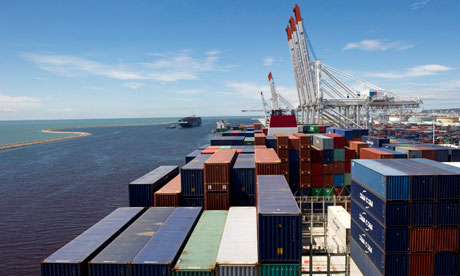
Containerized shipping emerged as a cost effective way to facilitate the massive growth in transportation of goods that accompanied this economic shift. Wal-Mart, Costco and other stores used high technology to manage inventory and drive down the cost of transportation and storage in order to sell at the lowest possible price. The emergence of big box retail is the flip side of outsourced manufacturing. Driven by the the need for expanded transportation capacity and the retailer's emphasis on just-in-time delivery the shipping industry responded by building larger and faster ships, container rail, etc.

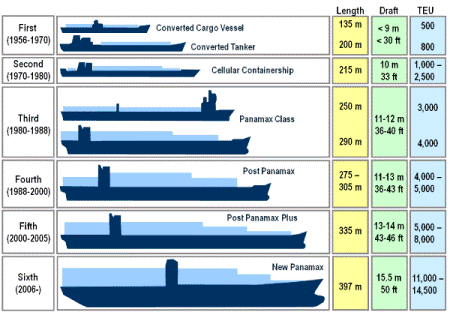
Container ships, as shown, have increased in size and capacity. (Capacity is meausred in Twenty-foot Equivalent Units (TEU), that is the number of twenty-foot containers the ship can carry.) PanaMax class ships (ships limited in size by their ability to pass through the Panama Canal), which dominated shipping during the 80's, have been surpassed by the larger Post-PanaMax classes. When the current expansion of the Panama Canal is complete, sixth generation ships from the New PanaMax class will be able to navigate the canal.

But ships have not only increased in size (blue line), but also in speed (green line) and carrying capacity (bottom axis). However, while it is possible to get larger ships to meet the speed of earlier ships by increasing the size of the motor (red line), current designs have reached the limits of speed. It is from these maximum designed limits that current shipping speeds have been reduced.

But the question of whether or not the slow speeds are here to stay hinges on the future of globalization and the nature of the transportation/distribution system that has evolved with it. Stated in resilience theory terms, will the world economy rebound and return to its previous system state? If that is the case, then we would expect slow speeds to be a temporary phenomena. Or, is the current economic slump the leading edge of a global economic transition that de-emphasizes globalization and re-emphasizes localization? If that is the case, then the slow speeds may be here to stay.

I don't claim to know enough to answer the question, but some additional understanding of the economic context is important. Following the banking collapse of 2008 the global economy went into recession and factories slowed production. Without the need for so much capacity, the shipping industry removed a significant number of ships from use and instituted the slow shipping provisions. As the economy has recovered (at least somewhat) the increased demand for shipping has not been met by adding additional ships (i.e., expanded capacity) and, as shown in the chart, the cost of shipping has increased significantly.

From what I've been able to tell, the retail end of things has been able to factor in both the additional cost of transportation and information that a particular product is no longer in production/available. What they seem to be up in arms about is the distribution issue -- the product is in production but delayed. Google 'shipping delays' and you will see what I mean. Globalized retailers have built just-in-time delivery into their retail scheme. And not having a product on the shelf is a no no. Telling a customer it will be in by day X and not have it show is even worse. Simply put, whether or not slow shipping stays will be dependent on changes in the retail industry. If the big box model collapses and/or other industries (like consumer electronics) that dependent on just-in-time delivery can adapt to slower delivery times, then slow shipping will remain. If, however, the global economic system turns out to be resilient and things return to the way they were, I suspect the pressure for speeded up delivery will be too great for the shipping industry to ignore.

Sunday, August 1, 2010

Oysters without even a half-shell

Interesting article in the Seattle Times examining the fact that billions of Pacific oyster larvae have died and oysters in the wild on Washington's coast haven't reproduced in six seasons. Scientists suspect ocean-chemistry changes linked to fossil-fuel emissions, the oceans are becoming more acidic (which the article calls 'corrosive'), are killing the juvenile shellfish. The article goes on to list a variety of changes being observed and suggests an 'upheaval,' perhaps akin to a regime shift, may be underway.

Signs environmental upheaval may be under way:

Sea snails: Tiny sea snails called pteropods, which make up 60 percent of the diet for Alaska's juvenile pink salmon, essentially dissolve in corrosive waters. Some microscopic plankton also are important fish food, and some are highly susceptible to corrosive water.

Clownfish: Scientists in Australia found that larval clownfish and damselfish exposed to corrosive waters tended to follow the scent of predators and were five to nine times more likely to die.

Killer whales: The ocean will absorb less background noise — in effect, become noisier — when pH levels drop by even small amounts. Research hasn't been done to detail what impact, if any, that might have on marine mammals such as orcas that rely on biosonar.

Giant squid: Scientists say the giant squid, also known as the Humboldt squid, typically found at depths of 660 to 2,300 feet, grow lethargic when subjected to acidified waters.

Sea urchins: Purple sea-urchin larvae exposed to acidifying waters were smaller, "stumpier" in shape and had less skeletal mass.

Oysters: Wild Pacific oysters have not reproduced in Willapa Bay for six years. Scientists suspect acidifying water, rising from the deep in coastal "upwelling" events, is helping wipe out juvenile oysters before they can grow.

Seagrass: All five species of seagrass that have been studied were found to thrive in increasingly corrosive waters.

Wednesday, June 23, 2010

Transition vs. Resilience vs. Public Opinion

I recently came across an interesting report by Alex Haxeltine and Gill Seyfang of the Tyndall Centre for Climate Change Research in the UK Transitions for the People: Theory and Practice of ‘Transition’ and ‘Resilience’ in the UK’s Transition Movement.

Here is the abstract:
This paper presents an exploratory case study of a new community-led sustainability initiative in the UK called the Transition movement. In recent months Transition movement groups have appeared in a significant number of UK towns with the stated aim of responding to the question: “how can our community respond to the challenges, and opportunities, of Peak Oil and Climate Change?” [Transition Network 2008]. The originators of the initiative have developed a “comprehensive and creative process” aimed at awareness raising, network building, and, eventually, a community-defined and community-led plan for a transition over a 15-20 year timescale. The parallels to the transition management approach being pioneered in the Netherlands and elsewhere are immediate and fascinating, but are they merely superficial? What are the actual differences and similarities between this emerging civil society movement and academic discourse and research on sustainability transitions? The resilience and transition frameworks are briefly presented as two ways of using a systems framing to understand, and inform, the governance of social and technical change in the context of sustainability. Using a combination of survey results, participant observation and documentary sources, we then explore how the terms transition and resilience are being used in the discourse of the Transition movement. The paper then explores the similarities and differences between how the terms are used in the academic literature versus the Transition movement. Finally, the analysis is employed to generate insights about the practical use of the notions of transition and resilience in civil society contexts that involve “lay practitioners”, and how these insights in turn might inform research on transitions and resilience.

Garry Peterson, over at the Resilience Science blog, has pulled out some interesting passages focusing on the differences in the two approaches:
The specific language used is of “rebuilding resilience” – drawing on historical descriptions of towns in the UK around 100 years ago, the handbook argues that resilience has been decreased in recent decades. The narrative describes how localised patterns of production and consumption (and the associated skill sets and community cohesion) were eroded in a relentless shift to ever larger scale industrialized systems of production and consumption, made possible by the use of fossil fuel energy sources. Hopkins argues that there is now a great urgency to the need to rebuild resilience because of imminent disturbances (or shocks) in the form of peak-oil, climate change, and the associated impacts on economic systems and trading patterns (Hopkins, 2008). He links this urgency directly to our current oil dependency: “it is about looking at the Achilles heel of globalization, one from which there is no protection other than resilience: its degree of oil dependency” (Hopkins, 2008).

The framing of the Transition model provided in the handbook does explicitly draw upon the academic literature on resilience in socio-ecological systems (citing a 2006 introductory text by Brian Walker and David Salt for example), but what ideas are being taken from this literature, and to what extent is the resulting framework consistent with the interpretation of resilience quoted in section 2 of this paper? The Transition Handbook (Hopkins, 2008) cites studies of what makes ecosystems resilient, identifying: diversity, modularity and tightness of feedbacks:


These initial resilience indicators rely heavily on equating resilience with the re-localisation of systems of production and consumption. So the Transition Handbook could be said to provide a starting point for talking about resilience in a Transition Town, but it is still a long way from being clear about what is needed in practice. Furthermore the evidence from observation of the local Transition groups (during 2008-2009) is that they are in an equivalent situation of trying to frame multiple actions in terms of the building of resilience but relying heavily on equating resilience with a re-localisation of production-consumption patterns.


Resilience theory highlights the fact that building resilience to a specified disturbance (such as Peak Oil) does not necessarily provide the same resilience to all possible disturbances. Some properties of a Transitioning community, such as strong community networks and diverse skill sets, may help provide resilience to most disturbances, while other properties may be very specific to one disturbance. If one were to take the position that the greatest shocks in the coming years may, in the end, turn out not to be the ones that we expected, then successfully building a specific resilience to an expected threat (such as Peak Oil) may not provide resilience against realized disturbances. So what may be required is to build resilience to specific threats in a way that also builds system properties that help in coping with diverse possible threats – implying, for example, a need for a capacity to innovate.


The current framing of resilience equates resilience with localisation in a rather unquestioning way, as demonstrated by the resilience indicators given in the Transition Handbook. We would argue that increasing any one of these indicators could actually either increase or decrease resilience to a specific disturbance, depending the exact nature of the disturbance and on the exact systemic changes used to enhance the indicator. We also argue that the desirable goal is not to simply increase such indicators as much as possible, but to find the right balance between resilience and other goals, such as quality of life and well being.


In the interest of never letting a good crisis go to waste, it is useful to look at public opinion following the current Gulf oil spill. Big events have been known to have significant and sometimes lasting impacts on public opinion and policy. Double hulled tankers became the rule following the Exxon Valdez accident and, more significantly, North America stopped building nuclear plants following the 1979 accident at Three Mile Island. A recent NY Times/CBS Poll on the Gulf Oil Spill has a number of interesting findings. It is worth plowing through the frequencies yourself, but the one I found most interesting was the disconnect between a) the appetite for dramatic change (58% think US energy policy needs to be fundamentally changed, 31% think it is so out of whack it needs to be completely rebuilt and a tiny 6% think it needs only minor changes)coupled with b) an expectation that fundamental change was unlikely (only 24% thought it very likely that the US would develop an alternative to oil as the major source of energy in the next 25 years) and c) their general unwillingness to pay any costs associated with facilitating the transition (51% opposing a gas tax compared to 45% willing to accept one).

Simply put, its unlikely that the Gulf Spill will have the same sort of transformational impact that, for example, TMI had. The reason? Even with all the attention it has received, only 13% if the public see it as the most important problem. In contrast, 20% identify jobs as the most important problem and another 20% list the economy. All crises are not alike. Had the oil spill occurred at a time when the economy was booming, it is likely that significant policy changes would result. But, in a global economy battered by the collapse of the banking system and worried about the financial viability of a number of European countries, bread and butter issues will trump environmental and energy policy concerns among the bulk of the population.

Tuesday, May 18, 2010

It was 30 years ago today .....

On Sunday, May 18, 1980 I was at my parents house in Yakima, Washington.

A little before 9:00 I looked out the window and saw what appeared to be the meanest storm cloud I'd ever seen.

We soon discovered that Mount St. Helens had erupted. Within a matter of hours day turned into night as the ash cloud blotted out the sun and their yard was covered with 5 inches of volcanic dust. Thus began an event that has shaped my view of the world in a number of profound ways.

I grew up hiking in the Cascades. My dad belonged to the local hiking/climbing group, The Cascadians, and on several occasions I had accompanied them to the top of St. Helens and other mountains in the area. These experiences, to borrow a phrase from Aldo Leopold, helped me 'think like a mountain.' The mountains were not just beautiful, they were monumental representations of the majesty and permanence of nature.

There is nothing like a good eruption to underscore the power of nature. In a few minutes, the height of the mountain shrank by roughly a kilometer. The summit on which I had so proudly stood vanished into the air.


(For a longer version that YouTube won't allow to be embedded, see http://www.youtube.com/watch?v=rbgAOfv-W20)

Gone with it was a key aspect of my worldview, the sense of permanence and stability that the mountains had conveyed. After the eruption, when I stood on the slopes of Mt. Rainier, I would visualize the mountain morphing away under my feet, just like in the video (above) made from Gary Rosenquist's remarkable still photos of the eruption. My view of nature was forever transformed. The fascination with permanence and stability was now tempered with a recognition that sudden and dramatic change could occur.

The other lesson I learned concerned resilience. In the weeks that followed, I became convinced that it would take years for Yakima to return to its former condition. Every time I left the house I had to put on a mask. As you drove, the car whipped up clouds of extremely fine dust, and you lived with the fear that the car's engine would seize up (as happened to many). The fruit and vegetable crops for which the region is famous (Yakima is known as the "Fruit Bowl of the Nation") were destroyed. The personal disruption of my life was accompanied by dramatic evidence of the extent to which the eruption had devastated much of the surrounding forest. What had been verdant forest was now barren, seemingly uninhabitable, wasteland.

(Photo taken by Frank Gohlke about 10 miles northwest of Mt. St. Helens)

Much to my surprise, things returned to normal relatively quickly. While the ash lingered, traffic quickly moved if off the road and with it the fear that your car's engine would seize up. Within a year or two the crops were back, better than ever. It turns out that volcanic ash, rich in nutrients and very porous, is a great way to amend your soil.

Now, with the 30 year anniversary, the press is starting to focus on the resurrection of the area immediately surrounding the mountain. According to the Seattle Times,
The eruption of Mount St. Helens 30 years ago destroyed so much that often overlooked is what it created. Scientists are witnessing the assembly, species by species, of an entirely new ecosystem.

Details of the transformation are provided in the article Species by species, a habitat takes shape and the accompanying still photos and video. A nice retrospective is available here, including a fascinating satellite animation of the spread of the ash here (Yakima, about 50 miles east of Mt. St. Helens, was covered by 10:15, animation slide number 4).

While the return is far from complete and thirty years seems like a long time to us, it is but the blink of an eye when you think like a mountain.

Monday, March 29, 2010

From Consumerism to Sustainability or The Story of Stuff

The Worldwatch Institute has issued their 2010 State of the World Report, Transforming Cultures: From Consumerism to Sustainability, a bold attempt to identify and address the range of issues surrounding large scale cultural transformation. A Table of Contents for the book, with links to selected chapters, is available online.

A podcast of Erik Assadourian, Senior Researcher at Worldwatch Institute and Director State of the World 2010, speaking with Diane Horn about report is available here.

Highlignts among the online chapters are The Rise and Fall of Consumer Cultures, a discussion of Engaging Religion to Shape Worldviews, a look at education's role in supporting sustainability by Rethinking School Food, and a look at how social marketing can be used to shift the media From Selling Soap to Selling Sustainability.

An interesting example of the latter is found in The Story of Stuff.

Thursday, March 4, 2010

Climate Wars, Part Deux

The past few years have seen the publication of a variety of popular titles discussing the global geopolitical implications of climate change. The first, and still the best, of these was Gwen Dyer's Climate Wars. In it Dyer, a noted military historian, takes a medium term view (e.g. to 2050 or so) in order to examine the connection among dwindling resources, population shifts, natural disasters, epidemics, drought, rising sea levels, plummeting agricultural yields, crashing economies, political extremism and climate change in order to build plausible scenarios about how any of them could tip the world towards conflict. CBC Ideas produced a three part series from the book. The podcast is available here.

More recently, Cleo Paskal has written Global Warring: How Environmental, Economic, and Political Crises Will Redraw the World Map

Guy Stanley describes the book as follows:
The Cold War was never this hot! We live in interesting times. The biggest western economic institutions are crumbling, what were once marginalized voices are now dominating international negotiations, and touchstone climate events, such as the monsoon, are failing. Everywhere you look economic, geopolitical and environmental assumptions are being shaken to the core. The world is changing. Fast. Global Warring examines these trends by combining insightful economic and political analysis with the most likely environmental change scenarios. It identifies problem areas that could start conflicts (access to water and resources in Asia), economic trends that are shifting the balance of power (China’s policy of nationalistic capitalism), and geopolitical realignments (the burgeoning strategic partnership between the United States and India). Award-winning writer and geopolitical expert Cleo Paskal makes sense of this overwhelming topic by dividing it into five sections: how seemingly impervious western nations, such as the United States, are shockingly vulnerable to hurricanes, storm surges and rising sea levels, and what that could mean for their internal stability and economic development; how the thawing Arctic is opening up a whole new arena for power politics as some of the world’s biggest countries wrangle for control over vast resources, strategic shipping routes such as the Northwest Passage and geopolitical leverage; how changing precipitation patterns, extreme weather and water shortages are creating severe disruptions in India and China, and how that could affect their relations with each other, and the world; how rising sea levels may shift borders and alter the very notion of statehood, potentially challenging international law to the breaking point; and, finally, what could happen in coming decades, and how to avoid the worst of it. Paskal combines ten years of research; the latest findings from the Hadley Centre and the United Nations; and interviews with top political, security and economic strategists with her own extensive travel as a foreign correspondent. The result is a penetrating, accessible, compelling, and chilling reminder that Global Warring is not only coming, it’s here. "In a clear, comprehensive and alarming analysis, Cleo Paskal underlines the geopolitically disruptive potential of climate change. Arguably this is the biggest challenge to human society since the Ice Age or the Black Death and it is not clear we are any readier to respond adequately to ours than were our unfortunate ancestors to theirs.


Another review is available here.

Friday, February 26, 2010

Oil Supply in Atlantic Provinces and Eastern Canada

Review of "Eastern Canadian crude oil supply and its implications for regional energy security"

by Rick Munroe

Authored by Dr. Larry Hughes, an energy security analyst at Dalhousie University in Halifax, Nova Scotia.

Dr. Hughes' study entitled “Eastern Canadian crude oil supply and its implications for regional energy security” was recently published in Energy Policy (Jan. 2010, 8 pgs).

The text of Hughes’ new study is clear and concise and is supplemented by eight tables and six figures which illustrate the various points. Most notable is Figure 5:

This graph clearly illustrates the stunning decrease in imports from the North Sea (UK and Norway), which provided almost two-thirds of eastern Canadian supply in 2000. North Sea decline has forced eastern Canada to increasingly rely on Algeria, Angola and Iraq to fill the gap, all countries with political stability risks.

The rest of the article and links to reports are at the Energy Bulletin.


Monday, January 18, 2010

Oil Constraints Return by 2011-Goldman Sachs

The video is Jeff Rubin's most recent talk on "peak oil": "We're not running out of oil—we're running out of the oil that you can afford to burn."


I've always been skeptical of Jeff Rubin's short term predictions on oil prices. If only he wasn't so right all the time. He predicts triple-digit oil prices by 2012. In fact, Goldman Sachs just announced their prediction for oil prices for the next 24 months: oil will go to $90 a barrel this year, 2010, and to $110 a barrel in 2011.

But note this: I'm not concerned about "peak oil" anymore. Yes, that's right, I'm ok with it. Why? Because I've had a chance to think this through for the last year at UNB and I've come to certain (qualified) conclusions: peak oil is not the problem, peak oil is the solution.

Look at what happened when oil reached $149 in 2008. What happened? People drove less, VMT went down dramatically and people started using public transit in record numbers. People cut back on shopping and started repairing and reusing the stuff they already owned. They started conserving all kinds of things: electricity, oil, water. They ate at home more and wasted less food. They even started growing their own food.

So if peak oil is the solution, what's the problem? I'm more certain all the time that the real problem is capitalist industrial civilization (whether state directed, like China, or corporate-directed, like U.S.) The high price of oil does a swift and decisive job of shrinking an overblown economy and the overdevelopment of land. It swiftly and decisively reduces excessive production and consumption of worthless consumer goods, which slows down the depletion of natural resources, and thus reduces the impact on our climate. We can find ways to adapt to peak oil, whether they are social adaptions or technological ones. The one thing we really can't reverse, at this point, is climate change, and that's the real long-term problem.

Monday, December 7, 2009

Human Side of Disaster

The current issue of the Disaster and Social Crisis Research Network Electronic Newsletter has just been released. It is edited by Eduardo Runte, a former graduate student in Sociology at UNB whose MA thesis dealt with the experiences of electrical linemen during the ice storm of 1998. Eduardo is now in the PhD program at the Ecole des Mines in Paris. The contents of his thesis are summarized here and a description of his PhD work, dealing with the social processes involved in the creation of safety, can be found here.

The newsletter has a blurb for a new book by Thomas Drabek, The Human Side of Disaster, which it describes as follows:

When disaster strikes, people react, and usually, fear levels rise. Temporarily, however, one motivation supersedes all others: survival of self and those nearby, especially loved ones. Based on the author’s years of research and teaching experience, The Human Side of Disaster scientifically evaluates human responses in the face of disasters. This examination informs emergency managers and response teams and teaches them how to anticipate human behaviors in-crisis.

The book begins with four scenarios based on interviews and real events that introduce the human side of disaster. The stories examine how attention to, or lack of, preparedness, response, recovery, and mitigation affect outcomes. Each subsequent chapter refers back to the original Experiences chapter and provides insights that can be applied not only to events such as hurricanes, tornadoes, earthquakes, and floods, but also to man-made threats including industrial accidents and acts of terrorism. The author explores how people’s responses can be predicted, the long term effects of disaster on the psyche, and the key issues involved in recovery.

A balanced interpretation of research, results, and experience, the book demonstrates how traditional warning methods and high-tech systems can work together to improve communications, evacuations, and reconstruction efforts. It highlights the role of the human element in any disaster situation and demonstrates how to use that element as part of a planned disaster response.

Friday, November 20, 2009

Social and Natural Systems in the Decline of North America's Megafauna

One of the most striking characteristics of humans is that we are adaptive generalists. Unlike most species, which are adapted to specific ecological niches, humans have radiated out to populate virtually every land-based ecosystem on the planet. We can do this because we build shelters, transport food and otherwise make arrangements for the necessities of life in those parts of the globe that would otherwise be inhospitable.

It is this capacity, the ability to transform situations to meet our needs, that lies at the root of the interconnection between social and natural systems. The most obvious example of this interconnection is climate change, where humans are pumping the carbon stored in the ground as fossil fuels into the atmosphere and, hence, fundamentally altering both atmospheric chemistry and the global climate.

But what lies at the root of this human capacity? The standard answer is technology. Through technology we transcend the limitations and constraints placed on other species. But a recent article by Christopher Johnson in Science (Science 20 November 2009: Vol. 326. no. 5956, pp. 1072 - 1073) detailing the process of magafaunal decline in North America casts doubt on this account. Here is the story in brief:

Twenty thousand years ago, North America had a more impressive array of big mammals than Africa does today; by 10,000 years ago, 34 genera of these mammals were gone, including the 10 species that weighed more than a ton. Many other drastic changes occurred in this interval, all of which have been advocated as possible causes of megafaunal extinction. The climate flipped from cold to warm, then back to cold in a 1000-year chill (the Younger Dryas), before rapidly rewarming. There were more, larger fires, and the structure and species composition of vegetation changed drastically. People arrived, and the Clovis culture—with a characteristic style of beautifully crafted stone spear points—flourished for less than 1000 years. Some scientists have argued that an extraterrestrial object struck Earth ~13,000 years ago, triggering the Younger Dryas, starting fires, killing the megafauna, and putting an end to the Clovis culture. ....

What about people? It has long been argued that Clovis artifacts signal the first arrival of people in North America south of the boreal ice sheets and that the Clovis people were specialized big-mammal hunters who caused a crash of megafaunal populations from prehuman abundance to extinction within a few hundred years. This “blitzkrieg” scenario is supported by the fact that terminal dates on megafaunal fossils range from 13,300 to 12,900 years ago, which coincides almost exactly with the Clovis period. But the new data show that the megafaunal decline had begun more than a thousand years earlier. If people were responsible for that decline, they must have been pre-Clovis settlers. The existence of such people has been controversial, but archaeological evidence is slowly coming to light and is consistent with their arrival around the beginning of the megafaunal decline. It is beginning to look as if the greater part of that decline was driven by hunters who were neither numerous nor highly specialized for big-game hunting. Clovis technology may have been a feature of the endgame, possibly reflecting an intensified hunting strategy that developed once megafauna had become rare, possibly wary, and harder to hunt. ...

Before 14,800 years ago, the environment around the site studied by Gill et al. was an open savanna or parkland, probably with scattered spruce and rare broad-leaved trees growing over a short grass-dominated pasture, and almost no fi re. As the megafauna declined, woody biomass increased, mainly by growth of broad-leaved trees that had presumably been suppressed by the large herbivores. The result was a transitory spruce/broadleaf woodland, the like of which does not exist today. Big fires broke out ~14,000 years ago, and for the next few thousand years, major fires returned every few centuries. These changes were widespread: Fire increased throughout North America ~14,000 years ago, and the transitory “no-analog” woodland extended over a vast area.

In short, we begin with an ecosystem dominated by open savanna and numerous species of megafauna. Humans arrive, and apparently without the aid of significant technology, kill off the majority of the megafauna thus setting loose a cascade of ecological changes that ultimately result in the replacement of the savanna by a "no-analog" woodland. Thus we have a clear, early example of the interconnection of social and natural systems, but one that seems not to implicate technology as the fundamental driver.

Tuesday, November 10, 2009

Whistleblower Says IEA Inflated Oil Estimates

An unnamed whistleblower at the International Energy Agency claims that the IEA's previous and current "World Energy Outlook" ('08 and '09) inflated the estimated amount of oil reserves in the world. The Guardian UK has the story, which includes a 3-minute audio segment by journalist Terry Macalister, a nice quick summary of the situation. The whistleblower inside the IEA says that the United States pressured the agency to make oil reserves look better than they really are to avoid panic in the markets and worsening of the financial crisis.

The current WEO states that world oil supplies can reach 105 mbd by 2030.

The whistleblower told The Guardian, "Many inside the organization believe that maintaining oil supplies at even 90 million to 95 million barrels a day would be impossible, but there are fears that panic could spread on the financial markets if the figures were brought down further.”

Currently, the world output is 83 mbd.

"A second senior IEA source, who has now left but was also unwilling to give his name, said a key rule at the organisation was that it was "imperative not to anger the Americans" but the fact was that there was not as much oil in the world as had been admitted. "We have [already] entered the 'peak oil' zone. I think that the situation is really bad," he added." (Guardian UK)

An October report by the UK Energy Research Council says that world oil production will go into permanent decline before 2020, in less than ten years. UKERC is a consortium of academic partners from 15 different UK institutions. Its headquarters are based at Imperial College Londonand at the Environmental Change Institute at the University of Oxford.

The World Energy Outlook '09 was just released today.