Showing posts with label key concept. Show all posts

Tuesday, March 6, 2012

Limits to Growth Revisited

It was forty years ago today,
Donella Meadows taught the band to play
They've been going in and out of style
But they're guaranteed to raise a smile.
So may I introduce to you
The act you've known for all these years,
Donella Meadows' Limits to Growth.


.... Well, truthfully, it was forty years ago on March 1, but close enough.

This book, which sold over ten million copies in various languages, was one of the earliest scholarly works to recognize that the world was fast approaching its sustainable limits. Forty years later, the planet continues to face many of the same economic, social, and environmental challenges as when the book was first published. Suitably, the event has spawned a number of retrospectives. The most fulsome occurred at the Smithsonian where the Club of Rome sponsored Perspectives on Limits to Growth: Challenges to Building a Sustainable Planet. Among the presentations were the following:
  • Dennis Meadows It is too late for sustainable development
  • Jørgen Randers Lessons of forty years of promoting limits to growth
  • Lester Brown World on the Edge
  • Doug Erwin Biodiversity: past, present and future
  • Richard Alley Climate change and energy; challenges and opportunities
  • Neva Goodwin Labor’s declining share and future quality of life
  • Panel discussion moderated by Eva Pell, Under Secretary for Science, Smithsonian Institution 
The full nine hour program -- including 10 minutes watching the audience mill about before the first presentation -- is archived at the above link.

For those who would like their celebration served up in a more time efficient manner, journey on over to Resilience Science where Garry Peterson has two interesting posts: Forty Years of Limits to Growth and Paul Gilding talks about Limits to Growth which includes Gilding's recent Ted Talk.


Thursday, August 4, 2011

Padgett, Part III: Autocatalysis in the Economy and in Persons

This is the third in a series dealing with one of the most interesting ideas I've come across in a decade: the theory outlined in John Padgett's The Emergence of Markets and Organizations. For an overview of the book and description of the network perspective, see Part I. Part II provides a concrete illustration of the approach, the emergence of the partnership structure in Renaissance Italy. This  post summarizes the chemical process (autocatalysis) that Padgett uses as a conceptual model for understanding the production of goods and people. This post begins with a description of autocatalytic networks in chemistry and then applies the concept to economic production and, finally, to the production of persons.


Saturday, July 23, 2011

On badgers, coyotes, humans and the evolution of cooperation

A number of years ago scientists documented a strange cooperative hunting relationship among badgers and coyotes. While they are natural enemies -- coyotes sometimes eat badgers, it turns out they both eat squirrels, marmots and prairie dogs. Thus, rather than face each other down they, on occasion, cooperatively hunt together in order to take advantage of the particular skill set each animal possesses.

Badgers and Coyotes catch ground squirrels differently. Badgers usually dig them up, coyotes pounce on them or chase them. Ground squirrels often escape a digging badger by leaving their underground burrows and running away across the surface of the ground. These same ground squirrels escape coyotes by running into burrows and disappearing underground. A ground squirrel will theoretically have less chance to escape a badger and a coyote hunting together. If it runs away from the coyote by going underground into a burrow, the badger will dig it up. If it leaves a burrow to escape the badger, the coyote will run after it and catch it.

These cooperative relations are not short term -- out of 214 observed associations in one study, over half of them lasted more than an hour and 2 lasted for over five hours. A brief video on the phenomena is here.

This is just one of a wide range of phenomena discussed in The Unselfish Gene, an interesting article by Yochai Benkler author of the soon to be released The Penguin and the Leviathan: How Cooperation Triumphs over Self-Interest.

Thursday, July 21, 2011

Padgett, Emergence of Organizations and Markets, Part I

I'm an idea junkie. I have fairly diverse interests and scan lots of things. But, for the most part, the things I come across strike me as either generally similar to this or that idea I've come across before or interesting and novel but focused on a matter that isn't terribly consequential.

It is very rare that I come across something that strikes me as fundamental -- in the sense that it addresses a deep problem in a novel way that makes intuitive sense to me. I count three instances in the past decade:
1) Holling's conceptualization of the operation of systems in terms of panarchy.
2) Abbott's description of the process of knowledge change.
3) The ideas discussed in the rest of this post.

How do new organizational forms originate? As a visit to the Oil Drum, or virtually any other major environmental website shows, you see lots of calls for dramatic social transformation. And you can also find good studies documenting historical change in organizational form, for example Chandler's analysis of capitalist managerial organization. But these works, in a Darwinian sense, focus on the selection process -- why a novel form gets perpetuated -- rather than the innovation process -- how the novel form originated. While there is some discussion of where novel ideas come from, the focus tends to be on technological innovation. In many ways it makes sense to speak of bureaucracy as a technology, but it is profoundly problematic to think that the process of social innovation is just a mirror of the process of technological innovation. So, to summarize, a general recognition of the need for social innovation -- that is the development of new forms of social organization -- coupled with virtually no understanding of how novel forms of social organization are generated.

Into this gaping hole walks John Padgett and his collaborators with their forthcoming Princeton University Press title The Emergence of Organizations and Markets. In a work of stunning scope, they lay out a general theory of organizational innovation and then proceed to provide a diverse set of illustrative examples covering the sweep of modern history -- from early capitalism (the emergence of merchant banks, the partnership system, global markets and the joint stock system), thru studies of communist economic transition (China, USSR, Hungary), to the emergence of new linkages between science and capitalism (e.g., the emergence of Silicon Valley and other high tech research network clusters). While the book focuses on economic organization, there is no obvious reason the theory wouldn't apply to other types of organization.

In essence, Padgett translates the biochemical theory of autocatalysis, which Stuart Kauffman has argued provides a model for abiogenesis (the emergence of biological life out of inorganic matter), into a form useful for understanding the emergence of organizations. There are three key parts. First, there is the emergence of novelty. In the abiogenesis example, this would be the emergence of life out of inorganic chemicals. Second, there is the requirement of persistence through time. If life emerged, but failed to persist over many generations, then its development would be transient and not terribly important. Third, the new development must be consequential. The emergence of a single-celled living organism that persisted for millions of years but remained the only form of living organism, as significant as that example of life may be, is not as consequential as the development of a wide variety of diverse living organisms (cats, dogs, whales, people, birds, insects, etc.). I'm not talking about the value of the different organisms themselves, but rather the importance of a process which spills over into other areas and generates greater and greater variety.

In the process, Padgett comes up with a new way of thinking about individual humans: not as static, bounded objects but, rather, as dynamic flows of chemicals, energy and information embedded in networks. The implications for scholars interested in understanding conjoined socio-ecological systems, which have been plagued by the attempt to integrate ecology's focus on flows (energy flows and biogeochemical cycles) with approaches to human systems that emphasize the primacy of individuals and their actions, are hard to overestimate.

Here is how they organize the theoretical discussion:
First, we describe the problem of organizational novelty in the context of multiple social networks. Next, we explain our core dynamic motor of autocatalysis, at the levels of both chemical and economic production. Then, we extend the biochemical concept of autocatalysis to encompass the social production of persons. Fourth, we describe six network mechanisms of organizational genesis that we have discovered in our case studies. Fifth, we identify seven mechanisms of multiple-network catalysis that turned these organizational innovations into systemic inventions. Finally, we discuss the important outstanding issue of structural vulnerability to network tipping. This question of poisedness, for us, is the next research horizon.
There is way too much here for one post. So, there will be several spread out over time. If you can't wait, the key theoretical chapter is here. Padgett's homepage has links to other material, both published and unpublished, including several other chapters from the forthcoming book.  For an extended overview, including description of the multi-network perspective,  read on ....

Wednesday, July 20, 2011

Global Heating or What's in a Name?

As the global warming / climate change debate has become stuck in an intractable rut, people have started looking for different words that more accurately convey what is going on. Tom Friedman, for example, has proposed 'global wierding'  in order to focus attention on the proliferation of unusual and extreme climate events. Over at Tumblr, Andrew Revkin has suggested the term global heating and provided a wonderful graphic to back up the choice.


The diagram/term have two big benefits. First, it dramatically emphasizes the importance of the ocean as repositories of heat energy relative to the land and atmosphere. Second, it focuses attention on changes to the system  -- accumulation of heat energy -- rather than attempting to describe the consequences of that change.

Friday, July 15, 2011

Defining Uncertainty, Difficulty, and Complexity

A useful taxonomy from Scott E. Page's Uncertainty, Difficulty, and Complexity (Journal of Theoretical Politics 20(2): 115–149 DOI: 10.1177/0951629807085815)
My point is that uncertainty differs from difficulty and complexity and that they too matter. ... (U)ncertainty refers to the absence of information about some relevant variable or what some call the state of the world – tomorrow’s weather, to give one example, is uncertain. Difficulty refers to problems that have many interacting variables. Developing a workable form of fusion is difficult as is designing an office building or writing a piece of legislation. Difficult problems have many possible solutions and no obvious best one a priori. When faced with a difficult problem, most problem solvers prove incapable of finding the optimum. They must rely on perspectives and heuristics (Page, 2007). Complexity in turn differs from difficulty. Complexity refers to dynamic environments that contain multiple actors who interact with one another. The response to a natural disaster like a hurricane creates a complex web of interactions whose outcomes are unpredictable. Complex environments cannot be solved in any sense. At best, the complexity can be harnessed (Axelrod and Cohen, 2000).

The relevance of the definitions is outlined in the abstract below:
In this article I clarify the often muddled distinctions between uncertainty, difficulty, and complexity and show that all three can enhance our understanding of institutional performance and design. To cope with uncertainty, institutions align incentives for information revelation; to handle difficult problems, institutions create incentives for diverse problem-solving approaches; and to harness complexity, institutions adjust selection criteria, rates of variation, and the level of connectedness. The distinction between complex systems and equilibrium systems also necessitates a discussion of the differences between the existence, stability, and attainment of equilibria and why, despite often being neglected, the latter two concepts are important to our understanding of institutions.

Sunday, June 12, 2011

Escaping the limitations of human perspective

In 1940 Aldo Leopold penned his famous essay "Thinking like a mountain" which drew attention to the limitations of human understanding of nature. Leopold's point, that human based perspective is not the only (nor necessarily the best) way of perceiving the world is nicely illustrated by the following video -- which records a girl hula hooping taken from the perspective of the hula hoop. Note the markings on the hoop and the way it, from the perspective of the camera embedded in the hoop, remains stable while the girl and the sky rotate around it.


Solving our environmental problems requires us to escape from the limitations of our human perceptions -- which are increasingly insulated from nature (see, Bill McKibbon's The Age of Missing Information), from phenomena that play out on time scales that differ from ours (Leopold's point) and from phenomena that exist at very large or very small scales (see the chapter titled The Big I in Homer-Dixon's Ingenuity Gap.) The role of scale and the dominance of the human perspective are humorously illustrated through a contrast with the following xkcd comic and the Eames film (The Powers of 10) it parodies.


Sunday, March 20, 2011

James Gleick's The Information

James Gleick, best known as the author who spelled out the details of chaos theory in Chaos, has a new book exploring the implications of another area of mathematics -- information theory: The Information: A History, a Theory, a Flood.

A substantial excerpt from Chapter 11, Into the Meme Pool (You Parasitize My Brain), covering the nature and spread of ideas and the parallels between genes and memes as carriers of information is available online.

Freeman Dyson has a written a nice review as has Geoffrey Nunberg.

Friday, September 17, 2010

Complexity and the Empire of Illusion

Chris Hedges discusses his recent book Empire of Illusion: The End of Literacy and the Triumph of Spectacle. In it he offers an updated take on the argument advanced by Neil Postman (Amusing Ourselves to Death) and Bill McKibbon (The Age of Missing Information), i.e., that modern media are fostering a set of cultural practices which are maladapted to dealing with the increasing complexity of our social and environmental problems.

This is a position that I think has some merit, but also significantly oversimplifies. The ability to deal with complex problems requires a combination of both a) deep thought, analysis and understanding of a phenomena and b) a breadth of perception and awareness in order to appreciate the wide variety and diverse nature of relevant facts and processes. Crudely put, modern media don't facilitate the first in the same way as print. But, the ability to link, connect and juxtapose ideas that aren't put together for you by the author is dramatically facilitated by new media. As such, the problem isn't the existence of new media but, rather, finding the appropriate cultural mix of the different forms. In this respect, I'm waiting expectantly for Stephen Johnson's new book, Where Good Ideas Come From.

Sunday, August 8, 2010

In Defense of Difference

In Defense of Difference by Maywa Montenegro & Terry Glavin, which originally appeared in the October 2008 print edition of Seed magazine, was recently put on-line. This is a really interesting article in terms of the way it conceptualizes the relationship between nature and society and, in particular, in the treatment of diversity as crucial to the resilience of both natural and social systems. Here are some representative quotes:
Experts have long recognized the perils of biological and cultural extinctions. But they’ve only just begun to see them as different facets of the same phenomenon, and to tease out the myriad ways in which social and natural systems interact. Catalyzed in part by the urgency that climate change has brought to all matters environmental, two progressive movements, incubating already for decades, have recently emerged into fuller view. Joining natural and social scientists from a wide range of disciplines and policy arenas, these initiatives are today working to connect the dots between ethnosphere and biosphere in a way that is rapidly leaving behind old unilateral approaches to conservation. Efforts to stanch extinctions of linguistic, cultural, and biological life have yielded a “biocultural” perspective that integrates the three. Efforts to understand the value of diversity in a complex systems framework have matured into a science of “resilience.” On parallel paths, though with different emphases, different lexicons, and only slightly overlapping clouds of experts, these emergent paradigms have created space for a fresh struggle with the tough questions: What kinds of diversity must we consider, and how do we measure them on local, regional, and global scales? Can diversity be buffered against the streamlining pressures of economic growth? How much diversity is enough? From a recent biocultural diversity symposium in New York City to the first ever global discussion of resilience in Stockholm, these burgeoning movements are joining biologist with anthropologist, scientist with storyteller, in building a new framework to describe how, why, and what to sustain.
....
It’s the ability of a system — whether a tide pool or township — to withstand environmental flux without collapsing into a qualitatively different state that is formally defined as “resilience.” And that is where diversity enters the equation. The more biologically and culturally variegated a system is, the more buffered, or resilient, it is against disturbance. Take the Caribbean Sea, where a wide variety of fish once kept algae on the coral reef in check. Because of overfishing in recent years, these grazers gradually gave way to sea urchins, which continued to keep algae levels down. Then in 1983 a pathogen moved in and decimated the urchin population, sending the reef into a state of algal dominance. Thus, the loss of diversity through overfishing eroded the resilience of the system, making it vulnerable to an attack it likely could have withstood in the past.
....
“There is an underlying assumption in much of the literature that the world can be saved from these problems that we face — poverty, lack of food, environmental problems — if we bring consumption levels across the world up to the same levels [of] North America and Europe.” But this sort of convergence, says Pretty, would require the resources of six to eight planets. “How can we move from convergence to divergence, and hence diversity?”

Traditional environmentalism, with its tendency to erect impermeable theoretical barriers between nature and culture, between the functions of artificial and natural selection, hasn’t been able to accommodate the perspective necessary to see larger patterns at work. Its distinction — as the writer Lewis Lapham recently put it — “between what is ‘natural’ (the good, the true, the beautiful) and what is ‘artificial’ (wicked, man-made, false)” has obscured their profound interrelatedness. Whether expressed as biocultural diversity or as diverse social-ecological systems, the language of these new paradigms reframes the very concept of “environment.” Explicit in both terms is a core understanding that as human behavior shapes nature in every instant, nature shapes human behavior. Also explicit is that myth, legend, art, literature, and science are not only themselves reflections of the environment, passed through the filter of human cognition, but that they are indeed the very means we have for determining the road ahead.

If you read the whole article you will find that biocultural diversity is, to my mind, too simplistically treated as equivalent to linguistic diversity -- a problem also found in an earlier (and similar) argument made by Thomas Homer-Dixon in We Need a Forest of Tongues. Linguistic diversity isn't important in and of itself but, rather, because it acts as a buffer that slows the homogenization process. If you don't communicate with the dominant group, then you are less likely to be consumed by it. But there are other factors, like the growth of transportation and communication technologies and the economics of globalization, that underpin the homogenization process. The trick is to discover how to be connected without being assimilated.

Monday, July 19, 2010

Review: Managed Annihilation, An Unnatural History of the Newfoundland Cod Collapse

On July 2, 1992 the Canadian government closed the northern Cod fishery to commercial fishing, putting 30,000 people out of work and signaling the end to what had been for 500 years the world's most productive fishery. By 2003, following more than a decade of rotating moratoria and other attempts to resuscitate the fishery, the spawning stock biomass was less than 1% of its historical level. Atlantic cod were placed on the Canadian endangered species list, shifting the specter of concern from commercial extinction to biological extinction.

In 2006 an article,Impacts of Biodiversity Loss on Ocean Ecosystem Services, appeared in Science suggesting that 30% of fish species had already collapsed and the remaining species of ocean fish would suffer a similar fate by 2050 (see chart at left). Studies of the Atlantic cod collapse identified a wide variety of causal factors, some of which were generic and potentially responsible for the collapse of other fish species (the logic of industrial capitalism, foreign fishing ships, greed, technology, incompetence), while other accounts adduced factors unique to the particular situation (the combination of merchant capital and location, Canada's failure to exert political control over the entire continental shelf, unusually cold water resulting from the North Atlantic Oscillation).

One group who appear in many accounts are the fishery scientists at the Department of Fisheries and Oceans, the individuals charged with calculating the Total Allowable Catch used to define the size of the annual catch and aimed at managing the fish stock for perpetuity. As someone who has studied the estimates of another unseen resource (undiscovered oil), I'm particularly fascinated by this and highly recommend Chris Finlayson's excellent analysis of DFO fish stock assessments, Fishing for Truth.

But, while lots of people have dumped on the management practices leading up to the collapse, relatively little has been published about the practices of the past 18 years. That is, until the publication of Dean Bavington's Managed Annihilation: An Unnatural History of the Newfoundland Cod Collapse.

Bavington's account is heavily informed by concepts taken from the work of Holling and other members of the Resilience Alliance, particularly the critique of command and control natural resource management and the concept of socio-ecological systems. However, Bavington is an environmental historian while the major conceptual roots of resilience thinking come from ecological science. Thus, while both groups have a similar view of traditional natural resource management, the systems they would replace it with are markedly different.

Garry Peterson, from the Resilience Science blog, has provided the following description of adaptive management from a resilience perspective. (An listing of relevant resources can be found here.)
Adaptive management seeks to aggressively use management intervention as a tool to strategically probe the functioning of an ecosystem. Interventions are designed to test key hypotheses about the functioning of the ecosystem. This approach is very different from a typical management approach of 'informed trial-and-error' which uses the best available knowledge to generate a risk-averse, 'best guess' management strategy, which is then changed as new information modifies the 'best guess'. Adaptive management identifies uncertainties, and then establishes methodologies to test hypothese concerning those uncertainties. It uses management as a tool not only to change the system, but as a tool to learn about the system. It is concerned with the need to learn and the cost of ignorance, while traditional management is focused on the need to preserve and the cost of knowledge.

There are several processes both scientific and social which are vital components of adaptive management:

1. management is linked to appropriate temporal and spatial scales
2. management retains a focus on statistical power and controls
3. use of computer models to build synthesis and an embodied ecological consensus
4. use embodied ecological consensus to evaluate strategic alternatives
5. communicate alternatives to political arena for negotiation of a selection

The achievement of these objectives requires an open management process which seeks to include past, present and future stakeholders. Adaptive management needs to at least maintain political openness, but usually it needs to create it. Consequently, adaptive management must be a social as well as scientific process. It must focus on the development of new institutions and institutional strategies just as much as it must focus upon scientific hypotheses and experimental frameworks. Adaptive management attempts to use a scientific approach, accompanied by collegial hypotheses testing to build understanding, but this process also aims to enhance institutional flexibility and encourage the formation of the new institutions that are required to use this understanding on a day-to-day basis.


In contrast, Bavington argues for a total rejection of the managerial impulse and its replacement with a new philosophy aimed at living within the limits of existing ecosystems. Bavington's argument is nicely summarized by Graham Wynn in the book's preface:
... the book argues that when this untoward (albeit unintended) outcome became clear, in 1992, neither politicians nor fisheries scientists questioned the fundamental tenets of the managerialist impulse that had brought them to this point. Instead, they simply ushered in a new phase of managerial ecology, emphasizing risk and uncertainty in place of “the confident forecasting and control-oriented approach associated with [earlier] single-species scientific management” (p. 83).

According to Bavington’s thought-provoking account, for the last two decades, fisheries managers and the governments they represent have been abandoning their former roles as researchers and regulators seeking to ensure stability in the fishery in favour of encouraging fishermen to manage themselves. To this end, they have considered two substantially different approaches.17 Turning away, in one direction, from what have come to be regarded as the industrial, capitalist, state-led, and abstractly scientific shortcomings of earlier forms of management, they have acknowledged the value of Local Ecological Knowledge (without denying the worth of formal scientific understanding), recognized the importance of the fishing economy to the (generally small and scattered) places in which fishing families live, and envisaged the possibilities of effective community stewardship. Communitarian at its base, this approach seeks to empower local people and to reduce the socioeconomic inequities that are said to have resulted from the former management regime. Much discussed, it has not been widely implemented.

More effective, as an action strategy, at least, has been a second approach that (in Bavington’s words [p. 9]) seeks to achieve “‘mutual coercion mutually agreed upon’ through the self-organizing disciplinary power of the market’s invisible hand.” In pursuing this option, fisheries scientists and managers have discarded their conviction “that the conditions for manageability exist in the nature of cod and fishing people as natural laws passively awaiting discovery” (p. 114) and have re-envisaged managerialism “as a condition that must be actively engineered into the very nature of cod and fishing people” (p. 114). To put Bavington’s point bluntly, fisheries managers turned from attempting to manage wild fish to domesticating fish and managing fishermen. As a corollary, fishermen are encouraged to “act more like corporate ranchers and farmers than hunters” (p. 89). Rather than pursuing wild fish in the depths of the untamed ocean, they are now expected to become careful harvesters of marine biomass (or fish conceptualized as living property even before they are caught [p. 11]) from a sea that is ever more like the land – enclosed, owned, and fenced about with laws and limits. Conveniently, these strategies proved entirely congruent with prevailing neoliberal economic doctrines emphasizing the challenges of complexity, conflict, and uncertainty in economic systems: “As centralized, state-led command and control, bureaucratic rule-following, and proceduralism ... [fell from] favour, flexibility, coping, experimentation, and learning ... [rose] to take their place” (p. 107).

In practice, the line between these seemingly discrete courses of action has blurred. As Bavington notes, “participatory management under neoliberal influence has stressed the importance of using local ecological knowledge and achieving ‘buy-in’ from resource users to achieve consensus, avoid conflict, and permit ongoing economic growth” (p. 107). More to the point, however, is Bavington’s view that neither of these strategies, the communitarian or the neoliberal approach, is truly a significant step forward, because neither questions the ultimate “need for, or the usefulness of, management” (p. 10). And this is the crux of the matter. Managed Annihilation argues that both the colossal failure of natural resources management that became evident in 1992 and subsequent efforts to manage the fishery hold wider lessons for people too much given to framing the world as a set of problems that they have the capacity to fix. Managed Annihilation pleads for renunciation of “the holy grail of manageability,” the belief that all problems (including environmental ones) can be solved merely by exerting more effort, and obtaining greater efficiency, within the status quo order of advanced industrial societies. In the end, this book urges a new view of human-environment relations, one that would replace Western society’s long-standing drive to manage nature with a commitment to living within the limits of the ecosystems of which we are part.

Sunday, May 23, 2010

Hornborg, Part 4: Power in Resilience Theory

This is the final post on the work of Alf Hornborg. For the earlier posts, see Part 1, Part 2 and Part 3.

Hornborg's book is titled The Power of the Machine. In the book he uses the word power in two different senses; to reference both political/social power and mechanical power. The underlying claim is that these two forms of power are manifestations of the same thing; that the capacity of machines to do work is a product of power in the social world.

Hornborg's focus on power led to a rather interesting, if ultimately unproductive, series of exchanges between himself and the posters at Resilience Science. Like ships passing in the night, Hornborg critiqued resilience theory for its lack of attention to power while the resilience researchers offered up references to papers done within the resilience tradition that they claimed explicitly incorporated the analysis of power into the work. Ironically, both have a point.

Hornborg appears 1) to ground his critique of the perspective on a reading of the conceptual material describing the resilience framework (e.g. Holling) rather than a familiarity with the empirical studies employing the framework and 2) to mistakenly interpret the resilience framework as sharing a view of systems similar to functionalism and, hence, subject to some of the same critiques. Putting aside Hornborg's misunderstanding of the notion of system embedded in panarchy/resilience approach, the root of the argument turns on the distinction between a theory and a framework.

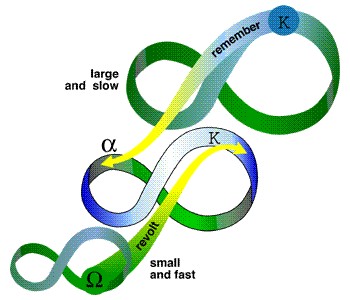
Holling, in "Understanding the Complexity of Economic, Ecological and Social Systems" develops the concept of panarchy as a means to elegantly account for the empirical behaviour of complex adaptive systems (i.e., by postulating a structure that allows a relatively small number of factors to generate the observed complexities rather than treating complexity as the product of a very large number of interacting factors). The concept of a panarchy involves three essential elements as diagrammed below: 1) a set of adaptive cycles (the sideways figure 8's in the diagram) that are 2) hierarchically ordered (from processes that are small scale and short duration to processes that are large scale and of long duration) and involve 3) processes of cross-scale interaction (the links labeled revolt and remember on the diagram).

Visual Representation of Panarchy as Framework and Metaphor

It is important to recognize the level of abstraction present in this representation. It is meant to apply generically to complex adaptive systems, whether they are social, ecological, economic or whatever. As such, it is a description of structure and processes that explain the general properties of systems, but does not theorize the operation of any specific system. To theorize the operation of particular systems, one must additionally outline the various 'controlling factors' that govern the operation of the various adaptive cycles associated with that specific system (as shown in the diagram below).


Visual Representation of Panarchy as Theory for a Specific System


Controlling factors for Adaptive Cycle A -->


Controlling factors Cycle B -->


Controlling factors Cycle C -->


Seen in this light, Hornborg is correct. The panarchy framework does not theorize power. However, the resilience researchers are also correct. Many empirical studies drawing on the panarchy framework have paid attention to power relations when attempting to 'fill in the blanks' and specify the factors responsible for the operation of the adaptive cycles in particular systems.

But, even if Hornborg read the specific empirical studies, I suspect he would still dispute the claim that the resilience researcher's had incorporated an analysis of power. The reason for this is that Hornborg advocates not just the incorporation of power into the analysis, but the incorporation of power theorized in a specific manner. To the extent that the resilience researchers incorporate power into their research they do it in relation to the specifics of the particular case and the theoretical proclivities of the individual researchers. Thus, viewed across the different empirical studies, the concept of power is not used in a consistent manner. Power means one thing in one study and another thing in a second study. In contrast, following Marx, Hornborg sees power as a very specific phenomena -- there is one dominant type of power (economic) to which all others are subservient. Thus, for example, he would recognize the coercive power held by the military but would argue that it is exercised in accordance with the interests of the ruling economic class.

This is where I part company with Hornborg. Historical analysis has showed that Weber had a better grasp on the concept of power than did Marx. Non-economic forms of power (military, bureaucratic, ideological, etc.) are often, but not always, subservient to the interests of the dominant economic elite. Thus, to preserve their explanatory utility in those situations where economic power does not trump all other forms, it is necessary to conceptualize power as consisting of a variety of independent dimensions rather than, as Marx does, as one dominant dimension that subsumes all other facets. For a concise discussion of this issue, see Chapter 1 of Michael Mann, The Sources of Social Power Volume 1.

Sunday, April 4, 2010

Ecological World Systems: Hornborg, Part 1

This is the first in what I expect to be a series of posts dealing with one particular approach to ecological sociology -- the fusion of ecological concerns onto world-system theory. Broadly speaking, the work in this area falls into two categories: a) writings by key figures in the world-system tradition with an interest in incorporating environmental/ecological concerns into their analysis and b) writings by individuals who have set as their task the development of a synthetic framework integrating the two perspectives. I'll be focusing on the second category of writings.

We begin with the work of Swedish anthropologist Alf Hornborg and, in particular, the arguments in his book The power of the machine : global inequalities of economy, technology, and environment. From world-systems theory Hornborg takes the conclusion that global society manifests aspects of a zero-sum game, i.e. that the gains of one region come at the expense of another. It is this idea that Hornborg sees as the fundamental factor underpinning the creation of world-systemic structures based around developed cores and less developed peripheries -- that the development of the core is built in part on the exploitation of the periphery.

But how do you measure exploitation? Traditional economics argues that exchanges between the core and the periphery are accurately measured by market prices and, hence, there is no exploitation; the core country pays $100 to the periphery country for each $100 worth of raw material it receives. Traditional world-systems theory builds on Marxist economic principals to argue that market prices aren't an accurate representation of the exchange and to show how such exchanges are economically unequal. Hornborg notes, correctly, that economics as a discipline finds the Marxist accounts wanting. Thus, he wants to develop an alternative metric for measuring the exchanges. It is here that Hornborg turns to ecology and, in specific, the implications of the second law of thermodynamics to propose a thermodynamics of imperialism, i.e. an ecology of unequal exchange.

Central to his argument is the concept of "technomass" which I'll take up in a future post.

Tuesday, December 15, 2009

Cooperation vs Competition

With Elinor Ostrom winning the Nobel Prize in Economics it is tempting to think that theorizing about cooperation is gaining traction relative to theorizing based on self-interest. But even that didn't prepare me for Matt Funk's claim, in On the Origin of Mass Extinctions: Darwin’s Nontrivial Error, that cooperation was as fundamental as he suggests. Here's the abstract.

Darwin's "Origin" launched evolution into theoretical orbit and it continues to influence its course. This magnum opus detailed a tenable solution to the most fundamental problem of human existence,and although this Promethean vision contains a few minor errors, there is one nontrivial error which misguides several crucial developments – not only in the evolving structure of evolutionary theory, but across the entire spectrum of science, including politico-economics. This problem has led theorists to mistakenly favour earth-based inputs over cosmic inputs, to over- emphasize biological evolution, and to under-emphasize stellar evolution. These perceptive, methodological, and logical errors have, in turn, emphasized the significance of the individual “struggle against competitors” over the cooperative “struggle against inclement environments”, and thus fashionable theories relating to Global Warming, The Problem of Sustainable Economic Development, and The Tragedy of the Commons have been erected upon false and sandy foundations and suggest evolutionarily unstable solutions. And to this point, in light of the discoveries presented here, we conclude that largely redirected global threat mitigation efforts will require unprecedented levels of international cooperation if long-term human survival is to be achieved.

Friday, November 20, 2009

Social and Natural Systems in the Decline of North America's Megafauna

One of the most striking characteristics of humans is that we are adaptive generalists. Unlike most species, which are adapted to specific ecological niches, humans have radiated out to populate virtually every land-based ecosystem on the planet. We can do this because we build shelters, transport food and otherwise make arrangements for the necessities of life in those parts of the globe that would otherwise be inhospitable.

It is this capacity, the ability to transform situations to meet our needs, that lies at the root of the interconnection between social and natural systems. The most obvious example of this interconnection is climate change, where humans are pumping the carbon stored in the ground as fossil fuels into the atmosphere and, hence, fundamentally altering both atmospheric chemistry and the global climate.

But what lies at the root of this human capacity? The standard answer is technology. Through technology we transcend the limitations and constraints placed on other species. But a recent article by Christopher Johnson in Science (Science 20 November 2009: Vol. 326. no. 5956, pp. 1072 - 1073) detailing the process of magafaunal decline in North America casts doubt on this account. Here is the story in brief:

Twenty thousand years ago, North America had a more impressive array of big mammals than Africa does today; by 10,000 years ago, 34 genera of these mammals were gone, including the 10 species that weighed more than a ton. Many other drastic changes occurred in this interval, all of which have been advocated as possible causes of megafaunal extinction. The climate flipped from cold to warm, then back to cold in a 1000-year chill (the Younger Dryas), before rapidly rewarming. There were more, larger fires, and the structure and species composition of vegetation changed drastically. People arrived, and the Clovis culture—with a characteristic style of beautifully crafted stone spear points—flourished for less than 1000 years. Some scientists have argued that an extraterrestrial object struck Earth ~13,000 years ago, triggering the Younger Dryas, starting fires, killing the megafauna, and putting an end to the Clovis culture. ....

What about people? It has long been argued that Clovis artifacts signal the first arrival of people in North America south of the boreal ice sheets and that the Clovis people were specialized big-mammal hunters who caused a crash of megafaunal populations from prehuman abundance to extinction within a few hundred years. This “blitzkrieg” scenario is supported by the fact that terminal dates on megafaunal fossils range from 13,300 to 12,900 years ago, which coincides almost exactly with the Clovis period. But the new data show that the megafaunal decline had begun more than a thousand years earlier. If people were responsible for that decline, they must have been pre-Clovis settlers. The existence of such people has been controversial, but archaeological evidence is slowly coming to light and is consistent with their arrival around the beginning of the megafaunal decline. It is beginning to look as if the greater part of that decline was driven by hunters who were neither numerous nor highly specialized for big-game hunting. Clovis technology may have been a feature of the endgame, possibly reflecting an intensified hunting strategy that developed once megafauna had become rare, possibly wary, and harder to hunt. ...

Before 14,800 years ago, the environment around the site studied by Gill et al. was an open savanna or parkland, probably with scattered spruce and rare broad-leaved trees growing over a short grass-dominated pasture, and almost no fi re. As the megafauna declined, woody biomass increased, mainly by growth of broad-leaved trees that had presumably been suppressed by the large herbivores. The result was a transitory spruce/broadleaf woodland, the like of which does not exist today. Big fires broke out ~14,000 years ago, and for the next few thousand years, major fires returned every few centuries. These changes were widespread: Fire increased throughout North America ~14,000 years ago, and the transitory “no-analog” woodland extended over a vast area.

In short, we begin with an ecosystem dominated by open savanna and numerous species of megafauna. Humans arrive, and apparently without the aid of significant technology, kill off the majority of the megafauna thus setting loose a cascade of ecological changes that ultimately result in the replacement of the savanna by a "no-analog" woodland. Thus we have a clear, early example of the interconnection of social and natural systems, but one that seems not to implicate technology as the fundamental driver.

Thursday, November 12, 2009

New Book: Thinking in Systems

A manuscript by Donella Meadows, the lead author of 1972's Limits to Growth, was published in August as a new book on systems theory called Thinking in Systems: A Primer. It's a posthumous publication (Meadows died in 2001) edited by Diana Wright of the Sustainability Institute.

"In the years following her role as the lead author of the international bestseller, Limits to Growth—the first book to show the consequences of unchecked growth on a finite planet— Donella Meadows remained a pioneer of environmental and social analysis until her untimely death in 2001.

Meadows’ newly released manuscript, Thinking in Systems, is a concise and crucial book offering insight for problem solving on scales ranging from the personal to the global. Edited by the Sustainability Institute’s Diana Wright, this essential primer brings systems thinking out of the realm of computers and equations and into the tangible world, showing readers how to develop the systems-thinking skills that thought leaders across the globe consider critical for 21st-century life."

It's in paperback and available at Canadian booksellers for about $17.00.

Meadow's article, "Places to Intervene in a System" was first published in Whole Earth magazine in 1997, but received little attention. It is available to download here, reprinted by the software developer blog, Developer.dot.star. Software developers picked up on her theory because it has implications for software modelling of complex systems.

UPDATE: I just read "Places to Intervene in a System" and I have to tell you, if you don't have the time or inclination to read anything else about systems theory, you should just read this article. It's 19 pages long, and it's the most brilliant analysis of how to pragmatically change systems, and fundamentally, how they work.

Sunday, November 8, 2009

Approaches to Complex Systems

In this talk George Francis provides an overview of different approaches to the study of complex adaptive systems. The talk is interesting in that he draws as much on social science theorizing as that developed in the natural sciences. World System Theory, in particular, is discussed at length.

He is also the author of 'Models for Sustainability Emerge in an Open Systems Context,' an article covering much the same ground.

Saturday, October 31, 2009

Key Concept: Emergence or Those flocking boids!

One of the great philosophical arguments of all time involves conceptualizing the relationship between different levels of phenomena: does one favor organicism or reductionism? Is the whole greater than the sum of its parts? Or can it be reduced to an understanding of those parts?

Sociology, following Durkheim and his 'social facts can only be explained through reference to other social facts' dictum, traditionally favored organicism. One of the more interesting places to explore these ideas is by looking at emergence. How, for example, do we understand the flocking of birds or the existence of segregated neighborhoods in cities?


Craig Reynolds has a mesmerizing page where you can watch an individual based model of boids that mimic the flocking behaviour of birds. In philosophical terms, Reynolds is trying to explain the emergent phenomena of flocking behaviour through a set of individual-level instructions to his computerized agents (the boids). The page does an excellent job of explaining both the assumptions that are programed into the agents and providing links to a wide variety of relevant literature.

This is similar to the famous explanation for segregation provided by Nobel prize winning economist Thomas Schelling in his book Micromotives and Macrobehavior. By positing the existence of individuals (agents in the jargon) with slight-but-not-malicious preference to have neighbors of the same race, Schelling developed an agent based model showing that, over time, the result of people acting to meet these preference leads not to a mixed neighborhood but, rather, to completely segregated populations. There are a number of different simulations of this on the web, for example, here, here and here. A simpler and less interesting version is here.

But, as Russ Abbott has noted, while boids do a good job of modeling flocking behavior, they ignore energy issues. Thus, as currently conceived, most agent based representations of ecosystem phenomena are seriously deficient.

Saturday, October 17, 2009

The Nobel Prize and the Tragedy of the Commons

Elinor Ostrom, Indiana University, won the Nobel Prize for Economics (along with O. Williamson) for her work of supplanting the "tragedy of the commons" with a more rigorous understanding of managing natural resources.

Garrett Hardin's 1968 article "The Tragedy of the Commons" proposed that a "commons," typically a natural resource such as grazing lands, could not be managed by local individuals, e.g. local cattle grazers, because the users would not share the commons fairly or sustainably; they would overgraze the commons with their own stock at the expense of others who use it, and thus destroy the commons. Hardin proposed that the only way to avoid the tragedy of the commons was to place it under the management of central governments or convert it to private property, managed by the owners. The Tragedy of the Commons became a sort of unquestioned mantra that governments, corporations, and certain NGOs used to justify policies that barred local people from using land and natural resources. Hardin even used the concept to justify population control, warning that "freedom to breed will bring ruin to all."

Elinor Ostrom demonstrated empirically that many local users of a commons have found ways to both share the commons and use it sustainably as a collective. In some cases, they were not able to do so, and her research identified why some commons were well-managed by locals and others were not. The factors she identified were the kinds of "social capital" that enabled people to manage it well on their own: well-defined boundaries, a strong community tradition, and the absence of government interference.(Leal). She found that small groups of people who develop their own rules for using the commons are able to get immediate feedback on their use of the commons and adjust their uses as needed. Rules devised by one group are "error checked" by rules developed by another small group using the same commons. Ostrom called this process of local rule-making "polycentric governance."

"The strength of polycentric governance systems is each of the subunits has considerable autonomy to experiment with diverse rules for a particular type of resource system and with different response capabilities to external shock. In experimenting with rule combinations within the smaller-scale units of a polycentric system, citizens and officials have access to local knowledge, obtain rapid feedback from their own policy changes, and can learn from the experience of other parallel units."

What's even more interesting about Ostrom's work is her empirical method. She developed and tested her theories by living with local communities, studying their relationships and use of natural resources.

Tuesday, October 13, 2009

More Blogs for Sociology and Complexity Science

Dr. Castellani, currently a professor of Sociology at Kent State, Ohio, has a blog dedicated to Sociology and Complexity Science. Interestingly, Dr. Castellani's background also includes extensive studies in psychology and visual arts. His Art & Science Factory includes his diverse interests in popular art and the social complexity of public health. The blog itself is loaded with fantastic art. His book on Sociology and Complexity Science looks like a good overview of the field, with a related website that gets into the specifics of complexity theories and models.

A related blog is Aaron Bramson's Complexity Blog that features Agent-Based Modeling.

And don't be embarrassed to take a look at the Wikipedia page on Sociology and Complexity Science. It's really a very good overview of the history of social complexity theory, it's related theories, schools and authors.