Emilio Moran poses an interesting question, what makes social ecological systems more vulnerable and less resilient?, in his recent article Transformation of social and ecological systems. The bulk of the article is a rather sweeping history of humanity aimed at emphasizing the unique nature of our current situation. In the conclusion, quoted after the break, Moran identifies the factors he sees as responsible for making current systems more vulnerable and less resilient: Hypercoherence, loss of redundancy, loss of trust and a sense of community, and the misuse of information by decision-makers. Read on .....
Showing posts with label vulnerability. Show all posts
Showing posts with label vulnerability. Show all posts
Monday, February 20, 2012


Thursday, January 19, 2012
Climate Change and Extinctions
Biologists have long argued that the current rate of species loss rivals the five great mass extinctions of the geological past. As long ago as 1993, Harvard biologist E.O. Wilson estimated that Earth is currently losing something on the order of 30,000 species per year, or three species per hour. Some biologists have begun to feel that this biodiversity crisis — this “Sixth Extinction” — is even more severe, and more imminent, than Wilson had supposed. Significantly, where past extinction events were the result of physical processes, the current uptick is largely a product of human actions: transformation of the landscape and resultant habitat destruction, overexploitation of species, pollution, and the introduction of alien species.
An article in the current issue of Nature argues that climate change may significantly increase the rate of species extinction through processes that have not previously been considered. Here's how Nature describes the article
More species may become extinct as a result of climate change than previously thought, a modelling study suggests. As the climate warms, many species are predicted to shift their ranges to stay within comfortable temperature zones. However, some species will be better able to do so than others. Mark Urban at the University of Connecticut in Storrs and his colleagues have created a model that takes into account the competition that species face for habitats when they move to new ecosystems. They modelled the effect of 4 °C of warming over 100 years on 40 simulated species, and found a much higher number of extinctions than did models that do not account for species competition and species' differing dispersal abilities. Even species with broad heat tolerances might be outcompeted — either by the arrival of newcomers in their current habitats or by native species in ecosystems that become habitable to them in future.More technical details are provided in the abstract below:
Most climate change predictions omit species interactions and interspecific variation in dispersal. Here, we develop a model of multiple competing species along a warming climatic gradient that includes temperature-dependent competition, differences in niche breadth and interspecific differences in dispersal ability. Competition and dispersal differences decreased diversity and produced so-called ‘no-analogue’ communities, defined as a novel combination of species that does not currently co-occur. Climate change altered community richness the most when species had narrow niches, when mean community-wide dispersal rates were low and when species differed in dispersal abilities. With high interspecific dispersal variance, the best dispersers tracked climate change, out-competed slower dispersers and caused their extinction. Overall, competition slowed the advance of colonists into newly suitable habitats, creating lags in climate tracking. We predict that climate change will most threaten communities of species that have narrow niches (e.g. tropics), vary in dispersal (most communities) and compete strongly. Current forecasts probably underestimate climate change impacts on biodiversity by neglecting competition and dispersal differences.
Tuesday, June 14, 2011
Miscellany: Appocalypse, Transformation and Hope
A few items that piqued my curiosity. I'll let you sort out which of the above labels applies to any particular one.
1) Noam Chomsky, best known for his political analyses, takes on the environment in Human Intelligence and the Environment.
2) In an interesting pair of developments in South America, Brazil is moving to reduce the protection given to the rainforest while (see following article) Ecuador is proposing a novel arrangement designed to maintain its rainforest.
3) Jonathan Hari reports on an interesting offer from Ecuador in A Turning Point We Miss at our Peril.
4) Finally, the lengthy (7000 word) essay A Brief History of the Corporation: 1600-2100 argues that the trajectory of globalization is leading toward the end of the corporation and into an era of Coesian growth which "is fundamentally not measured in aggregate terms at all. It is measured in individual terms"
1) Noam Chomsky, best known for his political analyses, takes on the environment in Human Intelligence and the Environment.
And what he (biologist Ernst Mayr) basically argued is that intelligence is a kind of lethal mutation. And he had a good argument. He pointed out that if you take a look at biological success, which is essentially measured by how many of us are there, the organisms that do quite well are those that mutate very quickly, like bacteria, or those that are stuck in a fixed ecological niche, like beetles. They do fine. And they may survive the environmental crisis. But as you go up the scale of what we call intelligence, they are less and less successful. By the time you get to mammals, there are very few of them as compared with, say, insects. By the time you get to humans, the origin of humans may be 100,000 years ago, there is a very small group. We are kind of misled now because there are a lot of humans around, but that’s a matter of a few thousand years, which is meaningless from an evolutionary point of view. His argument was, you’re just not going to find intelligent life elsewhere, and you probably won’t find it here for very long either because it’s just a lethal mutation. He also added, a little bit ominously, that the average life span of a species, of the billions that have existed, is about 100,000 years, which is roughly the length of time that modern humans have existed.
With the environmental crisis, we’re now in a situation where we can decide whether Mayr was right or not. If nothing significant is done about it, and pretty quickly, then he will have been correct: human intelligence is indeed a lethal mutation. Maybe some humans will survive, but it will be scattered and nothing like a decent existence, and we’ll take a lot of the rest of the living world along with us. So is anything going to be done about it? The prospects are not very auspicious.
2) In an interesting pair of developments in South America, Brazil is moving to reduce the protection given to the rainforest while (see following article) Ecuador is proposing a novel arrangement designed to maintain its rainforest.
In a move described as "disastrous" by conservationists, the nation's congress backed a bill relaxing laws on the deforestation of hilltops and the amount of vegetation farmers must preserve. The law also offers partial amnesties for fines levied against landowners who have illegally destroyed tracts of rainforest. The legislation, which must still be passed by the Brazillian Senate and approved by President Dilma Rousseff, aims to help owners of smaller farms and ranches compete with under-regulated rivals in countries such as the USA and Argentina.
3) Jonathan Hari reports on an interesting offer from Ecuador in A Turning Point We Miss at our Peril.
We have been putting short-term profits for a few ahead of the long-term needs of our species. Every rainforest on Earth is being reduced to the money that can be stripped from it: yesterday, Brazil's Chamber of Deputies voted to slash the amount of the Amazon that must be preserved by landowners. Except this time, for the first time, the people of Ecuador have offered us an alternative – a way to break this pattern. Alberto Acosta, the former energy minister who drew up the plan, calls it a punto de ruptura – a turning point, one that "questions the logic of extractive development" that drilled us into this species-swallowing hole. Here's the offer. The oil beneath the rainforest is worth about $7bn. Everybody knows that a stable climate, biodiversity and functioning lungs are worth far more than that. But until now, nobody has been willing to pay. Ecuador's democratic government says that, if the rest of the world offers just half of what the oil is worth – $3.5bn – they will keep the rainforest standing and alive and working for us all. . . . .They first made this offer in 2006. So how has the world responded? Chile has offered $100,000. Spain has offered $1.4m. Germany initially offered $50m, then pulled out. Now President Correa is warning that they can't wait forever in a country where 13 per cent are close to starving. If they don't have $100m in the pot by the end of this year, he says, they will have no choice but to pursue Plan B – the digging and destruction of the rainforest.
4) Finally, the lengthy (7000 word) essay A Brief History of the Corporation: 1600-2100 argues that the trajectory of globalization is leading toward the end of the corporation and into an era of Coesian growth which "is fundamentally not measured in aggregate terms at all. It is measured in individual terms"
Sunday, October 24, 2010
National Vulnerability to Climate Change: 2040
The British corporation Maplecroft, which specializes in developing quantitative measures of risk, has just released a report calculating the vulnerability of 170 countries to the impacts of climate change over the next 30 years. The report uses 42 social, economic and environmental factors to assess national vulnerabilities across three core areas: 1) exposure to climate-related natural disasters and sea-level rise; 2) human sensitivity, in terms of population patterns, development, natural resources, agricultural dependency and conflicts; and 3) the adaptive capacity of a country’s government and infrastructure to combat climate change.
 The results, summarized by the accompanying map, rank countries from extreme to low risk. A number of countries projected to be major economies of the future are among those with either extreme (Bangladesh, India, Philippines, Vietnam and Pakistan) or very high (China, Brazil, Japan) levels of risk. The Guardian summarized the report as follows:
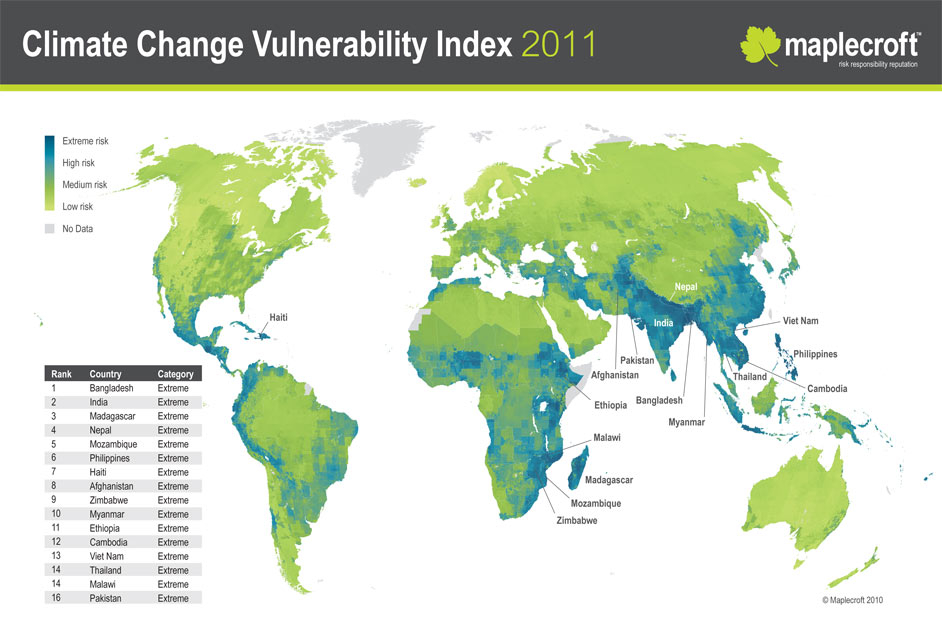 The results, summarized by the accompanying map, rank countries from extreme to low risk. A number of countries projected to be major economies of the future are among those with either extreme (Bangladesh, India, Philippines, Vietnam and Pakistan) or very high (China, Brazil, Japan) levels of risk. The Guardian summarized the report as follows:
According to Maplecroft, the countries facing the greatest risks are characterised by high levels of poverty, dense populations, exposure to climate-related events and reliance on flood- and drought-prone agricultural land.
Bangladesh ticks most of these boxes and the report warns that rising climate risks could hit foreign investment into the country, undermining the driving force behind economic growth of 88 per cent between 2000 and 2008.
Similarly, the report warned that India's massive population and increasing demand for scarce resources made it particularly sensitive to climate change.
Other Asian countries attracting high levels of foreign investment such as the Philippines, Vietnam and Pakistan were also classified as facing 'extreme risk' from climate change, while industrial giants China, Brazil and Japan are listed as 'high risk'.
"This means organisations with operations or assets in these countries will become more exposed to associated risks, such as climate-related natural disasters, resource security and conflict," said Dr Matthew Bunce, principal environmental analyst at Maplecroft. "Understanding climate vulnerability will help companies make their investments more resilient to unexpected change."
Some states were not listed because of a lack of data, including North Korea and small island states such as the Maldives that are vulnerable to rising sea l evels.
Wealthy European nations made up the majority of low risk countries, with Norway, Finland, Iceland, Ireland, Sweden and Denmark deemed to face the lowest risk of climate-related disruption.
However, Russia, USA, Germany, France and the UK were all rated as 'medium risk' countries.
Tuesday, September 14, 2010
The Climate Wars War
Gwen Dyer's 2008 book Climate Wars (discussed earlier on the blog both here and here) is the best known of a series of works analyzing the idea that climate change might be a trigger for social disorder, population migration and conflict. Among the others are 2003 report for the Pentagon on the national security implications of climate change; the Stern review on the economics of climate change, prepared for the UK government in 2006; and the United Nations’ post-conflict environmental assessment of Sudan in 2007, which suggested that climate change was an aggravating factor in the Darfur conflict.
But is there real proof of a link between climate change and civil war? It turns out, according to Nature News, that there is an academic war over the potential existence of such real wars.
Three important points are worth noting. First, there is a substantial tradition of research dealing with the link between environmental scarcity and violence. The focus on climate change as the driver for particular types of environmental scarcity (e.g., arable land, potable water, etc.) is merely a specific twist on that earlier research.
Second, that research has also been the subject of vigorous debate. However, there are some points which emerge from the cacophony: 1) there is a relationship between environmental scarcity and violence, but the relationship is much more subtle and indirect than most people think; and 2) in contrast to the bulk of the literature which interpret their results through the lens of a particular philosophical orientation, there exist a few analytic gems such as Colin Kahl's States, Scarcity, and Civil Strife in the Developing World (reviewed here).
Third, and perhaps most significantly, both Buhaug and Burke buttress their arguments with statistical evidence gleaned from studies of a variety of historical cases. The underlying premise is that the past is prologue to the future. However, to the extent that one sees climate change as potentially involving a dramatic tipping point, that premise may not be valid.
But is there real proof of a link between climate change and civil war? It turns out, according to Nature News, that there is an academic war over the potential existence of such real wars.
In research published this week, he (Halvard Buhaug, a political scientist with the Peace Research Institute Oslo) finds almost no correlation between climate change indicators, such as temperature and rainfall variability, and the frequency of civil wars over the past 50 years in sub-Saharan Africa — arguably the part of the world that is socially and environmentally most vulnerable to climate change. “The primary causes of civil war are political, not environmental,” says Buhaug.
The analysis challenges a study published last year by Marshall Burke, an economist at the University of California, Berkeley, and colleagues, who reported a strong historical relationship between temperature and the incidence of civil war. They found that the likelihood of armed conflict across the continent rose by some 50% in unusually warm years between 1981 and 2002. Neither Burke nor Buhaug is giving any ground; each challenges the other’s definition of ‘civil war’ and choice of climate data sets. Given the many causes of unrest, it is not surprising that a meaningful correlation with climate is hard to pin down, says Hans Joachim Schellnhuber, director of the Potsdam Institute for Climate Impact Research in Germany.
1. Buhaug, h. Proc. Natl Acad. Sci. USA doi:10.1073/
pnas.1005739107 (2010).
2. Burke, M. B. et al. Proc. Natl Acad. Sci. USA 106,
20670–20674 (2009).
Three important points are worth noting. First, there is a substantial tradition of research dealing with the link between environmental scarcity and violence. The focus on climate change as the driver for particular types of environmental scarcity (e.g., arable land, potable water, etc.) is merely a specific twist on that earlier research.
Second, that research has also been the subject of vigorous debate. However, there are some points which emerge from the cacophony: 1) there is a relationship between environmental scarcity and violence, but the relationship is much more subtle and indirect than most people think; and 2) in contrast to the bulk of the literature which interpret their results through the lens of a particular philosophical orientation, there exist a few analytic gems such as Colin Kahl's States, Scarcity, and Civil Strife in the Developing World (reviewed here).
Third, and perhaps most significantly, both Buhaug and Burke buttress their arguments with statistical evidence gleaned from studies of a variety of historical cases. The underlying premise is that the past is prologue to the future. However, to the extent that one sees climate change as potentially involving a dramatic tipping point, that premise may not be valid.
Sunday, August 15, 2010
Community Resilience: Lessons from New Orleans

Robert Cates, one of the authors of Community Resilience: Lessons from New Orleans and Hurricane Katrina, is working on a follow up article that makes explicit a number of general lessons about the creation of resilient communities.
The 8 lessons, listed below, are described in greater detail by Andrew Revkin.
1. The United States is vulnerable to enormous disasters despite being the richest and most powerful nation on earth.
2. Creating community resilience is a long-term process.
3. Surprises should be expected.
4. The best scientific and technological knowledge does not get used or widely disseminated.
5. Major response capability and resources were invisible, refused, or poorly used.
6. Disasters accelerate existing pre-disaster trends.
7. Overall vulnerability to hurricanes has grown from multiple causes.
8. Efforts to provide protection reduced vulnerability to frequent small events but increased vulnerability to rare catastrophic events.
While the work uses the term resilience, it is more in the ordinary language sense than in the technical sense developed by Holling and other resilience science researchers. Conceptually, the analysis is closer to Perrow's treatment of system accidents (see Normal Accidents) than to resilience theory.
Since I've got a chapter "Disasters as System Accidents" in the forthcoming Earthscan Press book Dynamics of Disaster: Lessons on Risk, Response and Recovery that covers some of the same territory, I thought I'd point out the major differences between this analysis and my own.
First, the concept of a system accident refers to an accident resulting from the unanticipated interaction of multiple failures in a complex system. While both Cates and I agree on the importance of multiple causes and the impossibility of perfect foresight (hence, the importance he places on surprises), I have a broader view of the types of causes that should be examined. Cates emphasizes two broad types of factor: natural factors (e.g., hurricane) and technological factors (e.g., levees). The central point of my chapter is the need to incorporate a third type of factor, socio-cultural, into the analysis. I don't think it is possible to fully understand what happened in New Orleans without taking account of both the specific culture of the city and the longstanding history of racism in the region.
Second, Cates argues that disasters accelerate pre-existing trends. Specifically, Katrina accelerated the economic and population decline that New Orleans was already experiencing. While Katrina does appear to have had this effect, I don't think it is safe to generalize from the single case. Naomi Kline, in her book The Shock Doctrine provides a number of examples where natural and human induced disasters alter the situation and provide the opportunity for a dramatic re-organization of the existing state of affairs. These cases illustrate not an acceleration of pre-existing trends but, rather, the replacement of the old trend by a new one. Thus, for example, the tsunami that hit Thailand and wiped out a number of small local villages that had been intractably opposed to tourist development became an opportunity for large corporations to move in and build resorts in those areas.
Third, as the following quote illustrates, Cates clearly understands that there is a potential relationship between adaptation and vulnerability.
A major concern in adapting to climate change is whether successful short-term adaptation may lead to larger long-term vulnerability. This seemed to be the case from the 40 year period between Hurricane Betsy and Katrina, when new and improved levees, drainage pumps, and canals — successfully protected New Orleans against three hurricanes in 1985, 1997, and 1998. But these same works permitted the massive development of previously unprotected areas and the flooding of these areas that resulted when the works themselves failed were the major cause of the Katrina catastrophe.
However, while noting the potential relationship, he doesn't provide any conceptual ideas to help us make sense of it. Individuals familiar with panarchy theory will recognize the similarities between the situation described above and the rigidities present in the conservation phase of the adaptive cycle.
Tuesday, March 16, 2010
Alternatives Features Holling and Resilience
The April Alternatives magazine (Canadian ecology 'zine) is focusing on Resilience, and includes an interview with Buzz Holling and a "Hardcore Guide to Resilience" using Hollings' research.
Inside is also a full-page add for a conference at the Dalhousie School of Social Work on "The Social Ecology of Resilience." The conference is scheduled for June 7th-10th, 2010. It is co-sposored by the Resilience Research Centre, directed by Michael Ungar at Dalhousie University.
The conference on resilience is not about ecological resilience, but resilience on a smaller scale, with families, youth, and the other sorts of people that social workers generally deal with. Social work, and psychology to a lesser extent, has been working with the idea of social resilience for decades. Just now the social work profession has been able to link research on social resilience with larger scale resilience theory for whole societies and ecosystems. The link between the two is absolutely correct in that vulnerable, stressed, and disadvantaged populations are more prone to suffering devastating effects from ecological crises.
Wednesday, February 17, 2010
Food Security: The Challenge of Feeding 9 Billion People

The current issue of Science magazine has a special section on Food Security. The introduction to the section, along with a list of the articles, is available here. One of the most interesting articles, "The Challenge of Feeding 9 Billion People" (Science 12 February 2010: Vol. 327. no. 5967, pp. 812 - 818 DOI: 10.1126/science.1185383) takes an ecological sociology perspective arguing that "the goal is no longer simply to maximize productivity, but to optimize across a far more complex landscape of production, environmental, and social justice outcomes." In other words, the global food security isn't simply a matter of sufficient food, it involves a number of interconnected problems: 1) Matching the rapidly changing demand for food from a larger and more affluent population to its supply, 2) in ways that are environmentally and socially sustainable and 3) ensure that the world’s poorest people are no longer hungry.
Tuesday, December 15, 2009
Cooperation vs Competition
With Elinor Ostrom winning the Nobel Prize in Economics it is tempting to think that theorizing about cooperation is gaining traction relative to theorizing based on self-interest. But even that didn't prepare me for Matt Funk's claim, in On the Origin of Mass Extinctions: Darwin’s Nontrivial Error, that cooperation was as fundamental as he suggests. Here's the abstract.
Darwin's "Origin" launched evolution into theoretical orbit and it continues to influence its course. This magnum opus detailed a tenable solution to the most fundamental problem of human existence,and although this Promethean vision contains a few minor errors, there is one nontrivial error which misguides several crucial developments – not only in the evolving structure of evolutionary theory, but across the entire spectrum of science, including politico-economics. This problem has led theorists to mistakenly favour earth-based inputs over cosmic inputs, to over- emphasize biological evolution, and to under-emphasize stellar evolution. These perceptive, methodological, and logical errors have, in turn, emphasized the significance of the individual “struggle against competitors” over the cooperative “struggle against inclement environments”, and thus fashionable theories relating to Global Warming, The Problem of Sustainable Economic Development, and The Tragedy of the Commons have been erected upon false and sandy foundations and suggest evolutionarily unstable solutions. And to this point, in light of the discoveries presented here, we conclude that largely redirected global threat mitigation efforts will require unprecedented levels of international cooperation if long-term human survival is to be achieved.
Saturday, December 12, 2009
Poverty, Gender, Vulnerability and Resilience.
I'm posting this from St. Andrews, NB because St. George doesn't have internet (in my part of town). It's my contribution on this International Day of Action for Climate Justice, part of the Copenhagen Climate Change Conference.
I have been researching "definitions of resilience" for my dissertation the Transition Towns movement in Canada. About a month ago, I contacted Rob Hopkins of Transition Towns UK, who put me in touch with Neil Adger of the (now infamous) University of East Anglia Center for Climate Change Research. This resulted in an email exchange with Rob, Neil, Katrina Brown and Helen La Trobe. I've been so swamped with course work I didn't have a chance to review them until now—but this post is a summary of those messages. In addition, Neil sent me a copy of the chapter, "Vulnerability and Resistance to Environmental Change." Co-authors Neil Adger and Katrina Brown gave me permission to post the chapter to this blog. If I figure out how to embed the document, I'll post it over the next week.
I told Neil I had been looking for a definition of "resilience" to use in my research. The first thing he wrote to me was "a good theory is better than a good definition":
"In response to your major points, let me say that you need to explore resilience as both an emergent system property – i.e. something you can observe independently, as well as resilience as a normative social goal." (Neil Adger.)
A discussion ensued about the many definitions and normative goals of resilience. An emerging question for me, and for the others, was whether "maintaining system stability" (i.e. sustainability) becomes "rigidity" or "resistance to change." Resistance to change, or "stability at all costs," can keep a system stable and keep people and communities intact for a short duration, but in the long run, it becomes counter-evolutionary, that is, it is maladaptive to changes that need to happen, either for normative social reasons or as a response to environmental shocks.
“The message of resilience is more radical for policy-makers than that of sustainability. The agenda implied by resilience actually challenges some widely held tenets about stability and resistance to change that are implicit in how sustainability is formulated in environmental and social policy arenas around the world. Promoting resilience means changing, in particular the nature of decision-making to recognise the benefits of autonomy and new forms of governance in promoting social goals, self-organisation, and the capacity to adapt. In a policy world focussed on resilience there is less scope for global blueprints, which are high on central control but low on equity – such blueprints create their own vulnerabilities and render some problems and issues invisible [3]. Promoting resilience is concerned with the knowledge required to facilitate robust governance systems that can cope with environmental changes and social, demographic and democratic transitions.” (Neil Adger)
"Resilience is not about promoting growth or change for its own sake. It is about promoting the ability to absorb shocks and stresses and still maintain the functioning of society and the integrity of the ecological systems. However, resilience also requires communities and societies to have the ability to self-organize and to manage resources and make decisions in a manner that promotes stability. Most important of all, resilience requires societies to have the capacity to adapt to unforeseen circumstances and risks. These objectives give generic guidance on how to promote sustainability at different scales.” (Helen La Trobe)
In human communities, it becomes very difficult to sort out what kind of change is "good in the long run", even though initial shocks are disruptive, and what kinds of change are damaging and maladaptive. As a bright line example, stepping down capitalist production and trade would cause serious shocks and disruptions to many communities in the over-developed world, but in the long run would slow climate change and help us adapt to a post-fossil fuel economy. On the other hand, Hurricane Katrina was a sudden ecological shock that was severely detrimental to poor people of colour in New Orleans and offered few opportunities for beneficial adaptation.
Which brings us to the next topic. Neil Adger and Katrina Brown's chapter on "Vulnerability and Resilience to Environmental Change" looks at several examples from cultures around the world that have experienced different kinds of ecological shocks: economic and environmental. To quickly sum it up, poverty and gender are factors which significantly effect a community's ability to adapt to shocks. In an example from Cameroon, "structural adjustment" policies led to a reduction in government employment and sent thousands of city dwellers back to the rural agricultural areas. Men who re-ruralized adapted well by growing cash crops. Women who had traditionally done farming became excluded from the land, and were relegated to producing household services and cottage crafts. The men prospered (relatively speaking) and the women suffered severely, There were other examples in the article which showed that women and the children they care for are more severely impacted by ecological shocks and less able to mount a beneficial adaptation to change. The power differential between men and women is a factor affecting resilience.
By the same token, there are several examples in the article which show that poverty makes people unable to adapt to serious ecological shocks, whether resulting from climate change, loss of water, farmland or other natural resources, political and economic shocks, etc. In other words, systemic poverty and powerlessness caused by race, gender, and economic exploitation sets poor people up to be devastated by ecological shocks, such as hurricanes, typhoons, droughts, floods and fires.
That is why today's protests in Copenhagen, the International Day of Action for Climate Justice, is such a powerful statement of this profound truth. Europeans and North Americans, as well as Indigenous and People of the South, who are protesting today in Copenhagen, have intuitively understood this profound truth: adaptation to climate change is possible only with the achievement of equity and justice around the world. The elimination of poverty and equitable access to resources and decision-making are fundamental conditions for adapting to climate change. The over-developed world needs to ratchet down its capitalist conquest of the world, share its resources, stop emitting any more carbon and greenhouse gasses, phase out fossil fuels, and share appropriate technologies and self-empowered development strategies with the South.
Monday, December 7, 2009
Human Side of Disaster
The current issue of the Disaster and Social Crisis Research Network Electronic Newsletter has just been released. It is edited by Eduardo Runte, a former graduate student in Sociology at UNB whose MA thesis dealt with the experiences of electrical linemen during the ice storm of 1998. Eduardo is now in the PhD program at the Ecole des Mines in Paris. The contents of his thesis are summarized here and a description of his PhD work, dealing with the social processes involved in the creation of safety, can be found here.
The newsletter has a blurb for a new book by Thomas Drabek, The Human Side of Disaster, which it describes as follows:
The newsletter has a blurb for a new book by Thomas Drabek, The Human Side of Disaster, which it describes as follows:
When disaster strikes, people react, and usually, fear levels rise. Temporarily, however, one motivation supersedes all others: survival of self and those nearby, especially loved ones. Based on the author’s years of research and teaching experience, The Human Side of Disaster scientifically evaluates human responses in the face of disasters. This examination informs emergency managers and response teams and teaches them how to anticipate human behaviors in-crisis.
The book begins with four scenarios based on interviews and real events that introduce the human side of disaster. The stories examine how attention to, or lack of, preparedness, response, recovery, and mitigation affect outcomes. Each subsequent chapter refers back to the original Experiences chapter and provides insights that can be applied not only to events such as hurricanes, tornadoes, earthquakes, and floods, but also to man-made threats including industrial accidents and acts of terrorism. The author explores how people’s responses can be predicted, the long term effects of disaster on the psyche, and the key issues involved in recovery.
A balanced interpretation of research, results, and experience, the book demonstrates how traditional warning methods and high-tech systems can work together to improve communications, evacuations, and reconstruction efforts. It highlights the role of the human element in any disaster situation and demonstrates how to use that element as part of a planned disaster response.
Sunday, November 22, 2009
The Great Agricultural Land Grab
 What do you do if your country has an increasing population, a lack of agricultural land and lots of cash? The standard answer coming from the CEO's of large corporations in the developed world is "give us money to develop more productive crops. We developed 'miracle rice' back in the 60's and with sufficient development funds we can save you again."
Increasingly, however, it appears that these countries are opting for an alternative solution: shopping for agricultural land in even less developed countries. When I visited my daughter last Christmas, she had this fascinating map up on her wall. Taken from an article in The Guardian, it graphically depicts the location of various land purchases made by several wealthy developing countries: China, South Korea, Saudi Arabia and the United Arab Emerits. Convinced they will not be able to provide the food necessary for their future populations, they have started to invest heavily in countries with historically unproductive agricultural lands like Sudan and Ethiopia, with the intent of using the land to support their burgeoning populations. A number of people have questioned the ethics of such actions since these African countries are already unable to feed their populations and, hence, can ill afford to use their land for export crops.
Thanks to the efforts of the folks at Grain and their related website (farmlandgrab.org), these developments are receiving an increasing amount of attention. The recent NYTimes Magazine article 'Is There Such a Thing as Agro-Imperialism' provides a good overview of the issue.
Friday, November 20, 2009
Social and Natural Systems in the Decline of North America's Megafauna
 One of the most striking characteristics of humans is that we are adaptive generalists. Unlike most species, which are adapted to specific ecological niches, humans have radiated out to populate virtually every land-based ecosystem on the planet. We can do this because we build shelters, transport food and otherwise make arrangements for the necessities of life in those parts of the globe that would otherwise be inhospitable.
It is this capacity, the ability to transform situations to meet our needs, that lies at the root of the interconnection between social and natural systems. The most obvious example of this interconnection is climate change, where humans are pumping the carbon stored in the ground as fossil fuels into the atmosphere and, hence, fundamentally altering both atmospheric chemistry and the global climate.
But what lies at the root of this human capacity? The standard answer is technology. Through technology we transcend the limitations and constraints placed on other species. But a recent article by Christopher Johnson in Science (Science 20 November 2009: Vol. 326. no. 5956, pp. 1072 - 1073) detailing the process of magafaunal decline in North America casts doubt on this account. Here is the story in brief:
Twenty thousand years ago, North America had a more impressive array of big mammals than Africa does today; by 10,000 years ago, 34 genera of these mammals were gone, including the 10 species that weighed more than a ton. Many other drastic changes occurred in this interval, all of which have been advocated as possible causes of megafaunal extinction. The climate flipped from cold to warm, then back to cold in a 1000-year chill (the Younger Dryas), before rapidly rewarming. There were more, larger fires, and the structure and species composition of vegetation changed drastically. People arrived, and the Clovis culture—with a characteristic style of beautifully crafted stone spear points—flourished for less than 1000 years. Some scientists have argued that an extraterrestrial object struck Earth ~13,000 years ago, triggering the Younger Dryas, starting fires, killing the megafauna, and putting an end to the Clovis culture. ....
What about people? It has long been argued that Clovis artifacts signal the first arrival of people in North America south of the boreal ice sheets and that the Clovis people were specialized big-mammal hunters who caused a crash of megafaunal populations from prehuman abundance to extinction within a few hundred years. This “blitzkrieg” scenario is supported by the fact that terminal dates on megafaunal fossils range from 13,300 to 12,900 years ago, which coincides almost exactly with the Clovis period. But the new data show that the megafaunal decline had begun more than a thousand years earlier. If people were responsible for that decline, they must have been pre-Clovis settlers. The existence of such people has been controversial, but archaeological evidence is slowly coming to light and is consistent with their arrival around the beginning of the megafaunal decline. It is beginning to look as if the greater part of that decline was driven by hunters who were neither numerous nor highly specialized for big-game hunting. Clovis technology may have been a feature of the endgame, possibly reflecting an intensified hunting strategy that developed once megafauna had become rare, possibly wary, and harder to hunt. ...
Before 14,800 years ago, the environment around the site studied by Gill et al. was an open savanna or parkland, probably with scattered spruce and rare broad-leaved trees growing over a short grass-dominated pasture, and almost no fi re. As the megafauna declined, woody biomass increased, mainly by growth of broad-leaved trees that had presumably been suppressed by the large herbivores. The result was a transitory spruce/broadleaf woodland, the like of which does not exist today. Big fires broke out ~14,000 years ago, and for the next few thousand years, major fires returned every few centuries. These changes were widespread: Fire increased throughout North America ~14,000 years ago, and the transitory “no-analog” woodland extended over a vast area.
In short, we begin with an ecosystem dominated by open savanna and numerous species of megafauna. Humans arrive, and apparently without the aid of significant technology, kill off the majority of the megafauna thus setting loose a cascade of ecological changes that ultimately result in the replacement of the savanna by a "no-analog" woodland. Thus we have a clear, early example of the interconnection of social and natural systems, but one that seems not to implicate technology as the fundamental driver.
Sunday, November 15, 2009
Climate Change and Agriculture in East Africa
 In the context of the earlier post discussing expected changes in global agricultural productivity by 2050 (in which the southern hemisphere suffers hugely), it is reassuring to see the recent article "Adapting to climate change: Agricultural system and household impacts in East Africa" in the journal Agricultural Systems.
While East Africa is likely to be one of the least affected regions on the continent, the article notes:
Yields of staples like maize and beans will double in the region's highland areas as a result of rising temperatures, as warmer climates make crops mature faster.But the reverse is likely to occur in both drier and more humid areas, with crop harvests decreasing significantly in these places.
In the worst-affected areas, the researchers recommend farmers keep more livestock, switch to more drought-hardy crops such as sorghum, or abandon crop cultivation altogether. New sources of income might include carbon sequestration, they say.
In areas where the effects of climate change are likely to be less severe and crop losses more moderate, the authors call for the adoption of new technologies and agricultural techniques — such as water harvesting — that will enable farmers to continue growing crops.
While it is somewhat comforting to know that mitigation techniques are plausibly successful in such the region, there remains the pressing issue of providing the resources necessary to make such adaptation possible.
Saturday, November 7, 2009
World Development Report 2010 focuses on Climate Change
The most recent World Bank Development Report, WDR 2010, focuses on development and climate change. The main ideas of the report aren't particularly surprising: a) both developed and developing countries need to address emissions now and b) developing countries can shift to lower-carbon paths while promoting development and reducing poverty, but this depends on financial and technical assistance from high-income countries.
However, there are a number of interesting specifics. Among them this map showing the predicted global changes in agricultural productivity. Canada, Northern Europe and Russia are the big winners, with the southern hemisphere suffering substantially.

Another graph compares the emissions savings from more fuel efficient cars in the US with the additional emissions needed to provide 1.6 billion people in developing countries with electricity. Quite a thought provoking comparison.

Thursday, October 22, 2009
Resilience, Vulnerability and Criticality
In my search for appropriate definitions of resilience, I have come across the work of Neil Adger, Prof. of Environmental Science at the University of East Anglia, Norwich, UK. Neil is a fellow at the Resilience Alliance, at the Tyndall Center for Climate Change, and one of the co-recipients of the Nobel prize awarded to scientists of the IPCC.
I am attempting to get several of his papers, some of which are not published, but one that is available online is "Social and ecological resilience: are they related?", a chapter from Progress in Human Geography, 24,3 (2000) pp. 347-364. This paper examines various definitions of 'resilience', 'vulnerability' and 'criticality'. The last term, 'criticality', is not one I had heard before:
"The concept of criticality is distinct from vulnerability. Environmental criticality ‘refers to situations in which the extent or rate of environmental degradation precludes the continuation of current use systems or levels of human well being, given feasible adaptations and societal capabilities to respond.'" (Kasperson et al., 1995: 25) (Adger 2000).
Resilience is sometimes defined as the capacity to cope with stress, at other times as the opposite of "reisistence."
"Resilience can be defined in many ways. It is the buffer capacity or the ability of a system to absorb perturbations, or the magnitude of disturbance that can be absorbed before a system changes its structure by changing the variables and processes that control behaviour (Holling et al., 1995). By contrast other definitions of resilience emphasize the speed of recovery from a disturbance, highlighting the difference between resilience and resistance, where the latter is the extent to which disturbance is actually translated into impact (see Figure 1). It is important to note that these definitions, shown for a population in the graphical representations in Figure 1, are most relevant at the ecosystem scale. (Adger 2000)
On social resilience:
"Social resilience has economic, spatial and social dimensions and hence its observation and appraisal require interdisciplinary understanding and analysis at various scales. But it is important to note that, because of its institutional context, social resilience is defined at the community level rather than being a phenomenon pertaining to individuals. Hence it is related to the social capital of societies and communities." (Adger 2000)
The empirical portion of this study focuses on the resilience of coastal communities related to changed in coastal resources, e.g. mangrove ecology in coastal Viet Nam.
Subscribe to:
Posts (Atom)