Even though GM flax was only briefly legal in Canada, and taken off the market several years ago due to producers concerns over export problems, Canadian flax is deemed too contaminated with genetically modified products of biotechnology for some exports now.
http://www.flaxcouncil.ca/files/web/GMO%20Flax%20Update%2020%20Jan%202010%20Brazil.pdf
http://www.gmwatch.org/latest-listing/1-news-items/11557-flax-contamination-soars-to-28-countries
Thursday, January 21, 2010


Monday, January 18, 2010
Oil Constraints Return by 2011-Goldman Sachs
The video is Jeff Rubin's most recent talk on "peak oil": "We're not running out of oil—we're running out of the oil that you can afford to burn."
I've always been skeptical of Jeff Rubin's short term predictions on oil prices. If only he wasn't so right all the time. He predicts triple-digit oil prices by 2012. In fact, Goldman Sachs just announced their prediction for oil prices for the next 24 months: oil will go to $90 a barrel this year, 2010, and to $110 a barrel in 2011.
I've always been skeptical of Jeff Rubin's short term predictions on oil prices. If only he wasn't so right all the time. He predicts triple-digit oil prices by 2012. In fact, Goldman Sachs just announced their prediction for oil prices for the next 24 months: oil will go to $90 a barrel this year, 2010, and to $110 a barrel in 2011.
But note this: I'm not concerned about "peak oil" anymore. Yes, that's right, I'm ok with it. Why? Because I've had a chance to think this through for the last year at UNB and I've come to certain (qualified) conclusions: peak oil is not the problem, peak oil is the solution.
Look at what happened when oil reached $149 in 2008. What happened? People drove less, VMT went down dramatically and people started using public transit in record numbers. People cut back on shopping and started repairing and reusing the stuff they already owned. They started conserving all kinds of things: electricity, oil, water. They ate at home more and wasted less food. They even started growing their own food.
So if peak oil is the solution, what's the problem? I'm more certain all the time that the real problem is capitalist industrial civilization (whether state directed, like China, or corporate-directed, like U.S.) The high price of oil does a swift and decisive job of shrinking an overblown economy and the overdevelopment of land. It swiftly and decisively reduces excessive production and consumption of worthless consumer goods, which slows down the depletion of natural resources, and thus reduces the impact on our climate. We can find ways to adapt to peak oil, whether they are social adaptions or technological ones. The one thing we really can't reverse, at this point, is climate change, and that's the real long-term problem.
Environmental disputes get a new twist
Sociologists have long talked about the role of values in understanding people's attitudes toward the environment and the role of generational change in values for understanding the emergence of the environmental movement.
Similarly, anyone who has seen an episode of Ed Begley Jr.'s environmental awareness show Living with Ed has a sense of the potential tension differences in environmental commitment can make. An ongoing part of the show's narrative shtick are the conflicts between Ed and his less zealous wife Rachelle Carson who has to put up with Ed's uncompromising beliefs. So, it shouldn't come as a surprise. But, nonetheless, it is interesting to note that therapists are reporting an increase in green disputes among family members.
Similarly, anyone who has seen an episode of Ed Begley Jr.'s environmental awareness show Living with Ed has a sense of the potential tension differences in environmental commitment can make. An ongoing part of the show's narrative shtick are the conflicts between Ed and his less zealous wife Rachelle Carson who has to put up with Ed's uncompromising beliefs. So, it shouldn't come as a surprise. But, nonetheless, it is interesting to note that therapists are reporting an increase in green disputes among family members.
Saturday, January 16, 2010
Transition Towns in—of all places. . . Calgary!
A Short Film about what Transition Calgary are up to
Posted using ShareThis
The Transition Town movement is spreading like wildfire in Canada. Three years ago, before I even applied for residency in Canada, I first pondered the idea of doing research on Transition Towns and related issues. At that time there were no known groups in Canada, and I thought I would have to conduct my research in the UK where the movement started. When I applied to UNB in 2008, there was only one known group in Canada, in Peterborough, Ontario.
There are now more than a dozen groups across Canada. Of course, you would expect British Columbia to be the frontrunners of this movement, where there are four groups: Nelson, Victoria, Powell River, with Village Vancouver soon to gain official status. But there are seven groups in Ontario: Peterborough, London, Guelph, Ottawa, Dundas, Oakville, and Barrie. Montréal is the first that I know of in Quebec. There is an official group in Cocagne, New Brunswick, and possibly others brewing in St Andrews and Fredericton. I'm sure there's a dozen more on the backburner that we haven't heard from yet.
In some ways, the Transition Towns movement is tailor-made for Canadian culture. It emphasizes mutual help and a stoic acceptance of tough conditions. It is civically engaged but non-confrontational. It encourages thrift and a do-it-yourself ethic. I feel certain now that Transition Towns is going to be a very successful model for climate activism in Canada.
And now, Transition Nova Scotia! Every time I turn around there's another one. The list just keeps growing. . .
Thursday, January 14, 2010
Agent Orange, the Military and the Environment
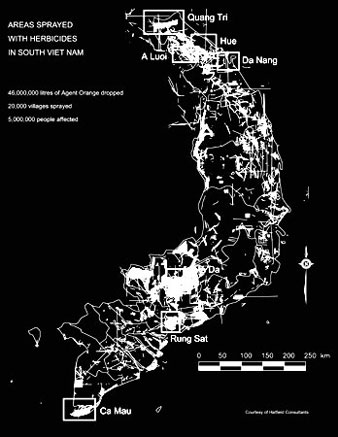
When people look for culprits to blame for environmental degradation, they typically pick on industry or the general public. There is, however, a strong case to be made that the military is responsible for much of the worst degradation -- one need only think of Hiroshima, the oil field fires in Kuwait or look at the list of Superfund sites in the US (which is topped by Hanford and other military related sites). People tend to give the military a pass because the actions are seen as necessary or in the public good (e.g., bringing WWII to an end) and because their operations are often shielded in secrecy and, hence, not widely known.
Photojournalist Philip Jones Griffiths covered the Vietnam war and his book Vietnam, Inc. is widely recognized the the best treatment of that war -- a war that saw more journalist access than any other in history. Griffiths' remains haunted by his Vietnam experience and in 2003 published Agent Orange: "Collateral Damage" in Viet Nam a book that stunningly documents the human and ecological tragedy.

Closer to home, a previous student of mine Chris Arsenault, recently published Blowback: A Canadian History of Agent Orange and the War at Home focusing particularly on the testing of Agent Orange and Agent Purple at Base Gagetown outside Fredericton. Significantly, exposed Canadian vets have gotten significantly less compensation from the government than have Americans. CBC's coverage of the controversy is available here.
In the US, a new report The Agent Orange Boomerang: A dark legacy of the Vietnam War is creating a whole new set of problems has just been released. The report covers four main topics: 1) A Legacy Revisited describes how Agent Orange is still damaging lives in Vietnam, 2) Agent of Influence makes the case for US compensation for victims in Vietnam, 3) Environmental Consequences of War takes a general look at the problem and, in specific, explores why the military rarely cleans up the messes they leave behind, and 4) A Hard Way to Die explores why hundreds of thousands of American Vietnam vets with Agent Orange–related
diseases have been made to suffer without VA health care.
A video from the press conference at the release of the report is also available.
Monday, January 11, 2010
Forests and Carbon in Canada
Deforestation, estimated to be responsible for up to 20 percent of global human generated emissions contributing to climate change, has long been a major focus of climate change policy. Most of the emphasis, however, has been on tropical deforestation. The reasons for this are fairly straightforward: 1) tropical forests are much more effective carbon sinks than are temperate forests (they grow faster and, hence, remove carbon at a more rapid rate) and 2 the volume of forest being cut is larger in the tropics than in temperate regions.
However, recent work by Werner Kurz and others in the Canadian Forestry Service has shifted attention to the forests of British Columbia and surrounding areas which are being devastated by an outbreak of the pine beetle.


According to the Montana Department of Environment, the mountain pine bark beetle (a species native to the region) has benefited from a variety of climate related changes:
As a result BC's forests, which have traditionally been viewed as a carbon sink, have become a major source of CO2 emissions. As shown in the diagram below, Canadian Forestry estimates now identify the pine beetle infestation as the single largest cause of CO2 emissions in Canada, exceeding by a significant amount the substantially more criticized emissions from the oil sands.

As a result, BC is now embroiled in a policy debate about how to proceed: harvest and burn the wood rapidly (which implies a big hit in short-medium term C02 emissions from the burning in order to get the forest back acting as a carbon sink through active reforestation) versus letting it decay slowly (and, hence, having a lower rate of emissions over a longer period coupled with a longer wait for the forest to return to its role as a carbon sink). The details of these, and other related debates, are nicely summarized in a recent article in the January 9, Globe and Mail, From Green Hero to Carbon Villain.
At a more fundamental level, these developments underscore the uncertainties inherent in attempting to devise a carbon accounting system for a planet that is in the process of profound transformation due to climate change. A few short years of warm winters and dry summers and a whole region goes from being a major carbon sink to a major source of emissions.
However, recent work by Werner Kurz and others in the Canadian Forestry Service has shifted attention to the forests of British Columbia and surrounding areas which are being devastated by an outbreak of the pine beetle.


According to the Montana Department of Environment, the mountain pine bark beetle (a species native to the region) has benefited from a variety of climate related changes:
1) Prolonged periods of cold weather in the -20 to -40 F range kill pine bark beetle larvae embedded in the thin bark of Lodgepole trees. However, winter weather over recent decades has afforded very few of these extended cold snaps. ... 2)Recent late summer drought conditions have stressed Lodgepole forests. Weakened individual trees have long been known to issue a biological invitation to beetle attack. During its adult mating phase in late summer, adult scout beetles identify weakened trees and issue an aggregating pheromone to other beetles to key-in and attack the tree. The apparent combination of large numbers of drought-weakened trees and the growing population of beetles perpetuates the infestations.
As a result BC's forests, which have traditionally been viewed as a carbon sink, have become a major source of CO2 emissions. As shown in the diagram below, Canadian Forestry estimates now identify the pine beetle infestation as the single largest cause of CO2 emissions in Canada, exceeding by a significant amount the substantially more criticized emissions from the oil sands.

As a result, BC is now embroiled in a policy debate about how to proceed: harvest and burn the wood rapidly (which implies a big hit in short-medium term C02 emissions from the burning in order to get the forest back acting as a carbon sink through active reforestation) versus letting it decay slowly (and, hence, having a lower rate of emissions over a longer period coupled with a longer wait for the forest to return to its role as a carbon sink). The details of these, and other related debates, are nicely summarized in a recent article in the January 9, Globe and Mail, From Green Hero to Carbon Villain.
At a more fundamental level, these developments underscore the uncertainties inherent in attempting to devise a carbon accounting system for a planet that is in the process of profound transformation due to climate change. A few short years of warm winters and dry summers and a whole region goes from being a major carbon sink to a major source of emissions.
Sunday, January 10, 2010
Dr. Suess goes to Copenhagen
I need to get off my Copenhagen fetish .... but this is just too good to pass up.
Friday, January 8, 2010
Fractal Adaptive Cycles
This is an excellent interpretation of the Panarchy model, and the diminishing returns of complexity.
Fractal Adapttive Cycles
Fractal Adapttive Cycles
Wednesday, January 6, 2010
Art and the Environment
The folks at Arts and Ecology put together a listing of 2009's best art dealing with the environment. There are lots of wonderful projects. Among my personal favorites was the Radical Nature show which, among other items, included Henrik Håkansson's, Fallen Forest (shown below). A full review of the show is available here.

But, for me, none of the others compared to Superflex's Flooded McDonalds. A couple of stills and a brief excerpt from this 20 minute video are shown below.

.

But, for me, none of the others compared to Superflex's Flooded McDonalds. A couple of stills and a brief excerpt from this 20 minute video are shown below.

.

Flooded McDonald's from Superflex on Vimeo.
Produced in 2009. Runtime: 20 minutes.
Flooded McDonald's is a film work in which a convincing life-size replica of the interior of a McDonald's burger bar, without any customers or staff present, gradually floods with water. Furniture is lifted up by the water, trays of food and drinks start to float around, electrics short circuit and eventually the space becomes completely submerged.
Stills, production images and further information:
http://superflex.net/floodedmcdonalds
Monday, January 4, 2010
Extreme Weather in Seattle, 2009

It is commonplace to note that an increase in weather extremes is one of the predicted outcomes of climate change. It is relatively unusual, however, to come across nicely presented evidence of extreme weather patterns for a particular community. The Seattle Times put together the following graphic displaying the wide range of extreme weather -- both unusually high and low temperatures and unusually high and low levels of precipitation -- that characterized Seattle in 2009. The accompanying article is available here.
Subscribe to:
Posts (Atom)