Generally speaking, I'm not a big fan of mega-corporations. My fast food consumption is close to nil. I buy something at WalMart once or twice a year. The one significant exception is Amazon. I collect relatively obscure art photography books. There is no place in town to satisfy that desire. While I'll get really obscure ones directly from the small presses, the lure of price and easy availability (30% off! Free shipping on orders over $39!)lures me into Amazon's clutches. But, interestingly, that same level of buying power that corporations have traditionally used to eek out every cent of profit for themselves (yes, I'm aware of how Amazon has forced local bookstores out of business and driven down the price that publisher's receive) can also be used for other purposes.
Thus, we have WalMart's plan to make its supply chain greener. In essence, WalMart is using its buying power to force its suppliers into examining the carbon lifecycle of their products. While it is the suppliers, not WalMart, that will bear the costs of modifying the product, general estimates place about 33% of energy efficiency gains as cost effective. Thus, in many ways, WalMart is only using a stick to get companies to make changes that are already sensible -- such as reducing packaging -- but require some sort of incentive to get the manufacturer to make the effort to change.
The press release claims that the plan will cut 20 million metric tons of greenhouse gas emissions from its supply chain by the end of 2015 -- the equivalent of taking 3.8 million cars of the road for a year. You can read more about it here.
We'll see. But on the face of it, this initiative makes sense for both WalMart and the suppliers. The carbon reductions will come from situations where efficiencies are cost effective and, hence, allow WalMart to further reduce prices at the same time that the suppliers are reducing both their carbon footprint and their production costs. The down side? In ten or twenty years, when all the economic efficiencies have been weaned out of the system, we end up with even more corporate concentration and a less resilient system at the time when hard, uneconomic reductions in carbon are necessary. At that point, all that corporate concentration, actively lined up against making the necessary changes, will come back to bite us in the butt.
Monday, March 1, 2010


Friday, February 26, 2010
Oil Supply in Atlantic Provinces and Eastern Canada
Review of "Eastern Canadian crude oil supply and its implications for regional energy security"
by Rick Munroe
Authored by Dr. Larry Hughes, an energy security analyst at Dalhousie University in Halifax, Nova Scotia.
Dr. Hughes' study entitled “Eastern Canadian crude oil supply and its implications for regional energy security” was recently published in Energy Policy (Jan. 2010, 8 pgs).
The text of Hughes’ new study is clear and concise and is supplemented by eight tables and six figures which illustrate the various points. Most notable is Figure 5:

This graph clearly illustrates the stunning decrease in imports from the North Sea (UK and Norway), which provided almost two-thirds of eastern Canadian supply in 2000. North Sea decline has forced eastern Canada to increasingly rely on Algeria, Angola and Iraq to fill the gap, all countries with political stability risks.
The rest of the article and links to reports are at the Energy Bulletin.
Behavioural Responses to Efficiency: The Piggy Principle
Efficiency and Resilience: After Jevons Paradox, the Piggy Principle
This is a guest post by Marco Bertoli. Mr. Bertoli has an economics degree from Bocconi University in Milano and a master degree in renewable energy from the Milano Politechnical University.

Energy efficiency is one of the themes most discussed by those who are interested in issues regarding energy and the environment. The key question is how effective these proposed solutions will be. Will these technological solutions labeled as ‘energy efficiency’ (i.e. an increase in power plants generation efficiency, cogeneration, home insulation, more efficient electric motors, cars, light bulbs, etc.) really lead to a decrease in the global demand for energy?
Read the rest of the article at The Oil Drum.
NOTE: In the rest of the article, the economist argues that producer efficiency is affected by Jevons Paradox, while consumer efficiency is affected by the Marginal Utility principle, or the Piggy Principle. The economist argues that we need to lower the point at which people feel satisfied with what they have, in the way that bariatric surgery lowers the point at which an obese person feels full. Ultimately, he argues for taxes that discourage any kind of excess consumption, rather than promoting "efficient" consumption.
Tuesday, February 23, 2010
Monday, February 22, 2010
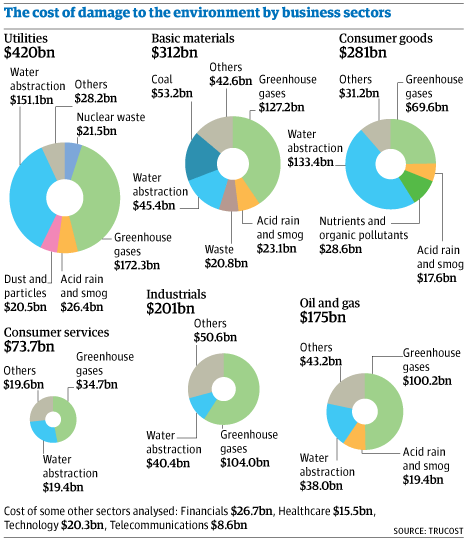
Estimating the Cost of Corporate Pollution
What is the environmental cost of industrial production? According to the Guardian's preview of a major UN Report scheduled to be released this summer, the world's 3000 biggest companies are responsible for $2.2 trillion of environmental damage, a figure equivalent to roughly one-third of their total profits.
According to the Guardian:
The report is based on data from Trucost, the company also responsible for Newsweek's rating of the 'Greenest Big Companies in America'.

According to the Guardian:
The biggest single impact on the $2.2tn estimate, accounting for more than half of the total, was emissions of greenhouse gases blamed for climate change. Other major "costs" were local air pollution such as particulates, and the damage caused by the over-use and pollution of freshwater.
The true figure is likely to be even higher because the $2.2tn does not include damage caused by household and government consumption of goods and services, such as energy used to power appliances or waste; the "social impacts" such as the migration of people driven out of affected areas, or the long-term effects of any damage other than that from climate change. The final report will also include a higher total estimate which includes those long-term effects of problems such as toxic waste.
The report is based on data from Trucost, the company also responsible for Newsweek's rating of the 'Greenest Big Companies in America'.
Saturday, February 20, 2010
Bill Gates on Energy and Climate
I have an odd love-hate relationship with Bill Gates. Like many, I use Microsoft products and have issues with their design and stability. More personally, I grew up in Washington state and experienced the changes -- both positive and negative -- resulting from the growth of Microsoft and the transformation of the Seattle region that accompanied it. But whatever you think of Microsoft, you have to admit Gates has both an unusually analytic mind and an exceedingly well developed ability to understand the big picture. He also puts evidence ahead of ideology and, as a result, his thought tends to evolve in relation to changing circumstances rather than stay fixed. He first used those abilities to identify a series of opportunities in computer technology and rather ruthlessly grow a business.
But, as he has moved into retirement, he has progressively applied those same abilities to a wider context. Thus in the late 1990's, much to the surprise of his Silicon Valley competitors, he argued that what the developing world needed was not computer technology (which they were pushing) but, rather, innovation in the area of health. Thus, he created the Gates Foundation and proceeded to fund innovation in the areas of vaccines and seeds. Now, in this wake of the Copenhagen debacle, Gates has shifted again, arguing that energy and climate are the central problem. His recent TED talk provides an exceptionally clear analysis of the benefits and, in particular, the technical and logistical hurdles associated with a variety of clean energy solutions. Interestingly, he is now seriously supporting development of a relatively unknown form of nuclear power, the traveling wave nuclear reactor (aka TerraPower). And, irrespective of whatever one may think of him, this is an interesting development in that his pedigree as the world's most successful late-20th century capitalist means his statements and views might reach climate skeptics in ways that others can't.
But, as he has moved into retirement, he has progressively applied those same abilities to a wider context. Thus in the late 1990's, much to the surprise of his Silicon Valley competitors, he argued that what the developing world needed was not computer technology (which they were pushing) but, rather, innovation in the area of health. Thus, he created the Gates Foundation and proceeded to fund innovation in the areas of vaccines and seeds. Now, in this wake of the Copenhagen debacle, Gates has shifted again, arguing that energy and climate are the central problem. His recent TED talk provides an exceptionally clear analysis of the benefits and, in particular, the technical and logistical hurdles associated with a variety of clean energy solutions. Interestingly, he is now seriously supporting development of a relatively unknown form of nuclear power, the traveling wave nuclear reactor (aka TerraPower). And, irrespective of whatever one may think of him, this is an interesting development in that his pedigree as the world's most successful late-20th century capitalist means his statements and views might reach climate skeptics in ways that others can't.
Wednesday, February 17, 2010
Food Security: The Challenge of Feeding 9 Billion People

The current issue of Science magazine has a special section on Food Security. The introduction to the section, along with a list of the articles, is available here. One of the most interesting articles, "The Challenge of Feeding 9 Billion People" (Science 12 February 2010: Vol. 327. no. 5967, pp. 812 - 818 DOI: 10.1126/science.1185383) takes an ecological sociology perspective arguing that "the goal is no longer simply to maximize productivity, but to optimize across a far more complex landscape of production, environmental, and social justice outcomes." In other words, the global food security isn't simply a matter of sufficient food, it involves a number of interconnected problems: 1) Matching the rapidly changing demand for food from a larger and more affluent population to its supply, 2) in ways that are environmentally and socially sustainable and 3) ensure that the world’s poorest people are no longer hungry.
Monday, February 15, 2010
Natural Disasters 1980-2009

The above chart is just one part of an interesting backgrounder put together by the United Nations International Strategy for Disaster Reduction Secretariat and available here.
The past decade saw 3,852 disasters globally, killing more than 780,000 people, affecting more than two billion others at a cost of more than 960 billion US$.
While Katrina and other hurricanes in the 2005 season accounted for the single largest economic impact, 85% of all disaster related fatalities over the past decade occurred in Asia.
Saturday, February 13, 2010
Sustainability Books
The University of Cambridge's Programme for Sustainability Leadership recently asked its alumni – "around 2,000 senior leaders from around the world who have participated in its sustainability programmes over the past decade or more" – to list some of their favourite "sustainability" books.
Here, in alphabetical order, are their Favorite 50. There are most of the requisite classics, but stunningly neither Walden (perhaps not as significant to Brits as to those of us on this side of the pond) nor McKibbon's The End of Nature made the list. The list also lacks any representation of resilience theory. What surprises or omissions do you find?
Here, in alphabetical order, are their Favorite 50. There are most of the requisite classics, but stunningly neither Walden (perhaps not as significant to Brits as to those of us on this side of the pond) nor McKibbon's The End of Nature made the list. The list also lacks any representation of resilience theory. What surprises or omissions do you find?
- Banker to the Poor: Micro-Lending and the battle Against World Poverty, by Muhammad Yunus1999
- Biomimicry: Innovation Inspired by Nature, by Janine Benyus, 2003
- Blueprint for a Green Economy: by David Pearce, Anil Markandya and Edward B. Barbier, 1989
- Business as Unusual: My Entrepreneurial Journey, Profits and Principles, by Anita Roddick, 2005
- Cannibals with Forks: The Triple Bottom Line of 21st Century Business, by John Elkington, 1999
- Capitalism as if the World Matters, by Jonathon Porritt, 2005
- Capitalism at the Crossroads: Aligning Business, Earth, and Humanity, by Stuart Hart, 2005
- Changing Course: A Global Business Perspective on Development and the Environment, by Stephan Schmidheiny and WBCSD, 1992
- The Chaos Point: The World at the Crossroads, by Ervin Laszlo, 2006
- The Civil Corporation: The New Economy of Corporate Citizenship, by Simon Zadek, 2001
- Collapse: How Societies Choose to Fail or Survive, by Jared Diamond, 2005
- The Corporation: The Pathological Pursuit of Profit and Power, by Joel Bakan, 2005
- Cradle to Cradle: Remaking the Way We Make Things by William McDonough and Michael Braungart, 2002
- The Dream of Earth, by Thomas Berry, 1990
- Development as Freedom, by Amartya Sen, 2000
- The Ecology of Commerce: A Declaration of Sustainability, by Paul Hawken, 1994
- The Economics of Climate Change: The Stern Review, by Nicholas Stern, 2007
- The End of Poverty: Economic Possibilities for Our Time, by Jeffrey Sachs, 2005.
- Factor Four: Doubling Wealth, Halving Resources Use-A Report to the Club of Rome, by Ernst Von Weizsäcker, 1998
- False Dawn: The Delusions of Global Capitalism, by John Gray, 2002
- Fast Food Nation: The Dark Side on the All-American Meal, by Eric Schlosser, 2005
- A Fate Worse than Debt: The World Financial Crisis and the Poor, by Susan George, 1990
- For The Common Good: Redirecting the Economy toward Community, the Environment and a Sustainable Future, by Herman Daly and John Cobb, 1989
- Fortune at the Bottom of the Pyramid: Eradicating Poverty through Profits, by C.K. Prahalad, 2004
- Gaia: A New Look at Life on Earth, by James Lovelock, 2000
- Globalization and its Discontents, by Joseph Stiglitz, 2002
- Heat: How to Stop the Planet from Burning, by George Monbiot, 2006
- Human-Scale Development: Conception, Application and Further Reflections, by Manfred Max-Neef, 1991
- The Hungry Spirit: Beyond Capitalism: The Quest for Purpose in the Modern World, by Charles Handy, 1999
- An Inconvenient Truth: The Planetary Emergency of Global Warming and What We Can Do About It, by Al Gore, 2006
- The Limits to Growth, by Donella H. Meadows, Dennis L. Meadows and Jorgen Randers, 1972
- Maverick: The Success Story Behind the World's Most Unusual Workplace, by Ricardo Semler, 1993
- The Mystery of Capital: Why Capitalism Triumphs in the West and Fails Everywhere Else, by Hernando De Soto, 2000
- Natural Capitalism: Creating the Next Industrial Revolution, by Paul Hawken, Amory Lovins and L. Hunter Lovins, 2000
- No Logo: No Space, No Choice, No Jobs, by Naomi Klein, 2002
- Open Society: Reforming Global Capitalism, by George Soros, 2000
- Operating Manual for Spaceship Earth, by Buckminster Fuller, 1969
- Our Common Future, by The World Commission on Environment and Development, 1987
- The Population Bomb, by Paul Ehrlich, 1969
- Presence: An Explanation of Profound Change in People, Organizations and Society, by Peter Senge, C. Otto Scharmer, Joseph Jaworski and Betty Sue Flowers, 2005
- The River Runs Black: The Environmental Challenge to China's Future, by Elizabeth C. Economy, 2004
- Sand County Almanac, by Aldo Leopold, 1949
- Silent Spring, by Rachel Carson, 1962
- The Skeptical Environmentalist, by Bjorn Lomborg, 2001
- Small is Beautiful: Economics as if People Mattered, by E.F. Schumacher, 1973
- Staying Alive: Women, Ecology and Development, by Vandana Shiva, 1989
- The Turning Point: Science Society and the Rising Culture, by Fritjof Capra, 1984
- Unsafe At Any Speed: The Designed-in Dangers of the American Automobile, by Ralph Nader, 1965
- When Corporations Rule the World, by David Korten, 2001
- When the Rivers Run Dry: What Happens When Our Water Runs Out? by Fred Pearce, 2006
Thursday, February 11, 2010
China vs. the US Take Two
An article in today's Guardian, based on a leaked internal document from a Chinese government think tank written just after Copenhagen, provides new insight into the Chinese view of the negotiations. And what we see isn't pretty. Among the highlights of the document as reported in the Guardian:
Anyone remotely familiar with Chinese rhetoric (China is great, Tibet is great, China and Tibet together is super great!) recognizes that their statements can't always be taken at face value. But this is an internal document and the Chinese are generally recognized as subtle interpreters of diplomatic process. Thus, it is worrying that they perceive the actions of the SIDS as the product of manipulation rather than what they obviously were -- a last gasp, self interested attempt to prevent their countries from disappearing under a rising sea. This isn't to say that Britain and the US didn't use the SIDS position as a mechanism to put pressure on China, they clearly did. But someone voluntarily changing sides isn't the same as manipulation. All this is further evidence supporting my earlier summary of the real issue that the global community will need to resolve if it expects to get an effective climate change policy.
- "the overall interests of developing countries have been defended" by (China) resisting a rich nation "conspiracy" to abandon the Kyoto protocol, and with it the legal distinction between rich nations that must cut carbon emissions and developing nations for whom action is not compulsory.
- "A conspiracy by developed nations to divide the camp of developing nations [was] a success," it said, citing the Small Island States' demand that the Basic group of nations - Brazil, South Africa, India, China - impose mandatory emission reductions.
- The paper is scathing about the US-led "umbrella group", which it says adopted a position of inaction.
- Canada "was devoted to conniving" to convince the world that its pledge of a 3% emissions reduction between 1990 and 2020 is significant, while having no intention of meeting its Kyoto protocol target of 6%.
- The 'conspiracy to divide developing world' will make future talks harder.
Anyone remotely familiar with Chinese rhetoric (China is great, Tibet is great, China and Tibet together is super great!) recognizes that their statements can't always be taken at face value. But this is an internal document and the Chinese are generally recognized as subtle interpreters of diplomatic process. Thus, it is worrying that they perceive the actions of the SIDS as the product of manipulation rather than what they obviously were -- a last gasp, self interested attempt to prevent their countries from disappearing under a rising sea. This isn't to say that Britain and the US didn't use the SIDS position as a mechanism to put pressure on China, they clearly did. But someone voluntarily changing sides isn't the same as manipulation. All this is further evidence supporting my earlier summary of the real issue that the global community will need to resolve if it expects to get an effective climate change policy.
Subscribe to:
Posts (Atom)