Futurestates is an interesting website. Aimed at provoking thought about the mid-term future (e.g., the next 50 years), the site has 11 fictional mini-feature films exploring potential futures through the lens of contemporary global issues. My favorite -- with the voice of noted film director Werner Herzog -- is the story of a plastic bag (available by link if the player below doesn't work).
Saturday, April 24, 2010


Wednesday, April 14, 2010
GM Foods and Resilience Thinking
The National Academies of Science just released their first systematic assessment of genetically modified crops Impact of Genetically Engineered Crops on Farm Sustainability in the United States. Here is a brief description of the report:
It is interesting that a report which is generally supportive of the productivity gains that GM crops have provided is highly critical of those same crops from an ecological sociology perspective. Specifically, there is a concern with a) the tendency toward homogeneity (i.e., monocrops) and the resulting lack of resilience in the agricultural ecosystems and b) the emergence of glyphosate resistant diseases due to the wide spread use of Round-up (a glyphosate based herbicide) in combination with Monsanto's Round-up ready GM seeds. The latter development leads farmers to use additional, even more toxic chemicals, to kill off the unwanted weeds.
Since genetically engineered (GE) crops were introduced in 1996, their use in the United States has grown rapidly, accounting for 80-90 percent of soybean, corn, and cotton acreage in 2009. To date, crops with traits that provide resistance to some herbicides and to specific insect pests have benefited adopting farmers by reducing crop losses to insect damage, by increasing flexibility in time management, and by facilitating the use of more environmentally friendly pesticides and tillage practices. However, excessive reliance on a single technology combined with a lack of diverse farming practices could undermine the economic and environmental gains from these GE crops. Other challenges could hinder the application of the technology to a broader spectrum of crops and uses.
Several reports from the National Research Council have addressed the effects of GE crops on the environment and on human health. However, The Impact of Genetically Engineered Crops on Farm Sustainability in the United States is the first comprehensive assessment of the environmental, economic, and social impacts of the GE-crop revolution on U.S. farms. It addresses how GE crops have affected U.S. farmers, both adopters and nonadopters of the technology, their incomes, agronomic practices, production decisions, environmental resources, and personal well-being. The book offers several new findings and four recommendations that could be useful to farmers, industry, science organizations, policy makers, and others in government agencies.
It is interesting that a report which is generally supportive of the productivity gains that GM crops have provided is highly critical of those same crops from an ecological sociology perspective. Specifically, there is a concern with a) the tendency toward homogeneity (i.e., monocrops) and the resulting lack of resilience in the agricultural ecosystems and b) the emergence of glyphosate resistant diseases due to the wide spread use of Round-up (a glyphosate based herbicide) in combination with Monsanto's Round-up ready GM seeds. The latter development leads farmers to use additional, even more toxic chemicals, to kill off the unwanted weeds.
Sunday, April 11, 2010
Energy: The Biggest Problem?
 What's the biggest problem facing humanity over the next 50 years? According to Nobel lauriate Richard Smalley, the answer is energy. In an engaging and thought-provoking lecture, Smalley explains that finding sustainable sources of energy for the entire world will not only alleviate a growing energy crisis, but will also assist in the solution to many of the world's other problems, such as water, terrorism, and health.
 In addition to diagnosing the magnitude of the problem, Smalley also presents his vision for our energy future -- the transition to renewable sources of energy by developing cost-effective technologies that capture solar, wind, and geothermal energy. While the talk looses a bit of its perspective at the end as Smalley argues that advances in his area (nanotechnology) are the key to achieving a sustainable energy future, it is interesting to contrast his general emphasis on the need for new energy technologies with the relatively decline in the proportion of R&D funding given to energy (see below).
Monday, April 5, 2010
Hornborg, Part 2: Technomass
This is a continuation from the previous post.

Hornborg treats satellite images like the one above as the visible manifestation of technomass, his term for the infrastructure of industrial technology and its products. As the phrasing suggests, Hornborg is interested in the parallels between technomass and biomass. Thus, technomass refers to the aggregate amount of technological infrastructure, not to individual local elements. Similarly, Hornborg sees local technologies as residing within the equivalent of an ecological niche composed of the features necessary for the effective operation of the technology (raw materials, fuels, labor). When the flows necessary to sustain the technomass stop, the technological infrastructure will disappear.
Hornborg, following world systems theory, is interested in the differences between the light and dark areas, that is the differences between the industrially developed regions of the globe and those less developed. What does the accumulation of technomass mean for the dark areas? Drawing on works like Cronon's Nature's Metropolis (which treats Chicago as linked to the West through a network of resource and commodity flows) and Wilkenson's Poverty and Progress (which argues that British industrial development resulted from exploitation of other areas, notably the shift in cloth production from native wool to US cotton that allowed British land to be liberated for industrial uses and the importation of iron from Sweden), Hornborg argues that the growth of local infrastructure is a result of accumulation.
Imagine that the lights on the satellite image are technomass. For a structure to reproduce itself, it must draw in exergy (potential to conduct work inherent in energy). Here is where Hornborg develops his thermodynamics of imperialism. According to the first law of thermodynamics energy can't be created or destroyed and, as a result, it is erroneous to speak of the consumption of energy. What gets consumed is exergy -- the quality in the energy that allows work to be done -- not the energy itself; energy is still there going out as heat into space, etc. Complex systems of any type, whether it be the human body or industrial technology, persist by inputting high quality energy into the system relative to the quality of energy outputted. Humans, for example, eat high quality molecules and dissipate low quality energy (heat). It is the constant input of high quality energy into the system that allows local complexity to survive in the face of entropy. But, as empirical studies such as those of Cronon and Wilkinson show, it is the net transfer of both energy and matter to the center from the periphery that allows industrial infrastructure to persist. It is the manner in which the inherent inequality of this physical process leads to social inequalities that leads Hornborg to label it the 'thermodynamics of imperialism.'

Hornborg treats satellite images like the one above as the visible manifestation of technomass, his term for the infrastructure of industrial technology and its products. As the phrasing suggests, Hornborg is interested in the parallels between technomass and biomass. Thus, technomass refers to the aggregate amount of technological infrastructure, not to individual local elements. Similarly, Hornborg sees local technologies as residing within the equivalent of an ecological niche composed of the features necessary for the effective operation of the technology (raw materials, fuels, labor). When the flows necessary to sustain the technomass stop, the technological infrastructure will disappear.
Hornborg, following world systems theory, is interested in the differences between the light and dark areas, that is the differences between the industrially developed regions of the globe and those less developed. What does the accumulation of technomass mean for the dark areas? Drawing on works like Cronon's Nature's Metropolis (which treats Chicago as linked to the West through a network of resource and commodity flows) and Wilkenson's Poverty and Progress (which argues that British industrial development resulted from exploitation of other areas, notably the shift in cloth production from native wool to US cotton that allowed British land to be liberated for industrial uses and the importation of iron from Sweden), Hornborg argues that the growth of local infrastructure is a result of accumulation.
Imagine that the lights on the satellite image are technomass. For a structure to reproduce itself, it must draw in exergy (potential to conduct work inherent in energy). Here is where Hornborg develops his thermodynamics of imperialism. According to the first law of thermodynamics energy can't be created or destroyed and, as a result, it is erroneous to speak of the consumption of energy. What gets consumed is exergy -- the quality in the energy that allows work to be done -- not the energy itself; energy is still there going out as heat into space, etc. Complex systems of any type, whether it be the human body or industrial technology, persist by inputting high quality energy into the system relative to the quality of energy outputted. Humans, for example, eat high quality molecules and dissipate low quality energy (heat). It is the constant input of high quality energy into the system that allows local complexity to survive in the face of entropy. But, as empirical studies such as those of Cronon and Wilkinson show, it is the net transfer of both energy and matter to the center from the periphery that allows industrial infrastructure to persist. It is the manner in which the inherent inequality of this physical process leads to social inequalities that leads Hornborg to label it the 'thermodynamics of imperialism.'
Sunday, April 4, 2010
Ecological World Systems: Hornborg, Part 1
This is the first in what I expect to be a series of posts dealing with one particular approach to ecological sociology -- the fusion of ecological concerns onto world-system theory. Broadly speaking, the work in this area falls into two categories: a) writings by key figures in the world-system tradition with an interest in incorporating environmental/ecological concerns into their analysis and b) writings by individuals who have set as their task the development of a synthetic framework integrating the two perspectives. I'll be focusing on the second category of writings.
 We begin with the work of Swedish anthropologist Alf Hornborg and, in particular, the arguments in his book The power of the machine : global inequalities of economy, technology, and environment. From world-systems theory Hornborg takes the conclusion that global society manifests aspects of a zero-sum game, i.e. that the gains of one region come at the expense of another. It is this idea that Hornborg sees as the fundamental factor underpinning the creation of world-systemic structures based around developed cores and less developed peripheries -- that the development of the core is built in part on the exploitation of the periphery.
But how do you measure exploitation? Traditional economics argues that exchanges between the core and the periphery are accurately measured by market prices and, hence, there is no exploitation; the core country pays $100 to the periphery country for each $100 worth of raw material it receives. Traditional world-systems theory builds on Marxist economic principals to argue that market prices aren't an accurate representation of the exchange and to show how such exchanges are economically unequal. Hornborg notes, correctly, that economics as a discipline finds the Marxist accounts wanting. Thus, he wants to develop an alternative metric for measuring the exchanges. It is here that Hornborg turns to ecology and, in specific, the implications of the second law of thermodynamics to propose a thermodynamics of imperialism, i.e. an ecology of unequal exchange.
Central to his argument is the concept of "technomass" which I'll take up in a future post.
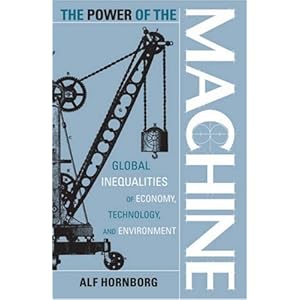 We begin with the work of Swedish anthropologist Alf Hornborg and, in particular, the arguments in his book The power of the machine : global inequalities of economy, technology, and environment. From world-systems theory Hornborg takes the conclusion that global society manifests aspects of a zero-sum game, i.e. that the gains of one region come at the expense of another. It is this idea that Hornborg sees as the fundamental factor underpinning the creation of world-systemic structures based around developed cores and less developed peripheries -- that the development of the core is built in part on the exploitation of the periphery.
 But how do you measure exploitation? Traditional economics argues that exchanges between the core and the periphery are accurately measured by market prices and, hence, there is no exploitation; the core country pays $100 to the periphery country for each $100 worth of raw material it receives. Traditional world-systems theory builds on Marxist economic principals to argue that market prices aren't an accurate representation of the exchange and to show how such exchanges are economically unequal. Hornborg notes, correctly, that economics as a discipline finds the Marxist accounts wanting. Thus, he wants to develop an alternative metric for measuring the exchanges. It is here that Hornborg turns to ecology and, in specific, the implications of the second law of thermodynamics to propose a thermodynamics of imperialism, i.e. an ecology of unequal exchange.
Central to his argument is the concept of "technomass" which I'll take up in a future post.
Monday, March 29, 2010
From Consumerism to Sustainability or The Story of Stuff
The Worldwatch Institute has issued their 2010 State of the World Report, Transforming Cultures: From Consumerism to Sustainability, a bold attempt to identify and address the range of issues surrounding large scale cultural transformation. A Table of Contents for the book, with links to selected chapters, is available online.
A podcast of Erik Assadourian, Senior Researcher at Worldwatch Institute and Director State of the World 2010, speaking with Diane Horn about report is available here.
Highlignts among the online chapters are The Rise and Fall of Consumer Cultures, a discussion of Engaging Religion to Shape Worldviews, a look at education's role in supporting sustainability by Rethinking School Food, and a look at how social marketing can be used to shift the media From Selling Soap to Selling Sustainability.
An interesting example of the latter is found in The Story of Stuff.
A podcast of Erik Assadourian, Senior Researcher at Worldwatch Institute and Director State of the World 2010, speaking with Diane Horn about report is available here.
Highlignts among the online chapters are The Rise and Fall of Consumer Cultures, a discussion of Engaging Religion to Shape Worldviews, a look at education's role in supporting sustainability by Rethinking School Food, and a look at how social marketing can be used to shift the media From Selling Soap to Selling Sustainability.
An interesting example of the latter is found in The Story of Stuff.
Sunday, March 28, 2010
Local systems
Decentralization is a major idea in lots of environmental thought. It can be traced back at least to 1973 and Schumacher's classic work Small Is Beautiful: Economics As If People Mattered. But, as local food producers are discovering, it isn't sufficient to localize one element of the system, you have to decentralize the whole system. The NYTimes has an interesting article illustrating the problem: small farmers are cutting back on the production of locally raised meat because they are unable to access slaughterhouses.
Tuesday, March 23, 2010
Will the Real #1 Driver of Climate Change Please Stand Up?
.jpg)
As I study energy and climate, statistics fly at me from every direction and it gets really hard to sort things out. Everything, it seems, is "the largest single producer of carbon emissions" and there is no way to sort out which really is the largest.
NASA recently conducted a study of all the major sources of greenhouse gas emissions and their net effects on climate change.
Clearly, electric power production is the largest single source of C02, but it is offset by aerosol-cloud effects and sulfates that actually cause global cooling, thus the net global warming effect of electricity production is about the same as the Industry sector.
Likewise, the road transportation sector produces less C02 than the Industry and power sectors, but road transportation does not have the aerosol offsets that would reduce it's impact on global warming. Thus, while the road transportation sector produces less C02, it actually contributes more to global warming than Industry and Power—today.
.jpg)
However, if you look at the title of the article, it says "Road Transportation Emerges as Key Driver of Warming." While is this is true in a qualified sense (it is "a" key driver), that statement doesn't make as much sense when you look at the first graph. Electric power production produces the most C02, and in fact, the NASA data shows that in the future, assuming BAU, electric power production will continue to be the largest driver of global warming, with road transportation second. As we build cleaner power plants that produce fewer aerosols, the warming effect of power production will increase dramatically. Road Transportation as "the" key driver only appears when you look at the second graph, which is an estimate of emissions for 2020.
What the article doesn't consider is the behavioral effects of car use. Driving increases casual consumption exponentially. The reason why we shop more, eat out at restaurants more, live, work and play at greater distances, is because of the power and convenience of the automobile to get us to every destination cheaply and efficiently. Cars exponentially increase the speed and amount that we are able to consume. This increased consumption creates a demand for more products and services, which in turn creates a demand for more electric energy production and more industrial production, which also leads to an increase in road transportation. So in that sense, road transportation is indeed a KEY driver in global warming. Ecologists call this effect a "positive feedback loop."
Monday, March 22, 2010
Book: Origins of Globalization
 Karl Moore (faculty of management at McGill University in Montreal) and David Lewis (faculty of history at California State University, Long Beach) recently published, The Origins of Globalization. In it they combine archeology, history, religion and economics with the theory and practice of the modern multinational corporation in order to argue advance the claim that:
 quite a few of today's business forms and business cultures existed in ancient times. Globalization, multinational enterprises, commercial partnerships, foreign joint ventures, and embryonic forms of mass production all had their precursors or prototypes in the very remote past.My reaction to the content is quite schizophrenic. On the one hand, the book brings together a wealth of information on business practices in the ancient world (i.e., the 3000 years before Christ). Here, as summarized by a review in the Globe and Mail, is the book's discussion of the collapse of Ur:
By 2000 BC, the Mesopotamian city of Ur (referenced in the Old Testament as Ur of the Chaldees) was the largest city-state in the world (population: 65,000), a metropolis of extraordinary prosperity in the fertile land between the Tigris and the Euphrates rivers in modern-day Syria and Iraq.
As it happened, the most ancient of crashes followed the collapse of the world’s first mutual fund, a distinctly capitalistic financial innovation that had enabled ordinary people (among them, shopkeepers, farmers and labourers) to invest in enterprises previously limited to the rich and the powerful. In this historic meltdown, the investment that went wrong was in copper. For the first time, investors in a publicly traded pool had experienced the excessive optimism that former Federal Reserve chairman Alan Greenspan would famously describe as “irrational exuberance.”
Share prices soared. Investors spent anticipated profits before they earned them. Ur never recovered from the credit freeze that followed the calamity of history’s first public offering.
This is just one of many fascinating stories in the book. More importantly, at least from the perspective of ecological sociology, the book calls "for today's globalizers to 'make the world safe for diversity.'" In other words, it argues against an interpretation of globalization as homogenization. There are obvious parallels between this position and the biologist's claim that complex and diverse ecosystems are more resilient than simple, homogeneous ones.
On the down side, the book interprets ancient economic practice in terms of modern management theory, specifically the Dunning's eclectic paradigm. As such, it suffers from a serious case of presentism -- that is interpreting the past in terms of concepts from the present. For example, it is impossible to have 'multinational corporations' without having nations. But, as conventionally understood by historians, nations didn't exist until the 17th century. Thus, it is hard to understand how multinational corporations in anything approaching the modern sense existed in ancient times. While full of wonderful stories and significant insights, the books larger argument suffers from an inattention to historical perspective. Moore and Lewis take an objectivist position, claiming they can identify the similarity between various economic actions based on the characteristics of the action itself. This is the equivalent of saying Priestley discovered oxygen, because that is what we call the substance he isolated. But, neither Priestly nor historians of science make that claim. They know he discovered pholgiston. Ever since Weber, sociologists have recognized it is not just the action/object itself, it is the conceptual understanding and meaning given to the action/object by the actor that is important. In short, while Moore and Lewis do an excellent job of opening our eyes to the diversity of economic activity in the ancient world, the attempt to draw explicit parallels between past and present economic behaviours seriously misrepresents things.
Tuesday, March 16, 2010
Richard Heinberg of the Post Carbon Institute interviewed Lester Brown on his latest version of "Plan B: 4.0". Lester confirmed in his interview what Johann Hari said in Democracy Now: that local, grassroots environmental campaigns have successfully stopped the development of new coal-fired power plants in the US, just as Climate Camp did in the UK. Furthermore, he said that older plants are being converted to cleaner fuels or shut down because of direct action and public pressure. Interestingly, Lester said that in 2009, more money was invested globally in renewable energy sources such as wind, solar and geothermal than was invested in fossil fuel production, a first in modern history.
Subscribe to:
Posts (Atom)