Saturday, April 9, 2011

Frontier Earth on Climate Central


Keith Kloor (from Collide-a-Scape) has a new blog, Frontier Earth over at Climate Central, that discusses topics of relevance to resilience science and sustainability. He reads widely and does an excellent job of keeping abreast of emerging discursive trends that affect the policy debate. See, for example, the entry Security Concerns get Top Billing in Climate and Energy Debates or the one dealing with momentum shifts on climate adaptation.

He also has the wisdom to list us in his Blogroll! Thanks, Keith!

Friday, April 8, 2011

Caution: Koch Brothers at Work

About a year ago, Greenpeace released a report, Koch Industries Secretly Funding the Climate Denial Machine. The main point of the report was to draw attention to the role of the secretive brothers in funding climate denial and, in particular, to highlight the scale of their activity relative to the much better known activities of Exxon Mobile.
Although Koch intentionally stays out of the public eye, it is now playing a quiet but dominant role in a high-profile national policy debate on global warming. Koch Industries has become a financial kingpin of climate science denial and clean energy opposition. This private, out-of-sight corporation is now a partner to Exxon Mobil, the American Petroleum Institute and other donors that support organizations and front-groups opposing progressive clean energy and climate policy. In fact, Koch has out-spent Exxon Mobil in funding these groups in recent years. From 2005 to 2008, Exxon Mobil spent $8.9 million while the Koch Industries-controlled foundations contributed $24.9 million in funding to organizations of the climate denial machine.

While the Greenpeace report focuses entirely on the Koch Brothers activities as they relate to climate change, this is only the tip of the iceberg. A couple days ago, The Center for American Progress released The Koch Brothers: What You Need to Know About the Financiers of the Radical Right. This report documents, in considerable detail, the role of the brothers in a wide range of national policy debates. Here are some of the highlights from the report:

The Koch brothers, whose wealth, when combined, is the fourth highest in the nation, run one of the largest private companies in the country. Koch Industries is involved in industries ranging from oil and gas, refining and chemicals, minerals, fertilizers, forestry, consumer products, polymers and fibers, and ranching. They have operations in 45 states.

The Koch brothers use their considerable wealth to bankroll the right wing, including the Tea Party. This serves the purpose of furthering not only their right-wing ideology but also their bottom line. Koch Industries has a lot to gain from gutting government oversight and electing candidates who oppose government regulation, especially in the oil-and-gas industry.

Chances are the Koch brothers are part of any recent right-wing attack as of late as they have fought health reform, Wall Street reform, collective bargaining rights, and efforts to curb climate change, to name just a few.

We have identified at least $85 million the Koch brothers have given to at least 85 right-wing think tanks and advocacy groups over the past decade and a half.


Their main advocacy group, Americans for Prosperity, has chapters in 32 states and spent $45 million in the last election, predominantly to help elect Republicans.

The Kochs donated directly to 62 of the 87 members of the House GOP freshman class.

The Koch brothers are active at the state level, spending $5.2 million on candidates and ballot measures in 34 states since 2003. They donated directly to 13 governors that won election last year.

The Kochs are not going away. In fact, they have already pledged to raise $88 million for the 2012 election and have started scheduling events for potential Republican presidential candidates.

Wednesday, April 6, 2011

Post-Disaster Resilience

By coincidence, I arrived for a month long stay in Thailand just two days after the 2004 tsunami. Within days there were discussions of rebuilding -- most interestingly of rebuilding large scale tourist infrastructure in locations where previous development had been held in check by local opposition. It was clear that the plans had long been in place and the developers recognized that the disaster provided a window of opportunity for them to advance their agenda. I was observing one small example of the larger phenomena that Naomi Klein described in her book The Shock Doctrine: The Rise of Disaster Capitalism.

In light of all the emphasis on top-down reorganization brought about by such events, it is interesting to see examples like Climate-related disaster opens a window of opportunity for rural poor in northeastern Honduras which examine more emergent, bottom-up responses to disaster. Here is the abstract:

Two distinct views are evident in research on how rural communities in developing countries cope with extreme weather events brought by climate change: (i) that the resource-reliant poor are acutely vulnerable and need external assistance to prepare for such events, and (ii) that climate-related shocks can offer windows of opportunity in which latent local adaptive capacities are triggered, leading to systemic improvement. Results from a longitudinal study in a Tawahka community in Honduras before and after Hurricane Mitch (1994–2002) indicate that residents were highly vulnerable to the hurricane—due in part to previous development assistance—and that the poorest households were the hardest hit. Surprisingly, however, the disaster enabled the poor to initiate an institutional change that led to more equitable land distribution, slowed primary forest conversion, and positioned the community well to cope with comparable flooding occurring 10 y later. The study provides compelling evidence that communities can seize on the window of opportunity created by climate-induced shocks to generate sustained social-ecological improvement, and suggests that future interventions should foster local capacities for endogenous institutional change to enhance community resilience to climate shocks.

Sunday, April 3, 2011

Greenhouse gas emissions: You say tomayto, I say tomaato

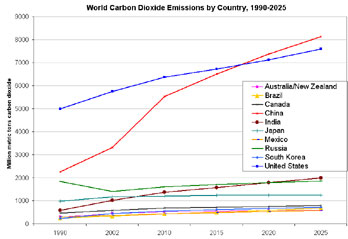
There are a variety of different ways of talking about greenhouse gas emissions. Each makes sense within its own context, but unlike different pronunciations, you need to take them all into account to make sense of the situation. It isn't a simple matter of choice.

One way, as in the chart to the left looks at total emissions by country. Given the current political arrangements of the planet -- where policy implementation is made at the level of the nation-state, this view gives a sense of the overall 'contribution' of each country to the problem. This view has the practical benefit of pointing out that the two countries most responsible for the increasing level of emissions (the US and China) are also the main players currently outside the Kyoto process. And, as discussed in some earlier posts, the ones most at odds with each other over the next step; the development of a policy framework to replace Kyoto.


To view this graph, please install Adobe Flash Player.


Another way of viewing emissions, as shown above, is on a per capita (per person) basis. Viewed in this light, we see that China's contribution remains comparatively small -- the total contribution is large because of the massive population of the country, the average contribution per person remains substantially less than in the developed world. While a bit dated (the information only goes up to 2004) the above chart is dynamically connected to a data set that allows you to play around and look at it in different ways. Try it out!

For more on carbon emissions by person, see this article.

Thursday, March 31, 2011

HSBC: Less than 50 Years of OIl Left

Karen Ward, Senior Global Economist for HSBC, announced an HSBC report claiming that there is less than 50 years of conventional oil left in the world. Fifty years of oil left at the current rates of consumption. The enormous growth of automobile use in China, India and other developing countries, estimated to be over one billion new cars, will put severe strains on those declining supplies.

http://green.blogs.nytimes.com/2011/03/30/less-than-50-years-of-oil-left-hsbc-warns/

What I find baffling is that this story is posted in the "Environment" section of the New York Times when it is clearly an economic story of a report released by the second-largest commercial bank in the world.

Sunday, March 27, 2011

Physicist Richard Muller on Climate Change

Richard Muller, Prof. of Physics at UC Berkeley, who teaches the famous “Physics for Future Presidents,” is leading an independent group of researchers at Berkeley, the Berkeley Earth Surface Temperature Study, to review and analyze climate change data. How “independent” is questionable, considering his group is receiving funding from the Charles G. Koch Foundation. His group is analyzing global temperature data and will present its findings at the end of this year. The group is computing all global temperature data, not a subset, and will make this data available on the web for anyone to view and analyze.


Muller contends that IPCC global temperature data is generally reliable, and its overall conclusions are correct: the average global temperature is rising and a continued rising temperature could have devastating consequences for human life. He states that the global average temperature increased 2 degrees Celsius since the mid 1800s, and has increased an additional 1 degree Celsius since 1957; furthermore, the one degree rise since 1957 is caused in part by human activity.


Mulller contends that many of the assertions in the 2007 IPCC report on climate change is anecdotal or conjecture—except for the temperature data. He claims that the only reliable indicator of global warming is global temperature data. The data and conclusions that are questionable are claims that there has been an increase in glacial melt (such as the Himalayan glaciers), Arctic and Antarctic polar melt, melt of permafrost in Alaska, forest fires, hurricanes (both frequency and severity), and tornadoes. He asserts these are not reliable indicators of global warming. Muller does not mention anything about increased rainfall or extreme rain events. However, more significantly, he argues that increased warming has caused increased evaporation of moisture from the earth’s surface and increased vapour in the atmosphere, which may—or may not—cause increased cloud cover. The greatest uncertainty with regard to predicting climate change is that it cannot be determined as yet whether global warming caused by increased C02 will or will not cause increased cloud cover. Muller asserts that if in fact cloud cover is increased by 2 percent, there will be no global warming, and he says that the IPCC report also states that.


Muller’s presentation shows that all the growth in emissions from this point on will be generated by developing nations, particularly China and India, and primarily because of coal-burning power plants. He states without reservation that if developing nations are allowed to continue their current rate of growth of carbon emissions that global warming will happen and that the effects will be disastrous.


Muller states that the IPCC Report and other climate change studies “cherry pick” the data they want to present and suppress other data. However, if you watch the video to the end of the question period, you will hear Muller admit that he failed to present graphs showing that carbon dioxide in the atmosphere has increased 36% and that the increase is “due to humans.”


Most tellingly, he states that climate change remedies must be “profitable to be sustainable.” He avoids the challenge by an audience member to define what “profitable” is or why climate measures must be profitable. He fails to qualify that “profitability” is a political objective, not an objective of scientific research.


Despite my reservations about Muller's nod to capitalism (profitability) and funding by the Koch Foundation, I believe that Muller's critique of climate change science is a valuable perspective. Furthermore, the Berkeley Earth Surface Temperature Study's analysis of global temperature data could be an important contribution to the science.

When did the Anthropocene begin?


Humans have a long history, going back well before the beginning of agriculture, of making substantial modification to the planet. The standard view, however, has been that such changes were comparatively modest in scale, affecting regions at most and not having planetary consequences significant enough to modify the operation of the global system. Global scale consequences, those tied to the emergence of conjoined social-ecological systems and significant enough to indicate the dawning of a new geological era (the Anthropocene) have been viewed as comparatively recent -- as a product of the industrial revolution.

The March 25 issue of Nature News, however, reports in The 8000 Year Old Climate Puzzle:
Scientists have come up with new evidence in support of the controversial idea that humanity's influence on climate began not during the industrial revolution, but thousands of years ago. Proposed by palaeoclimatologist William Ruddiman in 2003, the theory says that human influences offset the imminent plunge into another ice age and helped create the relatively stable climate that we are familiar with today. It has been repeatedly panned as implausible by palaeoclimate researchers, but eight years on, Ruddiman and others say that they have the data to support early anthropogenic climate change.


The argument centres on a curious trend in atmospheric carbon dioxide and methane levels since the last ice age ended about 11,000 years ago and the current Holocene epoch began. In previous interglacial periods, CO2 levels spiked early and then gradually declined until the globe went into another ice age. The Holocene began by following this trend, but then CO2 levels changed course and began to rise around 8,000 years ago. The same thing happened with methane levels around 5,000 years ago. These trends align with the expansion of human agriculture, and Ruddiman, of the University of Virginia in Charlottesville, argues that it is no coincidence — the clearing of land and expansion of irrigation released huge amounts of greenhouse gases into the atmosphere.

Critics say that human populations were probably too small to support such a hypothesis, and recent studies have raised serious questions about early anthropogenic carbon and methane emissions.

The article goes on to discuss preliminary findings from several studies and to note that supporting evidence is scheduled for publication in a special issue of The Holocene later this year.

For a popular treatments of the Anthropocene, see National Geographic's Enter the Anthropocene: The Age of Man and the Walrus's Age of Breathing Underwater.

Wednesday, March 23, 2011

Yann Arthus-Bertrand

Yann Arthus-Bertrand is the French (and, perhaps, more populist) version of Canada's Edward Burtynsky -- a photographer who uses the camera to describe the impact of humans on the planet.

In contrast to Burtynsky, who uses the monumental size of his photographic prints to memorialize the scale of human impact, Arthus-Bertrand is best known for his book and the associated UNESCO sponsored traveling exhibition, The Earth from Above.

Taken from the air, Arthus-Bertrand's images tend to be more abstracted and more traditionally beautiful than Burtynsky's. His aim appears to be to show the beauty of the planet, and thereby to promote love for it where Burtynsky tends to focus, albeit in ways that are visually stunning, on the impact of humans more than the beauty of the planet. Indeed, much of the environmental punch of both the Arthus-Bertrand's book and the exhibition come from the substantial amount of associated text that accompanies each image rather than the image itself. Arthus-Bertrand now has a film, Home, with much the feel of an IMAX film depicting the earth from above and available here on YouTube.

The Guardian recently posted an interesting article about him, Yann Arthus-Bertrand: Looking down on creation.

Sunday, March 20, 2011

James Gleick's The Information

James Gleick, best known as the author who spelled out the details of chaos theory in Chaos, has a new book exploring the implications of another area of mathematics -- information theory: The Information: A History, a Theory, a Flood.

A substantial excerpt from Chapter 11, Into the Meme Pool (You Parasitize My Brain), covering the nature and spread of ideas and the parallels between genes and memes as carriers of information is available online.

Freeman Dyson has a written a nice review as has Geoffrey Nunberg.

Tuesday, March 8, 2011

A new trend in environmental reporting?

There is little doubt that environmental issues have become more politicized over the past few years. Take climate change as an example. Faced with the claim that there is scientific consensus about climate change, deniers have responded by attacking science -- effectively making climate science the issue in the Climategate matter. While numerous investigations have largely cleared the scientists of any wrongdoing, the scientific community has been ineffective in communicating that point, and, as a result, the longstanding divisions between the scientific community and the public on matters of science have gotten worse.

Now, if the articles described below are any indication, the politicization of environmental matters has taken a new twist. Call it "everything good is bad for you reporting." This is reporting that takes conventional wisdom about environmental matters -- energy efficiency is good, recycling is good -- and turns it on its head by drawing attention to unexpected and unintended consequences. Here are two examples.

1) Over at the BBC, Nick Higham reports Recycled Cardboard poses a Risk

2) John Tierney reports on When Energy Efficiency Sullies the Environment

I'm not being a pollyanna here. I have no doubt that the problems the articles identify are real. We live in a complex world and should expect the unexpected. But I'm not sure these same matters would have been reported in this way a few years ago. So, how does one explain it? On the one hand, it could just be a random occurrence that several articles of this type appeared at the same time. But my sense is that the appearance of multiple articles of this type at this time more likely indicates a change in attitudes and, in particular, a shift in the type of findings that science journalists attend to.