Wednesday, July 20, 2011
Global Heating or What's in a Name?
The diagram/term have two big benefits. First, it dramatically emphasizes the importance of the ocean as repositories of heat energy relative to the land and atmosphere. Second, it focuses attention on changes to the system -- accumulation of heat energy -- rather than attempting to describe the consequences of that change.
Tuesday, July 19, 2011
Review: Dynamics of Disaster
Edited by Rachel A. Dowty and Barbara L. Allen
London: Earthscan
2011, 240 pages
ISBN: 9781849711432
Here's a briefly annotated Table of Contents followed by a review of the volume as a whole.
Sunday, July 17, 2011
When The Water Ends: Africa’s Climate Conflicts
Here's a description of the video's content.
For thousands of years, nomadic herdsmen have roamed the harsh, semi-arid lowlands that stretch across 80 percent of Kenya and 60 percent of Ethiopia. Descendants of the oldest tribal societies in the world, they survive thanks to the animals they raise and the crops they grow, their travels determined by the search for water and grazing lands.
These herdsmen have long been accustomed to adapting to a changing environment. But in recent years, they have faced challenges unlike any in living memory: As temperatures in the region have risen and water supplies have dwindled, the pastoralists have had to range more widely in search of suitable water and land. That search has brought tribal groups in Ethiopia and Kenya in increasing conflict, as pastoral communities kill each other over water and grass.
“When the Water Ends” tells the story of this conflict and of the increasingly dire drought conditions facing parts of East Africa. — how worsening drought in parts of Africa, the Middle East, and elsewhere will pit group against group, nation against nation. As one UN official told Abramson, the clashes between Kenyan and Ethiopian pastoralists represent “some of the world’s first climate-change conflicts.” But the story recounted in “When the Water Ends” is not only about climate change. It’s also about how deforestation and land degradation — due in large part to population pressures — are exacting a toll on impoverished farmers and nomads as the earth grows ever more barren.
Friday, July 15, 2011
Talisman Terry bites the dust
This past Monday (July 11), the Colbert Report poked fun at Terry. By Thursday, as reported in the Calgary Herald, he was history. Talisman Energy, as shown in the screen capture below, has done its best to erase Terry's digital presence.If you're so inclined, you can check out the colouring book's contents here.
Defining Uncertainty, Difficulty, and Complexity
My point is that uncertainty differs from difficulty and complexity and that they too matter. ... (U)ncertainty refers to the absence of information about some relevant variable or what some call the state of the world – tomorrow’s weather, to give one example, is uncertain. Difficulty refers to problems that have many interacting variables. Developing a workable form of fusion is difficult as is designing an office building or writing a piece of legislation. Difficult problems have many possible solutions and no obvious best one a priori. When faced with a difficult problem, most problem solvers prove incapable of finding the optimum. They must rely on perspectives and heuristics (Page, 2007). Complexity in turn differs from difficulty. Complexity refers to dynamic environments that contain multiple actors who interact with one another. The response to a natural disaster like a hurricane creates a complex web of interactions whose outcomes are unpredictable. Complex environments cannot be solved in any sense. At best, the complexity can be harnessed (Axelrod and Cohen, 2000).
The relevance of the definitions is outlined in the abstract below:
In this article I clarify the often muddled distinctions between uncertainty, difficulty, and complexity and show that all three can enhance our understanding of institutional performance and design. To cope with uncertainty, institutions align incentives for information revelation; to handle difficult problems, institutions create incentives for diverse problem-solving approaches; and to harness complexity, institutions adjust selection criteria, rates of variation, and the level of connectedness. The distinction between complex systems and equilibrium systems also necessitates a discussion of the differences between the existence, stability, and attainment of equilibria and why, despite often being neglected, the latter two concepts are important to our understanding of institutions.
Thursday, July 14, 2011
Barbara Ehrenreich: Smile or Die
Wednesday, July 13, 2011
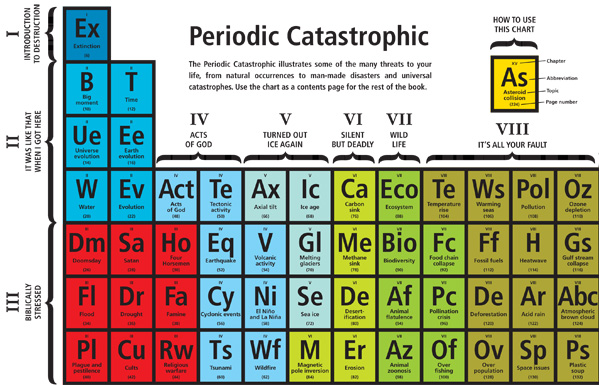
A Is for Armageddon
As they put it over at BrainPickings,
From religious warfare to grey goo to deforestation, Horne combines science, superstition and sociology in a beautifully illustrated, delightfully dystopian guide to the apocalypse. Underlying the wickedly entertaining tone, however, is a grounded, non-preachy crusade for awareness that exudes the call of urgency none of us want to hear but all of us must.
Opening with a Table of Contents that riffs on the periodic table of the elements, this is a book that make you laugh while it educates. Lots of photos follow. Click on them to get to the full size versions where you can read the text. If you haven't had enough, be sure to check out Slavoj Žižek’s Four Horsemen of the Apocalypse in One Minute (the Elvis of Cultural Theory only comes up with four impending catastrophes!) and, for an antidote, An Optimist's Tour of the Future.
Tuesday, July 12, 2011
Parenti on Climate Change and War: Threat Multipliers
"The Pentagon, particularly around 2007, was putting out these reports and think tanks around them, realizing they were going to be called upon to respond to this problem. To their credit the armed services take climate change seriously, which is more than you can say for, say the GOP leadership in the House. And what they see again and again is not so much a future of interstate conflict, but of irregular warfare within states, social breakdown, increased banditry, mass migration. They realize they’re going to be called upon to respond to these low intensity conflicts and these civil wars, so front and center in their program of response is counterinsurgency.
This goes by different names — small wars, low-intensity conflict, counter insurgency. This is as part of the War on Terror become very important to U.S. foreign policy and I’m critical of that one, because I don’t think it will work. I don’t think it’s moral. But also, counterinsurgency, if you look at its record, what it does to societies is very damaging. Because the object is the population rather than territory, it leaves societies fragmented and vulnerable."
These themes echo the historical study of collapse that I have been reading in Joseph Tainter's The Collapse of Complex Civilizations.
Monday, July 11, 2011
Emergence: Spontaneous Order Theory
1) The online journal Studies in Emergent Order
2) A couple of papers in the journal that look particularly interesting:
“Conflicts and Contradictions in Invisible Hand Phenomena”
This paper makes three interconnected arguments.
- Building off my other writings, in a world where there are many non-teleological complex adaptive systems exist, no automatic harmony exists between their different coordinating processes. This paper will focus on four of these systems: the ecological system at the landscape level, and three cultural systems, the market, science, and democracy.
- Organizations originating within one such system but operating within more than one, will ultimately be dependent on one set of feedback signals over the others. When conflict between sets of signals arises, such organizations will disrupt, undermine, or destroy the other ordering processes.
- Therefore a system of Hayekian spontaneous orders such as the market, democracy, and science, is not and cannot be sustainable based solely on their own internal characteristics because conflict between them is an intrinsic feature of social life. The same hold for any of these systems and an ecosystem. They need to be viewed within a larger context.
In this paper I contrast Hayek’s and Luhmann’s treatment of law as a complex social system. Through a detailed examination of Hayek’s account of law, I criticize the explanatory power of his central distinction between spontaneous order and organization. Furthermore, I conclude that its application to law leads to different results from the ones derived by Hayek. The central failure of Hayek’s failure, however, lies in his identification of complex systems with systems of liberal content maximizing individual freedom. Indeed, in this way, he can only account for systems-individuals and not systems-systems interactions. I introduce Luhmann’s theory of autopoietic systems, which I submit, can solve all the mentioned problems and seems a much more promising conceptual architecture to grasp social systems in the context of a complex society.
3) An annotated bibliography of works on self organizing systems
4) An article tracing the intellectual history of the tradition: From Smith to Menger to Hayek: Liberalism in the Spontaneous-Order Tradition
Friday, July 8, 2011
Climate Change Culture Wars?
The conventional explanation for controversy over climate change emphasizes impediments to public understanding: limited popular knowledge of science, the inability of ordinary citizens to assess technical information, and the resulting widespread use of unreliable cognitive heuristics to assess risk. A large survey of U.S. adults (N = 1540) found little support for this account. On the whole, the most scientifically literate and numerate subjects were slightly less likely, not more, to see climate change as a serious threat than the least scientifically literate and numerate ones. More importantly, greater scientific literacy and numeracy were associated with greater cultural polarization: respondents predisposed by their values to dismiss climate change evidence became more dismissive, and those predisposed by their values to credit such evidence more concerned, as science literacy and numeracy increased. We suggest that this evidence reflects a conflict between two levels of rationality: the individual level, which is characterized by the citizens’ effective use of their knowledge and reasoning capacities to form risk perceptions that express their cultural commitments; and the collective level, which is characterized by citizens’ failure to converge on the best available scientific evidence on how to promote their common welfare. Dispelling this “tragedy of the risk-perception commons,” we argue, should be understood as the central aim of the science of science communication.
Having read through the article, I find myself in a love-hate relationship with it. On the one hand, the study gets the big picture right. The empirical evidence that increased scientific literacy and numeracy leads to increased polarization over the reality of global warming rather than increased consensus, it is a devastating critique of the deficit model. Moreover, I agree with their emphasis on the importance of values.
But the paper goes seriously off track in its understanding of the dynamics of public opinion. At the individual level, the paper treats each individual as a little philosopher, rationally organizing their world into a coherent scheme. This is the same basic presumption that animates the deficit model. Except the proponents of the deficit model presume the existence of a universal rationality (science), leading to the presumption that greater scientific literacy will result in enlightenment. In place of a universal rationality, Kahan and his co-authors have substituted culturally specific (and, thus, not universal) rationalities tied to particular values. Everyone is still 'rational' and living in a world that is intersubjectively coherent and consistent, it is just that the shared consensus is within a particular group (people who share the same values) rather than the public as a whole.
This is true, and a big improvement on the standard story, to a point. The problem is they presume every individual is a little philosopher when the evidence is that only about 15-20% of the population is 'rational' in the sense of holding an ideologically coherent view of the world. Admittedly, this small slice of the public is disproportionately important because they tend to frame the terms of the debate. But in a democracy, where everyone's opinion counts, it is a mistake to treat all public opinion as a projection of the dynamics associated with the ideological minority. And this is precisely what Kahan and his colleagues, with their argument about the 'tragedy of the risk perceptions commons,' do.
Think, for example, of the classic culture war issue: the abortion debate. On the one hand you have a view that is ideologically coherent and privileges life. These people see abortion as murder and are opposed to all abortions. On the other hand, you have an ideologically coherent view that privileges women's control over her body and, hence, the right to choose an abortion if she wishes. On the face of it, this scenario conforms very well with the dynamics Kahan and his colleagues describe. You have two separate cultural value systems, each rational in their own way, and a debate framed in terms of the two conflicting cultural values.
But the vast majority of individuals do not hold ideologically pure and consistent views -- that abortion is always wrong or that it is always a choice to be made by the woman. The bulk of individuals have contingent and contextually specific views: abortion is wrong, but there are exceptions for rape or the health of the mother; abortion is a women's choice but she shouldn't choose an abortion for purely economic reasons, etc.
The little philosopher model of human thought argues that people have a coherent set of consistently prioritized values: a > b > c > d > e. Thus, they will choose a over c but prefer c to d. But, as the abortion example shows, this isn't the best way to conceptualize public opinion. The vast majority of people do not think in these terms. For most people, context and the specifics of the situation matter more than abstract principals.
Simply put, the cultural war model is a big improvement on the deficit model. But the culture war model has a significant problem of its own. It represents the public as divided into two mutually exclusive groups based on competing value schemes. A more accurate representation sees the public as divided into three groups rather than two: the two ideological factions who, despite being a numerical minority, dominate the debate and a third group, the bulk of the public who conceptualize the world in situational and contextual specifics rather than ideological absolutes and are increasingly disenchanted with the polarization of political discourse. Moving away from the deficit model is a good first step. But substituting the culture war model isn't the answer. We need a model of political discourse that doesn't presume everyone is a little philosopher.