Harvey says that past communist systems failed because they did not provide "the liberty to pursue novelty" and promote human development. My take: adapting to climate change, resource constraints and economic degrowth (whether planned or forced) will require constant innovation, and all our creative problem solving capacity, just to keep up with the constantly shifting environment.
Tuesday, November 13, 2012


Saturday, November 10, 2012
Transition Towns: Possibilities, not Probabilities
The following blog post from Rob Hopkins is by far the best explanation of what Transition Towns is about. It contains numerous but implicit references to chaos theory: that we have to self-organize, start from the simplest level, from the ground up, that we don't know the mature state of the system or even where we're going, but that by following simple 'nearest neighbor' rules, we can create resilient communities and perhaps arrive at a mature system state that is resilient and more ecologically sound than the current one.
After reading this, my 'aha' moment was that I realized that there's no way we can solve the problem of global climate change—it's impossible. It's too big, it's too complex and too intractable. Since we can't solve the problem of global climate change (or 'peak oil') we have to focus on problems that we can solve. "Focus on possibilities, not probabilities." We have the capacity to build local, resilient communities that can survive whatever hits us, whether climate change, peak oil, economic collapse, or the decline of an empire. But just working on any collective social problem won't help us develop the right skills for the crisis. In order to develop the necessary skills to survive climate change, we have to work on problems and projects that "model" the larger crisis. So working on the cooperative local provision of food, shelter, energy and governance in a low carbon mode, creating systems that can react quickly and flexibly to localized change, helps us develop capacities for a future that is energy scarce and climate disrupted. We can solve those problems by working through movements like Transition Towns that ask the right questions and focus on the right issues, even if they don't have all the answers. "Resilience" doesn't solve the problem of climate change either—it just helps us to survive it so that we can adapt to whatever conditions will be thrust upon us for the indefinite future. In the face of these insurmountable dilemmas, we cannot avoid collapse, large or small. Catastrophic transformation is on it's way and we can't stop it. All we can do is survive it and hope that the new communities we create will evolve into a system that is adapted to the new world that awaits us.

After reading this, my 'aha' moment was that I realized that there's no way we can solve the problem of global climate change—it's impossible. It's too big, it's too complex and too intractable. Since we can't solve the problem of global climate change (or 'peak oil') we have to focus on problems that we can solve. "Focus on possibilities, not probabilities." We have the capacity to build local, resilient communities that can survive whatever hits us, whether climate change, peak oil, economic collapse, or the decline of an empire. But just working on any collective social problem won't help us develop the right skills for the crisis. In order to develop the necessary skills to survive climate change, we have to work on problems and projects that "model" the larger crisis. So working on the cooperative local provision of food, shelter, energy and governance in a low carbon mode, creating systems that can react quickly and flexibly to localized change, helps us develop capacities for a future that is energy scarce and climate disrupted. We can solve those problems by working through movements like Transition Towns that ask the right questions and focus on the right issues, even if they don't have all the answers. "Resilience" doesn't solve the problem of climate change either—it just helps us to survive it so that we can adapt to whatever conditions will be thrust upon us for the indefinite future. In the face of these insurmountable dilemmas, we cannot avoid collapse, large or small. Catastrophic transformation is on it's way and we can't stop it. All we can do is survive it and hope that the new communities we create will evolve into a system that is adapted to the new world that awaits us.
From today’s Guardian Sustainable Business section: ‘Community action alleviates climate change gloom’
In his recent piece on climate change on the network, Jo Confino wrote of the dark place he found himself in after a few weeks immersed in the latest news on sustainability – his climate change ”dark night of the soul” if you like. For the past six years I have been part of an experiment known as Transition, which encourages people to do just what Confino suggests: to sit with the pain of this awareness, while also pointing to a path beyond it.
It’s a bottom-up approach to the creation of community resilience; the ability to withstand shocks at the local level. It focuses on “engaged optimism”, a solutions-focused and positive response, rather than the “false cheer” Confino warns against.
There is an important distinction to be made between the kind of positive thinking that Barbara Ehrenreich lambasts in Smile or Die: How Positive Thinking Fooled America and the World, and the Transition approach. Ehrenreich writes of “mandatory optimism and cheerfulness”, whereas Transition is very different. It acknowledges the scale of the challenges we face and that they can be deeply upsetting, but also invites you to be part of a collective response, with no predetermined answers, to help make history figuring it out. A collective experiment, if you like.
It works like this: an initiating group forms; raises awareness about climate change, peak oil and so on (always in the context of what can we, now, here, do about it); then subsequent groups form around key areas – food, energy, transport – which enable the people who are passionate about those areas to get involved. It works to create a collective vision of how it would like its future to be in the context of the challenges outlined above. This then leads to practical projects driven by what people feel enthused to do. You might think of it as a “do-ocracy”, a process driven by the people who are doing stuff.
It is open source, bottom-up and self-organised. It represents a shift from focusing on probabilities to focusing on possibilities. Confino’s despondency following his immersion in the data on climate change is about probabilities, the probability that such-and-such will happen by a certain time. But what if the thinking shifted to what was possible? Given that we are where we are, what might we be able to create in this situation?
It is that refocusing that led to the creation of Bath & West Community Energy, a co-operative, community-owned energy company which just raised £750,000 in its first share launch. It led to the Bristol Pound, launched last month with the full support of the city council and already accepted in many hundreds of businesses, and Transition Lancaster’sFruity Corners, fruit trees planted across the city. . There are many other examples of such initiatives.
While none of these on their own are an adequate response to climate change, combined they represent communities taking visionary leadership when their leaders are failing to do so.
Might we redefine resilience as the degree to which we can breathe possibility into our local communities, changing the stories they tell about themselves, so that when they encounter shock, they are able to refocus on the possibilities that emerge? The realisation that we live in a world of limits can be a great stimulus for new thinking and creativity.
I too have sat in the pit Confino writes about, the gloomy place where it feels like you are the only person who can see the wall our juggernaut of civilisation is heading for at great speed. Indeed, I pop back there on a fairly regular basis. But feeling part of a process, with others, of starting to build the kind of world we want to see, helps hugely. It contributes to my own personal resilience, as well as to the resilience of the community around me.
It is perhaps a path out of the pit driven by action.
Rob Hopkins is co-founder of Transition Network and author of The Transition Companion. He blogs at TransitionCulture.org and tweets as@robintransition. You can find the original of this piece here.
Thursday, October 18, 2012
Networks in Community Energy Projects
Research on community energy projects in the UK cites Transition Towns as a key player in a network of organizations that support sustainability. The researchers used a 'sociogram' to diagram the linkages and nodes among these organizations:

"The other aspect of networking explored was the links these projects had with intermediary organisations and networks. This built up a fascinating picture of the web of organisations, from local networks to national networks, national-scale organisations, public sector and third sector organisations and private organisations. The authors mapped these relationships in what they call a ‘sociogram’ which shows the complexity of these relationships, and who influences who (see below, click to enlarge).
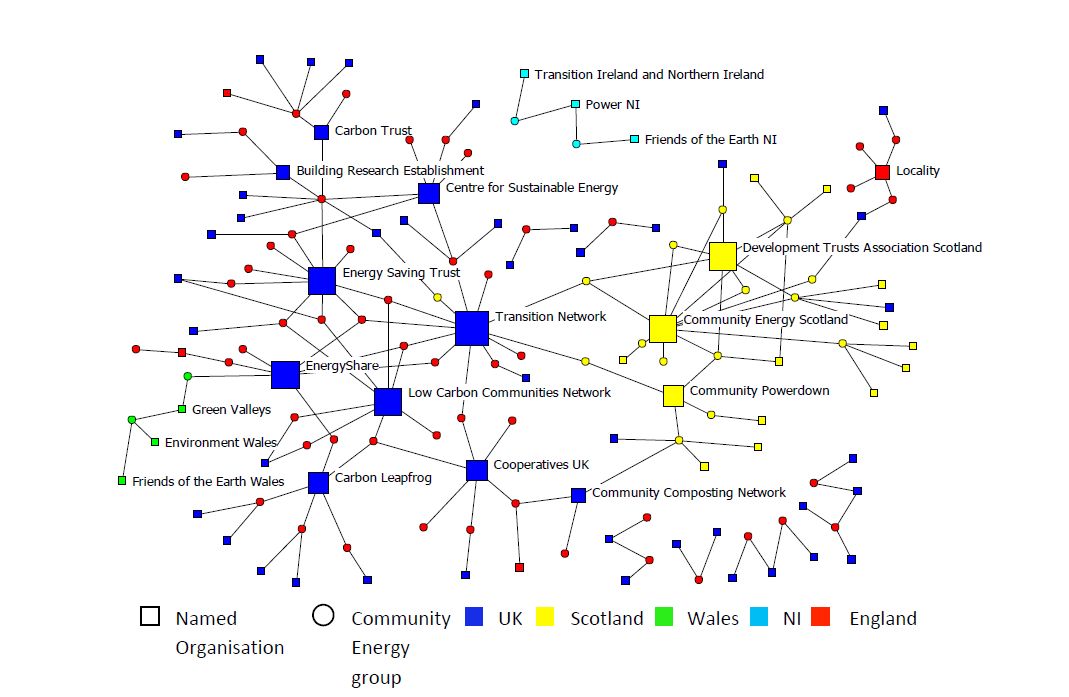
It concludes that “Transition Network was the most commonly named organisation” by respondents, and this is reflected in the sociogram. Given that it is followed in the list by organisations such as the Energy Savings Trust whose resources and size far outstrip Transition Network’s, this is a fascinating taste of the impact of Transition, and of how it works, being as much an idea, a unifying context and identity, a motivating concept and active network, as it is a provider of tangible support in relation to community energy. For an organisation that has been around for only a short time, and whose staff consist of less than 10 people, this is really something to celebrate I feel."
From a systems theory approach, I would call Transition Towns' collection of unifying contexts and ideas an attractor around which groups can self-organize. Multiple groups linked by these common ideas form a network to continue sharing, learning and building the network to a new emergent level of social organization, perhaps a regional ecology.
Wednesday, October 17, 2012
Foodless Days in 2012
Lester Brown has published two books, available free online, that detail the ongoing crisis in world food supplies. His latest book, Full Planet, Empty Plates: The New Geopolitics of Food Security, describes the current state of people in the world near starvation:
"In early 2012, Adam Nossiter wrote in the New York Times about the effect of high food prices in the Democratic Republic of the Congo, a country where hunger is common. Interviewing individual families in Kinshasa, he noted that three years ago everyone ate at least one meal a day. But today even families with both parents working often cannot afford to eat every day. It is now a given in many households that some days will be foodless, days when they will not eat at all. Selecting the days when they will not eat is a weekly routine.
As always, war, foreign and capitalist exploitation, political regimes, gendercide, racism and other social and political factors adversely and unjustly impact the distribution of food. But this time it's different. In addition to all these factors, there simply isn't enough grain to feed everyone. Catastrophic climate change in the form of floods droughts and heat waves, soil erosion, water shortages, and the demand for grain-based ethanol are having severe impacts on the total global supply of grain. World grain supplies are at their lowest in since the mid-20th century.
Data from Lester Brown's earlier book, World on the Edge, is presented in a pdf slideshow that encapsulates these issues.
"In early 2012, Adam Nossiter wrote in the New York Times about the effect of high food prices in the Democratic Republic of the Congo, a country where hunger is common. Interviewing individual families in Kinshasa, he noted that three years ago everyone ate at least one meal a day. But today even families with both parents working often cannot afford to eat every day. It is now a given in many households that some days will be foodless, days when they will not eat at all. Selecting the days when they will not eat is a weekly routine.
The international charity Save the Children commissioned detailed surveys in five countries—India, Pakistan, Nigeria, Peru, and Bangladesh—to see how people were dealing with rising food prices. Among other things, they learned that 24 percent of families in India now have foodless days. For Nigeria, the comparable figure is 27 percent. For Peru it is 14 percent. Family size plays an important role in hunger. Almost one third of large families in all countries surveyed have foodless days."
As always, war, foreign and capitalist exploitation, political regimes, gendercide, racism and other social and political factors adversely and unjustly impact the distribution of food. But this time it's different. In addition to all these factors, there simply isn't enough grain to feed everyone. Catastrophic climate change in the form of floods droughts and heat waves, soil erosion, water shortages, and the demand for grain-based ethanol are having severe impacts on the total global supply of grain. World grain supplies are at their lowest in since the mid-20th century.
Data from Lester Brown's earlier book, World on the Edge, is presented in a pdf slideshow that encapsulates these issues.
Monday, October 15, 2012
The Cybernetic Cycle
Let's take another look at Abel's energy diagram. Moving from left to right, the diagram shows flows of energy, or eMergy, as it is transformed into more complex embodied forms. However it doesn't show emergent levels. It depicts transformations as if it were one continuous flow from solar energy to "legal codes." But there are stages of emergence that structure these flows, transformations that happened over tens of thousands of years. Solar power produces plants, which leads to human agriculture as an emergent stage. Agriculture creates the possibility of complex civilizations, including learning and cultural complexity at various stages of development. Complex civilizations create the possibility of fossil fuels and technology, which makes possible an advanced technological society. Finally, the knowledge sector grows until it becomes the dominant system of the planet. Unfortunately, what is missing from the diagram is "economic" and "scientific" data, which are the information sectors that control most of the human activity on the planet, and reshape the entire terrain of minerals and living things.
Moving from right to left on the diagram are the backward pointing arrows, which depict what I call the Cybernetic Cycle. At the point of agriculture, developed by human intelligence, energy is transformed into a civilization that can produce and store information. From that point on, at each successive stage, more information and energy is generated and stored in more complex forms, in cultural products and institutional routines. But knowledge and information is also deployed "backwards", demanding, extracting and controlling more energy from the root sources (solar, plants and fossil fuels) in order to drive the transformation "forward" to new stages of emergence and new levels of complexity. At the end point, human information in the form of economic and scientific data is controlling the entire chain of energy and materials, continuously demanding and extracting more energy, and continuously driving the production of culture and institutions that store more information and energy.

Moving from right to left on the diagram are the backward pointing arrows, which depict what I call the Cybernetic Cycle. At the point of agriculture, developed by human intelligence, energy is transformed into a civilization that can produce and store information. From that point on, at each successive stage, more information and energy is generated and stored in more complex forms, in cultural products and institutional routines. But knowledge and information is also deployed "backwards", demanding, extracting and controlling more energy from the root sources (solar, plants and fossil fuels) in order to drive the transformation "forward" to new stages of emergence and new levels of complexity. At the end point, human information in the form of economic and scientific data is controlling the entire chain of energy and materials, continuously demanding and extracting more energy, and continuously driving the production of culture and institutions that store more information and energy.

Monday, September 24, 2012
Collapse and Change
In this video, filmed at a Transition Towns 2011 conference, "Mike from Forrest Row" explains that collapse is a necessary and unavoidable stage that systems go through, and is the immediate cause of systemic change. It is possible and necessary to prepare materially and psychologically for collapse and the for the profound changes that will result.
Tuesday, September 11, 2012
Finding the Future

In Apologia Pro Vita Sua, Emanuel Derman reflects on life as a "financial engineer" who worked in investment banking and built financial models designed to quantify a "vast and ill-understood sea of ephemeral human passions." Two points from the article are worthy of note. First, the concept of financial engineering is hugely flawed. Engineering models, for example of the structural tensions on a bridge, involve a set of deterministic factors for which one can calculate precise answers. The notion that one can directly port such deterministic mathematical models to finance is, as noted by many subsequent to the crash, a bit of hubris. As Weber noted oh so long ago, the causes of social action differ from those found in the natural world. This underpins the second key point in the article: the models work well when the sea stays calm, but not when a storm hits
In Trending Upward, Michael Horowitz and Philip Tetlock explore ways the intelligence community can better see into the future. Based on an analysis of the National Intelligence Community Global Trends Reports, they note a similar pattern. The reports almost inevitably fall into the trap of treating the conventional wisdom of the present as the blueprint for the future 15 to 20 years down the road. Thus, many of the things the reports get right were already unfolding when the report was written and the reports have struggled to make accurate non-obvious predictions of big-picture trends. The article goes on to suggest a number of specific ways that analysts might improve their predictions. Interestingly, the suggestions largely involve various ways to quantify the process. Unlike financial engineering, which builds quantitative models of the economy itself, Horowitz and Tetlock eschew attempts to model the political future directly. Instead, they suggest various means to quantify the process of making and aggregating expert judgments about the future.
Saturday, September 8, 2012
Digital Snow Days
Another brilliant article by Mary Logan on the sudden temporary loss of complexity.
http://prosperouswaydown.com/digital-snow-days/
As we progress further into descent, we will see more electricity brownouts, blackouts, and other events where there is a sudden failure of complexity, resulting in a shutdown of productivity. This failure of complexity has created a new urban word; "digital snow day." And since our digital snow day in Anchorage coincided withtermination dust on the mountains, the name is especially fitting. When we lose complexity suddenly, much of modern life stops, as our subsystems are highly connected. What sort of systems will be impacted when we have complexity brownouts, and what will some of those snow days look like? Does digitization make the failures worse, with a drop to a lower trophic level than would have occurred without digitization?
What's really interesting is how H. T. Odum characterized industrial energy as an extension of the food chain, as "highly embodied energy", as a higher trophic level of transformed energy that both drives and controls production. These concepts are critical to understanding the link between energy and information, a complex set of questions that I have been pursuing for the last four years.

http://prosperouswaydown.com/digital-snow-days/
As we progress further into descent, we will see more electricity brownouts, blackouts, and other events where there is a sudden failure of complexity, resulting in a shutdown of productivity. This failure of complexity has created a new urban word; "digital snow day." And since our digital snow day in Anchorage coincided withtermination dust on the mountains, the name is especially fitting. When we lose complexity suddenly, much of modern life stops, as our subsystems are highly connected. What sort of systems will be impacted when we have complexity brownouts, and what will some of those snow days look like? Does digitization make the failures worse, with a drop to a lower trophic level than would have occurred without digitization?
What's really interesting is how H. T. Odum characterized industrial energy as an extension of the food chain, as "highly embodied energy", as a higher trophic level of transformed energy that both drives and controls production. These concepts are critical to understanding the link between energy and information, a complex set of questions that I have been pursuing for the last four years.
Vulnerabilities from added levels of complexity

Odum, 1995, p. 24
Trophic levels are descriptions of organisms’ position in the energy hierarchy through their positions in the food chain. But what people do not realize is that trophic levels extend from natural ecosystems on into human economies, as higher and higher amounts of energy and other resources are transformed to build added complexity (see an example of this hierarchy in a figure at the end of the post). If we consider human economies as complex extensions of the food chain, then electricity and transmitted cultural information yield higher trophic levels that have undergone a series of energy-using transformations that exert top-down control in regulating productivity. Information is one of the most highly embodied forms of energy, and high transformity digital information can be shared over a large territory with global impact. Odum was especially concerned about the long-term storage of information in a digital age. How many of these digitized formats have paper backups that are relatively secure for the long-term in an increasingly chaotic world?

[note: I was going to post the above notes on Monday, Labor Day, but I got distracted with a bunch of other stuff as usual. Anyway, Happy Belated Labor Day.]
[the following selections are from my scattered 'Notes on Energy and Information']
I could not understand the concept of emergy, or embodied energy, until I understood General Systems Theory, which explains how matter/energy at each level is contained wholly in the next higher levels, up to the most all-inclusive levels. Energy/matter is embodied and concentrated within each higher level, enabling QUALITATIVE COMPLEXITY, i.e. new morphogenic forms and capacities to emerge at higher levels; GST explains how energy and information are concentrated and concatenated upward through the chain of complexity and evolution. At each higher level, more information is also embodied, which more precisely controls energy and slows entropy, and makes possible more complex functions and interactions with the environment. The concatenation of information and energy makes it possible to produce more specialized and carefully-controlled work (efficiency); the outcome of these processes alters the environment and creates new environmental conditions, which are then re-imported in a feedback system as more information.
Energy + Information = Power. Information organizes energy to do work; at the cognitive level (the social level) cognition organizes other cognitions, as information, to control and use energy for work. Energy directed toward a purpose is power.
How is energy converted to information in social systems? Through COMMUNICATION.
Cybernetic systems are systems of energy and power. Language not only generates systems, it also controls them internally. Externally, cybernetic systems do the work of controlling what’s in their environments. This requires energy and exerts power—power to influence and control other systems, or influence their outcomes.
Human information is potential energy. It is organized in to complex and integrated forms through communication and then stored as memory, whether in brains, books, computer systems, or institutional routines. As a stored, complex and integrated form, is has the potential to organize material energy (e.g. electrochemical, fossil fuels, electricity, muscles) for work, for a specific function. When human information is combined in a functional system with material energy, it is transformed into actual or kinetic energy (electrochemical, mechanical, chemical, physical, etc) and does work, performs a function, produces a civilization.
Connectedness is the way that energy/information is organized and categorized, catalogued, and connected to prior knowledge and information. Energy drives the dissemination of information, but information organizes energy and puts it to useful work. Information overload is too much energy/information that has not been connected and organized In a useful way. 'Knowledge as power' is energy/information that has been connected and organized in such a way as to control the flow and organization of other energy/information.
Entropy is disorganized, disconnected information that does not direct energy toward a purpose, a function. Entropy is too much noise, not enough signal; entropy is dead, lost, archaic information.
Luhmann's error, if you will, is that he analyzed communication as the starting point of creating social systems. We need to go back much further, as H. T. Odum did, and begin at the level of solar and organic energy, and using General Systems Theory, understand how energy and information are successively embedded holonically in each level of complexity, up to the most complex level on earth, the human social system, and human communication, which is the end point of this planetary system. That's why Odum was right--human information systems are the most highly embodied form of energy.
The human brain, and the human ability to communicate, is the result of millennia of evolutionary development—energy/matter combined in ever more complex forms by information/feedback from the environment. Joanna Macy explains how feedback/information is encoded in patterns, and how organisms use codes/patterns, whether genetic or behavioural, to connect with things in the environment that fit those codes and thus meet their life-support needs. The human brain, and the human ability to communicate, has the capacity to generate an almost infinite number of complex codes, but only with other humans. Individuals, by themselves, do not have the capacity to generate this infinite variety of codes. Luhmann was right to focus on communication and code generation as the key to the development of complex societies. Once humans got to a stage of evolution where they were able to communicate regularly, and learn from each other, our collective intelligence generated an almost infinite variety of codes that could be used to generate every possible thing we need from the environment—in short, to create human civilization.
[note: I was going to post the above notes on Monday, Labor Day, but I got distracted with a bunch of other stuff as usual. Anyway, Happy Belated Labor Day.]
Tuesday, August 28, 2012
Muse's 2nd Law
Muse is a popular rock band from the UK. They're putting out a new concept album called "The Second Law", referring to the Second Law of Thermodynamics, or Entropy. As a sociologist, it's interesting to me how an idea as abstract and scientific as the Second Law of Thermodynamics can make it's way into popular culture; and how it becomes politicized. Muse is an awesome band; I've enjoyed their previous releases and I'm going to buy this one when it comes out in September. This video is "The 2nd Law: Unsustainable".
Sunday, August 12, 2012
John Bellamy Foster on Weber and the Environment
Thirteen years ago John Bellamy Foster published "Marx’s Theory of Metabolic Rift: Classical Foundations for Environmental Sociology" (American Journal of Sociology 105 (2): 366–401), a work that mined Marx's work for long forgotten themes, drew attention to and explicated the concept of metabolic rift, and fundamentally reoriented Marxist thought about the natural world.
In the current issue of the American Journal of Sociology, Foster and co-author Hannah Holleman have produced an article about Weber, "Weber and the Environment: Classical Foundations for a Postexemptionalist Sociology" (AJS Volume 117 Number 6, May 2012: 1625–1673) which, I expect, will have a similar impact for future Weberian analyses of the environment.
The article itself is long, detailed and examines Weber's approach in relation to a diverse variety of themes, including:
- Weber’s interpretive/causal sociology and the environment
- Weber's historical sociology and the environment in terms of two eras
- The traditional-organic era in human history: the environment and nonindustrial society (including discussions of hydraulic bureaucracy and of deforestation and the shift from the epoch of wood to the age of iron)
- The rational-inorganic era in human history: the age of coal, iron, and industrial capitalism (including a discussion of the concept of "raubbau" (land-robbing agriculture) and its connection to the heedless consumption of natural resources)
- The sociology of energy
- The disenchantment of the world and its relation to human conquest of nature
- And, finally, Weber and the classical foundations for postexemptionalist sociology in relation to the following questions:
- How do we account for the fact that leading environmental sociologists have characterized Weber’s environmental contributions as “relatively invisible”?
- And what do Weber’s insights into the environment and society teach us with regard to the needed transformation of environmental sociology and sociology as a whole—in our postexemptionalist age, symbolized by global warming, when we realize all too fully the dangers of the human degradation of the environment?
Here is the abstract:
All in all, a provocative read well worth the effort.In the last two decades classical sociology, notably Marx, has been mined for environmental insights in the attempt to surmount the “human exemptionalism” of post–Second World War sociology. Weber, however, has remained an enigma in this respect. This article addresses Weber’s approach to the environment, including its significance for his interpretive-causal framework and his understanding of capitalism. For Weber, sociological meanings were often anchored in biophysical realities, including climate change, resource consumption, and energy scarcity, while environmental influences were refracted in complex ways within cultural reproduction. His work thus constitutes a crucial key to constructing a meaningful postexemptionalist sociology.
Subscribe to:
Posts (Atom)