Sunday, October 24, 2010

National Vulnerability to Climate Change: 2040

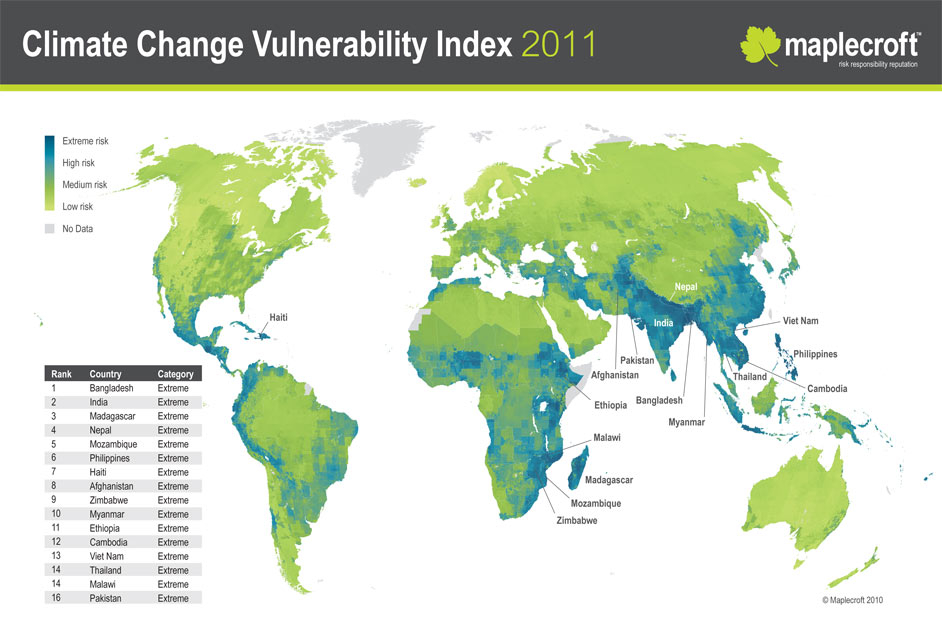
The British corporation Maplecroft, which specializes in developing quantitative measures of risk, has just released a report calculating the vulnerability of 170 countries to the impacts of climate change over the next 30 years. The report uses 42 social, economic and environmental factors to assess national vulnerabilities across three core areas: 1) exposure to climate-related natural disasters and sea-level rise; 2) human sensitivity, in terms of population patterns, development, natural resources, agricultural dependency and conflicts; and 3) the adaptive capacity of a country’s government and infrastructure to combat climate change.

The results, summarized by the accompanying map, rank countries from extreme to low risk. A number of countries projected to be major economies of the future are among those with either extreme (Bangladesh, India, Philippines, Vietnam and Pakistan) or very high (China, Brazil, Japan) levels of risk. The Guardian summarized the report as follows:
According to Maplecroft, the countries facing the greatest risks are characterised by high levels of poverty, dense populations, exposure to climate-related events and reliance on flood- and drought-prone agricultural land.

Bangladesh ticks most of these boxes and the report warns that rising climate risks could hit foreign investment into the country, undermining the driving force behind economic growth of 88 per cent between 2000 and 2008.

Similarly, the report warned that India's massive population and increasing demand for scarce resources made it particularly sensitive to climate change.

Other Asian countries attracting high levels of foreign investment such as the Philippines, Vietnam and Pakistan were also classified as facing 'extreme risk' from climate change, while industrial giants China, Brazil and Japan are listed as 'high risk'.

"This means organisations with operations or assets in these countries will become more exposed to associated risks, such as climate-related natural disasters, resource security and conflict," said Dr Matthew Bunce, principal environmental analyst at Maplecroft. "Understanding climate vulnerability will help companies make their investments more resilient to unexpected change."

Some states were not listed because of a lack of data, including North Korea and small island states such as the Maldives that are vulnerable to rising sea l evels.

Wealthy European nations made up the majority of low risk countries, with Norway, Finland, Iceland, Ireland, Sweden and Denmark deemed to face the lowest risk of climate-related disruption.

However, Russia, USA, Germany, France and the UK were all rated as 'medium risk' countries.

Thursday, October 21, 2010

UrlAi analysis of Ecological Sociology

For fun, I ran the text of Ecological Sociology through the text classification software at UrlAi.com. Here are the results.

The software correctly classified me as male and, not surprisingly, recognized the tone as academic. As someone thinks of themselves as young at heart (I have a passion for indie music and have frequently been the oldest, by several decades, at numerous concerts I've attended), it was a bit of a shock to be identified as somewhere in the 66-100 range. Got to work on that. Perhaps the June Cleaver image in the previous post will ..... oops, no ... that was a 60's show and the software only analyzes text. Anyway, given the rather dour topics that the blog covers, it was nice to find the mood remains happy!

Tuesday, October 19, 2010

The Evolution of Political Complexity

As someone with a personal interest in the processes that govern the long-term evolution of complexity in socio-ecological systems, my attention was drawn to an article in the October 14 issue of Nature, Rise and fall of political complexity in island South-East Asia and the Pacific (doi:10.1038/nature09461). The article is an attempt to empirically address an argument in anthropology and archaeology about the evolution of political systems.

According to the classic academic narrative of political evolution, post-ice age complexity — defined as increasing levels of social hierarchy — evolved slowly but surely, with mechanical predictability. First came egalitarian bands of closely-related people; then came larger but still-egalitarian tribes, with only informal leadership; these clustered into chiefdoms, with hereditary leaders; chiefdoms united into states, with bureaucracies and administrative offices.

To some scholars, however, this narrative is deterministic. They say that political evolution doesn’t proceed neatly from lower to higher complexity, but proceeds in bursts. To them, tribes, chiefdoms and states all represent distinct evolutionary trajectories rather than stages of a single progression. The critics also say that the tendency of societies to move from higher to lower complexity has been underestimated.

Here is the article's abstract:

There is disagreement about whether human political evolution has proceeded through a sequence of incremental increases in complexity, or whether larger, non-sequential increases have occurred. The extent to which societies have decreased in complexity is also unclear. These debates have continued largely in the absence of rigorous, quantitative tests. We evaluated six competing models of political evolution in Austronesian-speaking societies using phylogenetic methods. Here we show that in the best-fitting model political complexity rises and falls in a sequence of small steps. This is closely followed by another model in which increases are sequential but decreases can be either sequential or in bigger drops. The results indicate that large, non-sequential jumps in political complexity have not occurred during the evolutionary history of these societies. This suggests that, despite the numerous contingent pathways of human history, there are regularities in cultural evolution that can be detected using computational phylogenetic methods.

In short, the article argues (as shown in the following diagram) that political complexity evolves slowly through a series of stages (e.g., from simple chiefdom to complex chiefdom to state), but can fall apart much more rapidly and dramatically (e.g., in addition to reversing the process described above, a collapsing society could go directly from state to simple chiefdom).

While this is more speculation than evidence based conclusion, translating these findings into a panarchy framework highlights some interesting possibilities. Specifically, it seems that some of the transitions (e.g., from simple to complex chiefdom) would most likely be the product of adaptive cycle processes. Others, however (e.g., from complex chiefdom to state), seem intuitively to involve the emergence of processes operating at a larger scale (similar to the problem of going from nation-state to global governance). In other words, to involve the emergence of a new and separate adaptive cycle that operates at a larger scale. If this is the case, this would also make sense of the asymmetric nature of the process whereby development occurs in a path (with each level in the controlling panarchy necessary for the emergence of the next) but collapse can be more dramatic (as processes of cross-scale interaction cascade down through the panarchical levels).
Sunday, October 17, 2010

The death of not one, but two, visual icons

In a strange convergence, the deaths of two iconic contributors to global visual culture were announced yesterday.

Barbara Billingsley's performance as June Cleaver on the classic sitcom "Leave it to Beaver" has come to define, especially for those who didn't live through the era, the experience of women in 1950's America. She represented the postwar family ideal of the ever-sweet, ever-helpful, stylishly dressed, upwardly mobile stay-at-home mom who lived an all white suburban existence where she and her family were blissfully unaffected by the civil rights movement and other social issues of the times. Billingsley's obituary is here.

At the other end of the spectrum, is eccentric mathmatecian Bernoit Mandelbrot. In contrast to Billingsley, whose visual image became synonymous with her iconic character, few would recognize a photo of Mandelbrot. They would, however, recognize images based on the fractal geometry he described. And, of more direct relevance to this blog, the fractal notion of self similarity is at the core of Andrew Abbott's brilliant analysis of sociological theory -- The Chaos of Disciplines. Mandelbrot's obituary is here.

They will each live on in their own distinctive ways.

Saturday, October 16, 2010

Tuesday, October 12, 2010

The politics of US energy policy

The past few decades of US politics have been dominated by a strategy of polarization. This approach isn't necessarily the only way to be elected, but both parties have followed along because it is the script they know and understand. Polarization has two basic consequences. First, it depicts the world in simple black and white terms designed to motivate a party's base and vilify the opponents. Second, it alienates those in the center. The result is to drive down voter turnout among the unpredictable middle (particularly young voters) and turn elections into a contest between the extremes, i.e., those groups that the parties know how to reach and influence.

Obama's election, as I have argued here, was interesting precisely because he broke from this mold. His election turned largely on his ability to expand the pool of voters -- that is to get youth who had not voted in previous elections to come to the polls. But, while the Obama campaign had a brilliant strategy for the 2008 election, they have failed miserably in their attempt to transform Washington politics.

One of the most detailed (and depressing) accounts of this failure can be found in an article by Ryan Lizza, As the World Burns: How the Senate and the White House missed their best chance to deal with climate change in the current issue of the New Yorker. The article describes the factors that initially brought together an unusual coalition of Senators (Republican Lindsey Graham, Independent Joe Lieberman, and Democrat John Kerry) to draft a Senate energy and climate change bill and a second set of factors that blew apart the coalition before the bill was brought to a vote.

Tom Friedman, in his recent editorial "An X-Ray of Dysfunction", uses quotes from Lizza's analysis to identify factors relevant to understanding how the policy negotiations went off track.
A TV network acting as the political enforcer of the Republican Party: Lizza: “Back in Washington, Graham warned Lieberman and Kerry that they needed to get as far as they could in negotiating the bill ‘before Fox News got wind of the fact that this was a serious process,’ one of the people involved in the negotiations said. ‘He would say: The second they focus on us, it’s gonna be all cap-and-tax all the time, and it’s gonna become just a disaster for me on the airwaves. We have to move this along as quickly as possible.’ ”

Special interests buying policy: Lizza: “Then Newt Gingrich’s group, American Solutions, whose largest donors include coal and electric-utility interests, began targeting Graham with a flurry of online articles about the ‘Kerry-Graham-Lieberman gas tax bill.’ ”

Politicians who put their interests before the country’s: Lizza: “Then, suddenly, there was a new problem: Harry Reid, the Senate majority leader, said that he wanted to pass immigration reform before the climate-change bill. It was a cynical ploy. Everyone in the Senate knew that there was no immigration bill. Reid was in a tough re-election, and immigration activists, influential in his home state of Nevada, were pressuring him.”

A political system that cannot manage multiple policy shifts at once — even though it needs to: Lizza: Obama aide Jay Heimbach attended meetings with the three sponsoring senators, “but almost never expressed a policy preference or revealed White House thinking. ‘It’s a drum circle,’ one Senate aide lamented. ‘They come by: How are you feeling? Where do you think the votes are? What do you think we should do? It’s never: Here’s the plan, here’s what we’re doing.’ Said one Obama adviser, explaining the president’s difficulty in motivating Congressional Democrats on energy: ‘The horse has been ridden hard this year and just wants to go back to the barn.’ ”

I just have one thing to add: We need to do better. ...

But, as the current elections are showing, polarization is back with a vengeance. And, oddly, the only one who seems seriously concerned about it is a comedian.

Sunday, October 10, 2010

Brief bits: Military fuel and Skepticgate


The photo, of oil tankers that have been set on fire, accompanies a fascinating NYTimes article U.S. Military Orders Less Dependence on Fossil Fuels which a) describes a wide variety of logistic and tactical problems faced by the military as a result of their dependence on fossil fuel and b) documents policy changes designed to reduce that dependence.

=================================================

It seems that Climategate has met its karmic match: Skepticgate. USA Today is reporting officials at George Mason University have confirmed they are investigating plagiarism and misconduct charges made against noted climate science critic Edward Wegman. Wegman is best known in skeptic circles for an influential report critiquing the "hockey stick" graph. Further details are available on the Deep Climate blog, which documented that Wegman's arguments involved passages "lifted nearly verbatim from Bradley’s Paleoclimatology: Reconstructing Climates of the Quaternary, and then edited in a manner that introduced distortions and errors." As noted in the letter reproduced below, the parallels between Wegman's report and Bradley's book were sufficient that Bradley asked the administration at George Mason to investigate.

Friday, October 8, 2010

Jason Moore, World Systems and Agriculture

Several years ago, while at the Environment Section presentations at the ASA meetings in San Francisco, I had the pleasure of meeting Jason Moore. At that point he was a graduate student at UC-Berkley. The paper he presented (later published as "Silver, Ecology, and the Origins of the Modern World, 1450-1640") was, by far, the most interesting one at the conference.

It provided a fascinatingly detailed and historically rich description of the relationship between developments in Spain (leading to a need for silver) and those in Bolivia (where silver production was declining). At the core of the paper was a description of how Latin American agricultural practices were changed in order to free up the labor necessary to increase silver production through the implement new, labor intensive silver extraction and smelting techniques. While the bulk of the paper deals with the silver industry, it was the shift in agriculture that fascinated me. It went from a labor intensive vertical model that exploited the variety of ecological niches present in the narrow space between the Pacific and the Andes -- where different crops were grown and livestock raised at different altitudes with guano from the coast used as fertilizer -- to a labor efficient horizontal model -- combining agriculture and livestock into a single ecological zone and using the livestock to plow the fields. It remains one of the best historical scale accounts of the operation of social-ecological systems that I know. Unbeknown to me, Moore had already received several awards for his work (including a best graduate student paper award and an Honourable Mention for the Rheinhard Bendix prize offered by the Historical Sociology Section).

Moore, like Hornborg who's writing I've discussed here, is a world systems theorist. Indeed, one of his earliest pieces was a critique of Hornborg. I had originally intended to post material about Moore's work as a follow-up to the Hornborg posts, but things intervened.

And now Moore is back with another great piece "The End of the Road? Agricultural Revolutions in the Capitalist World-Ecology, 1450–2010". Here is the abstract:
Does the present socio-ecological impasse – captured in popular discussions of the ‘end’ of cheap food and cheap oil – represent the latest in a long history of limits and crises that have been transcended by capital, or have we arrived at an epochal turning point in the relation of capital, capitalism and agricultural revolution? For the better part of six centuries, the relation between world capitalism and agriculture has been a remarkable one. Every great wave of capitalist development has been paved with ‘cheap’ food. Beginning in the long sixteenth century, capitalist agencies pioneered successive agricultural revolutions, yielding a series of extraordinary expansions of the food surplus. This paper engages the crisis of neoliberalism today, and asks: Is another agricultural revolution, comparable to those we have known in the history of capitalism, possible? Does the present conjuncture represent a developmental crisis of capitalism that can be resolved by establishing new agro-ecological conditions for another long wave of accumulation, or are we now witnessing an epochal crisis of capitalism? These divergent possibilities are explored from a perspective that views capitalism as ‘world-ecology’, joining together the accumulation of capital and the production of nature in dialectical unity.


While Moore's analysis, from my perspective, places a bit too much emphasis on capitalism and, correspondingly, too little emphasis on the consequences of industrialization, he provides a significantly more nuanced view of the social portion of socio-ecological systems than most individuals working with the concept.

Finally, for those wanting more Moore, Jason has graciously posted many of his papers to the web.

Sunday, October 3, 2010

Is there such a thing as collective intelligence?

There is a long running debate in psychology over whether or not there is such a thing as general (or g-factor) intelligence. Charles Spearman, in the 1920's, proposed the existence of such a factor as a way of explaining why schoolchildren's grades in seemingly unrelated subjects were correlated.

A recently published article in Science (DOI: 10.1126/science.1193147) extends this concept to groups of people, arguing that groups have a “collective intelligence” that predicts their performance on a range of collaborative tasks. The study, of 699 people working in small groups, found that groups which performed well on one type of collaborative task tended to perform well on others while groups that performed poorly on one type of task tended to perform poorly on others. They found that neither the intelligence of any particular group member nor the average individual intelligence of the group members were particularly good predictors of group behaviour. Instead, the study found the degree to which group members were attuned to social cues (e.g., recognizing whether other group members were annoyed or worried) and their willingness to take turns speaking were more important, as was the proportion of women in the group.

Personally, I have huge problems with the specifics of this type of study -- where grandiose claims are made based on artificial tests that bear little resemblance to real world situations. More fundamentally, if such a group trait exists, it is likely to be an emergent phenomenon rather than one that can be explained in reductionist terms (e.g., through reference to the individual psychological traits and simple interactional processes identified in the article). That said, they deserve credit for revisiting the study of small groups (which sociology largely abandoned after the 1950's) and for their emphasis on understanding collaborative behaviour. All in all an interesting supplement to Elinor Ostron's work on processes of collaborative governance.

Tuesday, September 28, 2010

Erosion

While looking for data comparing the amount of earth moved by human processes with that moved naturally, I came across this beautiful image and its related story. The picture shows a curl of sand and dust from the Sahara desert blowing west over Africa and across the North Atlantic before heading north at the Cape Verde islands. The Sahara contributes about half of all of the dust dumped into the atmosphere every year.

According to research reported in the New Scientist, much of this dust comes from a single valley in the Sahara and ends up fertilizing the Amazon basin.
The trees and plants in the Amazon rainforest rely on nutrient-rich dust from a single valley in the Sahara desert for sustenance, researchers have discovered.

Scientists know that millions of tonnes of mineral dust are blown from the Sahara desert to the Amazon basin each year. The dust helps keep the Brazilian rainforest soils fertile.

Now, researchers have found that 56% of this dust comes from one place: the Bodélé depression in Chad, Africa. They also showed that three times more dust than previously thought is transported each year from the Sahara to the Amazon - over 40 million tonnes.

.....

The Bodélé valley is 200 times smaller than the Amazon basin, and forms only 0.2% of the Sahara itself. The reason the valley supplies so much dust is its location between two mountain ridges. It forms a funnel that accelerates the flow of air, not unlike a wind tunnel, allowing more dust to be carried. In winter, the valley produces an average of 700,000 tonnes of dust per day.

For more details, see Environmental Research Letters (DOI: 10.1088/1748-9326/1/1/014005)