Saturday, December 22, 2012

Quilley: A New Great Transformation

Stephen Quilley, using primarily the work of Karl Polanyi's The Great Transformation, makes a case for a new Great Transformation in the context of economic degrowth. He explains Polanyi's thesis of the 'disembedding' of the free market economy from non-economic social relations and how that led to two conflicting policies: an unregulated and predatory free market and a nationalized attempt to redistribute some private wealth as public benefits in the form of welfare states. Quilley's thesis is that conditions of degrowth might mean a return to re-embedding of a more localized economy within localized social relations that influence the market with non-economic social values, such as a concern for local skilled production and ecological impacts. Quilley's article, though dense, is a nice work of classical sociological argument. He references the work of the Social Innovation Generation at the University of Waterloo, a good source of research in this ares. [Check out "Pathways to System Change" as an example of their excellent work.] Following Polanyi, Quilley proposes that:


"The disembedding of economic activity involves the systematic loosening of the relationship between processes of production and consumption on the one hand, and particular place-bound communities on the other. Globalization is but the latest phase in the subordination of specific places as generic, interchangeable nodes in an abstract economic space (Lash and Urry 1994). By contrast, in the context of regeneration and community development, social innovation frequently seeks:
  • to foster recursive and circular economic flows within communities and places
  • to link economic activity to the enhancement of social and cultural capital of local community members
  • to reduce the vulnerability of place-bound communities to the vagaries of market forces by embedding economic activity in the wider matrix of local social, cultural and political activity.8"
What I liked best about the piece is his conclusion that in a period of crisis and transformation, which I agree is certainly underway, we must not try to look for or latch on to any one or one set of possible solutions. Rather we should allow for maximum diversity and experimentation of as many social innovations as possible, in order to select out those that work under a variety of localized conditions.

Thursday, December 6, 2012

Heinberg: Conflict In a Declining World System

MuseLetter #247 / December 2012 by Richard Heinberg

This month's Museletter comes from an address which I gave to the International Conference on Sustainability, Transition and Culture Change in November. Part two 'A theory of change for a century of crisis' will appear in January's Museletter.

Conflict and Change in the Era of Economic Decline: Part 1
Address to the International Conference on Sustainability, Transition and Culture Change, November 16, 2012, by Richard Heinberg
The speakers at this conference and, I would guess, most of the attendees broadly share a certain view of the world. It’s probably fair to say that, as a group, we see resource depletion, financial chaos, and environmental disasters (principally associated with global climate change) as looming storms converging on industrial civilization. We also tend to agree that the unprecedented level of complexity of our society today is due to the historically recent energy subsidies of fossil fuels, and to a certain extent the enabling factor of financial innovation. Thus, as the quality and quantity of our energy sources inevitably decline, and as financial claims melt away with the ongoing burst of history’s greatest credit bubble, a simplification and decentralization of societal systems is inevitable.
What are the social implications of all this? Will wars and revolutions break out with ever-greater frequency? Will democracy thrive, or will traumatized masses find themselves at the mercy of tyrants? Will nation states survive, or will they break apart? Will regional warlords rule over impoverished and enslaved survivors? Or will local food networks and Occupy groups positively transform society from the ground up?
I don’t claim to have a functioning crystal ball. But tracing current trends, and looking to historic analogies, may help us understand our prospects better, and help us make the most of them.
The 21st century landscape of conflict
Looking forward, four principal drivers of conflict are easily apparent. More may be lurking along the way.
First is the increasing prospect of conflict between rich and poor—i.e., between those who benefitted during history’s biggest growth bash on one hand, and on the other hand those who provided the labor, sat on the sidelines, or were pushed aside in resource grabs.
Economic growth produces inequality as a byproduct. Not only do industrialists appropriate the surplus value of the labor of their workers, as Marx pointed out, but bankers accumulate wealth from the interest paid by borrowers. We see inequality being generated by economic growth in real time in China, where roughly six hundred million people have been lifted from poverty in the last thirty years as a result of nine percent annual economic growth—but where economic inequality now surpasses levels in U.S. and even Eastern Europe.
Just as economic growth produces winners and losers domestically, the level of wealth inequality between nations grows as the global economy expands. Today the disparity between average incomes in the world’s richest and poorest nations is higher than ever.
The primary forces working against inequality as economies grow consist of government spending on social programs of all sorts, and on international aid projects.
As economic growth stops, those who have benefitted the most have both the incentive to maintain their relative advantage and, in many cases, the means to do so. Which means that in a contracting economy, those who have the least tend to lose the most. There are exceptions, of course. Billionaires can in theory go broke in a matter of hours or even seconds as a result of a market crash. But in the era of “too-big-to-fail” banks and corporations, government provides a safety net for the rich as well as the poor.
High and increasing inequality is usually bearable during boom times, as people at the bottom of the wealth pyramid are encouraged by the prospect of its overall expansion. Once growth ceases and slips into reverse, inequality becomes socially unsustainable. Declining expectations lead to unrest, while absolute misery (in the sense of not having enough to eat) often results in revolution.
We’ve seen plenty of examples of these trends in the past two years in Greece, Ireland, Spain, the U.S., and the Middle East.
In many countries, including the U.S., government efforts to forestall or head off uprisings appear to be taking the forms of criminalization of dissent, the militarization of police, and a massive expansion of surveillance using an array of new electronic spy technologies. At the same time, intelligence agencies are now able to employ up-to-date sociological and psychological research to infiltrate, co-opt, misdirect, and manipulate popular movements aimed at achieving economic redistribution.
However, these military, police, public relations, and intelligence efforts require massive funding as well as functioning grid, fuel, and transport infrastructures. Further, their effectiveness is limited if and when the nation’s level of economic pain becomes too intense, widespread, or prolonged.
A second source of conflict consists of increasing competition over access to depleting resources, including oil, water, and minerals. Among the wealthiest nations, oil is likely to be the object of the most intensive struggle, since oil is essential for nearly all transport and trade. The race for oil began in the early 20th century and has shaped the politics and geopolitics of the Middle East and Central Asia; now that race is expanding to include the Arctic and deep oceans, such as the South China Sea.
Resource conflicts occur not just between nations, but also within societies: witness the ongoing insurgencies in the Niger Delta, where oil revenue fuels rampant political corruption while drilling leads to environmental ravages felt primarily by the Ogoni ethnic group; see also the political infighting in fracking country here in the U.S., where ecological impacts put ever-greater strains on the social fabric. Neighbors who benefit from lease payments no longer speak to neighbors who have to put up with polluted water, a blighted landscape, and the noise of thousands of trucks carrying equipment, water, and chemicals. Eventually, however, boomtowns turn to ghost towns, and nearly everyone loses.
Third, climate change and other forms of ecological degradation are likely to lead to conflict over access to places of refuge from natural disasters. The responsible agencies—including the United Nations University Institute for Environment and Human Security—point out that there are already 12 million environmental refugees worldwide, and that this number is destined to soar as extreme weather events increase in frequency and severity. Typically, when bad weather strikes, people leave their homes only as a last resort; in the worst instances they have no other option. As America learned during the Dust Bowl of the 1930s, when hundreds of thousand were displaced from farms in the prairies, rapid shifts in population due to forced migration can create economic and social stresses, including competition for scarce jobs, land, and resources, leading to discrimination and sometimes violence.
Where do refugees go when the world is already full? Growing economies are usually able to absorb immigrants and governments may even encourage immigration in order to keep wages down. But when economic growth ceases, immigrants are often seen as taking jobs away from native-born workers.
In this instance as well, conflict will appear both within and between countries. Low-lying island nations may disappear completely, and cross-border weather-driven migrations will increase dramatically. Inhabitants of coastal communities will move further inland. Farmers in drought-plagued areas will pick up stakes. But can all of these people be absorbed into shantytowns in the world’s sprawling megacities? Or will at least some of these cities themselves see an exodus of population due to an inability to maintain basic life-support services?
Lastly, climate change, water scarcity, high oil prices, vanishing credit, and the leveling off of per-hectare productivity and the amount of arable land are all combining to create the conditions for a historic food crisis, which will impact the poor first and most forcibly. High food prices breed social instability—whether in 18th century France or 21st century Egypt. As today’s high prices rise further, social instability could spread, leading to demonstrations, riots, insurgencies, and revolutions.
In summary, conflict in the decades ahead will likely center on the four factors of money, energy, land, and food. These sources of conflict will overlap in various ways. While economic inequality will not itself be at the root of all this conflict (one could argue that population growth is a deeper if often unacknowledged cause of strife), inequality does seem destined toplay a role in most conflict, whether the immediate trigger is extreme weather, high food prices, or energy shortages.
This is not to say that no other sources of conflict beyond money, energy, land, and food will exist. Undoubtedly religion will provide the ostensible banner for contention in many instances. However, as so often in history, this is likely to be a secondary rather than a primary driver of discord.

Wednesday, December 5, 2012

Naomi Klein: Movement Mobilizing in a Crisis


Naomi Klein talks about using climate change crises like Superstorm Sandy to mobilize people politically as a response to the crisis.

Monday, December 3, 2012

Transportation history: Ribbon vs. Square Farms

Overly simplistic but provocative short piece comparing the historical legacy of the way land is parceled up and its implications for how we think about transportation. Argues that square farms have social consequences -- "We feel transportation should come to us instead of the other way around" -- that differ from nations where land is divided in the ribbon format.

Saturday, December 1, 2012

A Deeper Definition of Resilience


The following definition of resilience comes from Resilience.org, the new website of the Energy Bulletin, published by the Post-Carbon Institute. 
The essential feature of biocultural systems that has ensured their persistence in time and space has been their resilience. Prominent resilience scientist Dr. Brian Walker describes resilience as the propensity of a system to learn, adapt, self-organize (through co-evolution between different sub-systems) and absorb change without losing functional integrity. Resilient systems are characterized by a diversity of patterns, functions, and processes — from nutrient cycles to ecological niches, from inter- and intra-specific variability to between and within the richness of languages, from epistemologies to traditional institutions of governance — that ensures a wide range of responses to external or internal challenges.
Resilient systems are characterized by a diversity of patterns, functions, and processes that ensures a wide range of responses to external or internal challenges.
Another important characteristic of a resilient system is its modularity, the presence of relatively autonomous “nodes” (e.g., local communities, ecological refugia, pastoral networks) throughout a system that reduces its over-connectedness and therefore enhances its ability to resist rapid transmission of environmental and social shocks. Tight feedback mechanisms between various elements of biocultural systems enable detection of approaching thresholds, or tipping points (from coral- to algae-dominated systems, from rainforest to savannah, from commons to private property, from subsistence to market-based economy), long before the system is on the verge of flipping into a new, potentially irreversible state.
Functional overlap is a reflection of redundancy in the system that enhances its continuity when some of its elements experience change (e.g., carbon sequestration is achieved in different parts of an ecosystem; traditional diets include varied sources of protein; wildlife harvest is regulated through different institutional arrangements). Substantial social capital — in the form of trusted social networks, wise leadership, intergenerational transmission of knowledge, an equitable integration of different ways of knowing into decision-making —  also allows for diverse systemic responses to change.

Tuesday, November 13, 2012

Oil Shale: Finally a Bride?

The past few years has seen an explosion in the production of shale gas. The recently released World Energy Outlook 2012 predicts that the US will replace Saudi Arabia as the world's largest producer of oil by 2020 as a result of a dramatic increase in production from an unconventional source: shale oil.

How plausible is this? Lets begin with the facts. First, there is a tremendous amount of oil locked up in US shale, particularly in Colorado. With 'known' reserves of approximately 600 billion barrels of oil equivalent and estimated potential of 1.8 trillion bbl, this resource is the American version of Canada's oil sands -- an unconventional source of petroleum that has a long history of being a bridesmaid, but never a bride. A popular saying in the Colorado industry captures this nicely: “Oil shale is the fuel of the future, and always will be.” But, as the tar sands have shown, changes in the economics of the industry coupled with technological developments can foster large scale production from previously inaccessible sources.

Second, the projection is based on expectations about both price and technology. Significantly, a recent survey of petroleum economists showed little consensus about future prices. The survey revealed two distinct camps -- those who think prices will remain high or increase and those who think they will fall substantially. Their take on prices is largely tied to their expectations about the impact of shale oil on the global market. One camp argues that the upside from shale oil supplies will be more than enough to meet demand growth. The other disputes that, saying the likely impact from shale is being exaggerated.

The role of technology is equally contentious. Some geologists point to the role of two technologies that have been central to the development of shale gas: hydraulic fracturing and horizontal drilling. Others emphasize the technologies present at Shell's Mahogany Ridge Project; a new, working, but small scale, oil shale demonstration technology that produced 1400 barrels of oil without mining. The traditional approach to oil shale -- which led to the bridesmaid label -- involved 'retorting,' a process that required mining the shale, hauling it to a processing facility that crushed the rock into small chunks, then extracted a petroleum substance called kerogen, then upgraded the kerogen through a process of hydrogenation (which requires lots of water) and refined it into gasoline or jet fuel. Here is a description of the Mahogany Ridge process from Shell's Terry O'Connor:
“Most of the petroleum products we consume today are derived from conventional oil fields that produce oil and gas that have been naturally matured in the subsurface by being subjected to heat and pressure over very long periods of time. In general terms, the In-situ Conversion Process (ICP) accelerates this natural process of oil and gas maturation by literally tens of millions of years. This is accomplished by slow sub-surface heating of petroleum source rock containing kerogen, the precursor to oil and gas. This acceleration of natural processes is achieved by drilling holes into the resource, inserting electric resistance heaters into those heater holes and heating the subsurface to around 650-700F, over a 3 to 4 year period.

“During this time, very dense oil and gas is expelled from the kerogen and undergoes a series of changes. These changes include the shearing of lighter components from the dense carbon compounds, concentration of available hydrogen into these lighter compounds, and changing of phase of those lighter, more hydrogen rich compounds from liquid to gas. In gaseous phase, these lighter fractions are now far more mobile and can move in the subsurface through existing or induced fractures to conventional producing wells from which they are brought to the surface. The process results in the production of about 65 to 70% of the original “carbon” in place in the subsurface.

“The ICP process is clearly energy-intensive, as its driving force is the injection of heat into the subsurface. However, for each unit of energy used to generate power to provide heat for the ICP process, when calculated on a life cycle basis, about 3.5 units of energy are produced and treated for sales to the consumer market. This energy efficiency compares favorably with many conventional heavy oil fields that for decades have used steam injection to help coax more oil out of the reservoir. The produced hydrocarbon mix is very different from traditional crude oils. It is much lighter and contains almost no heavy ends.

“However, because the ICP process occurs below ground, special care must be taken to keep the products of the process from escaping into groundwater flows. Shell has adapted a long recognized and established mining and construction ice wall technology to isolate the active ICP area and thus accomplish these objectives and to safe guard the environment. For years, freezing of groundwater to form a subsurface ice barrier has been used to isolate areas being tunneled and to reduce natural water flows into mines. Shell has successfully tested the freezing technology and determined that the development of a freeze wall prevents the loss of contaminants from the heated zone.”

It may seem, as O’Conner said, counter-intuitive to freeze the water around a shale deposit, and then heat up the contents within the deposit. It’s energy-intensive. And it’s a lot of work. What’s more, there’s no proof yet it can work on a commercial scale.

Yet both technologies, the freeze wall and the heating of shale, have been proven in the field to work. The freeze wall was used most recently in Boston’s Big Dig project. It was also used to prevent ground water from seeping into the salt caverns at the Strategic Petroleum reserve in Weeks Island, LA.
In short, the individual 'pieces' of a working approach have been demonstrated, but their viability as a systemic whole, particularly on a commercial scale, remain unproven.

Third, a number of other factors have to be taken into account. The energy content of oil shale varies tremendously from region to region. Colorado shale is, by far, the most concentrated and, hence, most attractive. But, the process is both energy and water intensive, and water is at a premium in Colorado. Moreover, 72% of known US oil shale reserves are on government land. This is a fact that cuts both ways. On the one hand, this provides an economic lure; development of the lands could provide a significant revenue stream. On the other, as the case of drilling in the Alaska National Wildlife Refuge shows, exploitation of sensitive government lands can be a political hot potato. The Colorado reserves lie on land surrounded by National Parks and other sensitive areas. So, simply put, in addition to the economic and technology matters, there are also significant political considerations.

Finally, as my earlier research on the history of oil estimates showed, the current political economy of the oil industry accounts for the way assumptions underlying such projections are interpreted. In other words, while the projections are justified in terms of geology and technology, it is the current political economy of the industry which affects whether such estimates incorporate 'optimistic' or 'pessimistic' assumptions about the implications of those factors.  Simply put, when there is lots of shut in short term capacity, the industry thinks that there is lots of energy available and opts for optimistic assumptions about future geology and technology. Alternatively, when demand outstrips supply, there is no shut in capacity, and the industry is doing everything it can to find new sources and get them on to the market, then pessimistic assumptions about future geology and technology become the order of the day. Thus, given the current glut of supply on the market, history suggests we would be wise to question the ultimate validity of these particular projections.


Harvey: Zero Growth and Novelty

Harvey says that past communist systems failed because they did not provide "the liberty to pursue novelty" and promote human development. My take: adapting to climate change, resource constraints and economic degrowth (whether planned or forced) will require constant innovation, and all our creative problem solving capacity, just to keep up with the constantly shifting environment.

Saturday, November 10, 2012

Transition Towns: Possibilities, not Probabilities

The following blog post from Rob Hopkins is by far the best explanation of what Transition Towns is about. It contains numerous but implicit references to chaos theory: that we have to self-organize, start from the simplest level, from the ground up, that we don't know the mature state of the system or even where we're going, but that by following simple 'nearest neighbor' rules, we can create resilient communities and perhaps arrive at a mature system state that is resilient and more ecologically sound than the current one.

After reading this, my 'aha' moment was that I realized that there's no way we can solve the problem of global climate change—it's impossible. It's too big, it's too complex and too intractable. Since we can't solve the problem of global climate change (or 'peak oil') we have to focus on problems that we can solve. "Focus on possibilities, not probabilities." We have the capacity to build local, resilient communities that can survive whatever hits us, whether climate change, peak oil, economic collapse, or the decline of an empire. But just working on any collective social problem won't help us develop the right skills for the crisis. In order to develop the necessary skills to survive climate change, we have to work on problems and projects that "model" the larger crisis. So working on the cooperative local provision of food, shelter, energy and governance in a low carbon mode, creating systems that can react quickly and flexibly to localized change, helps us develop capacities for a future that is energy scarce and climate disrupted. We can solve those problems by working through movements like Transition Towns that ask the right questions and focus on the right issues, even if they don't have all the answers. "Resilience" doesn't solve the problem of climate change either—it just helps us to survive it so that we can adapt to whatever conditions will be thrust upon us for the indefinite future. In the face of these insurmountable dilemmas, we cannot avoid collapse, large or small. Catastrophic transformation is on it's way and we can't stop it. All we can do is survive it and hope that the new communities we create will evolve into a system that is adapted to the new world that awaits us.


From today’s Guardian Sustainable Business section: ‘Community action alleviates climate change gloom’

In his recent piece on climate change on the network, Jo Confino wrote of the dark place he found himself in after a few weeks immersed in the latest news on sustainability – his climate change ”dark night of the soul” if you like.  For the past six years I have been part of an experiment known as Transition, which encourages people to do just what Confino suggests: to sit with the pain of this awareness, while also pointing to a path beyond it.
It’s a bottom-up approach to the creation of community resilience; the ability to withstand shocks at the local level. It focuses on “engaged optimism”, a solutions-focused and positive response, rather than the “false cheer” Confino warns against.
There is an important distinction to be made between the kind of positive thinking that Barbara Ehrenreich lambasts in Smile or Die: How Positive Thinking Fooled America and the World, and the Transition approach. Ehrenreich writes of “mandatory optimism and cheerfulness”, whereas Transition is very different. It acknowledges the scale of the challenges we face and that they can be deeply upsetting, but also invites you to be part of a collective response, with no predetermined answers, to help make history figuring it out. A collective experiment, if you like.
It works like this: an initiating group forms; raises awareness about climate change, peak oil and so on (always in the context of what can we, now, here, do about it); then subsequent groups form around key areas – food, energy, transport – which enable the people who are passionate about those areas to get involved. It works to create a collective vision of how it would like its future to be in the context of the challenges outlined above. This then leads to practical projects driven by what people feel enthused to do. You might think of it as a “do-ocracy”, a process driven by the people who are doing stuff.
It is open source, bottom-up and self-organised. It represents a shift from focusing on probabilities to focusing on possibilities. Confino’s despondency following his immersion in the data on climate change is about probabilities, the probability that such-and-such will happen by a certain time. But what if the thinking shifted to what was possible? Given that we are where we are, what might we be able to create in this situation?
It is that refocusing that led to the creation of Bath & West Community Energy, a co-operative, community-owned energy company which just raised £750,000 in its first share launch. It led to the Bristol Pound, launched last month with the full support of the city council and already accepted in many hundreds of businesses, and Transition Lancaster’sFruity Corners, fruit trees planted across the city. . There are many other examples of such initiatives.
While none of these on their own are an adequate response to climate change, combined they represent communities taking visionary leadership when their leaders are failing to do so.
Might we redefine resilience as the degree to which we can breathe possibility into our local communities, changing the stories they tell about themselves, so that when they encounter shock, they are able to refocus on the possibilities that emerge? The realisation that we live in a world of limits can be a great stimulus for new thinking and creativity.
I too have sat in the pit Confino writes about, the gloomy place where it feels like you are the only person who can see the wall our juggernaut of civilisation is heading for at great speed. Indeed, I pop back there on a fairly regular basis. But feeling part of a process, with others, of starting to build the kind of world we want to see, helps hugely. It contributes to my own personal resilience, as well as to the resilience of the community around me.
It is perhaps a path out of the pit driven by action.
Rob Hopkins is co-founder of Transition Network and author of The Transition Companion. He blogs at TransitionCulture.org and tweets as@robintransition.  You can find the original of this piece here.  

Thursday, October 18, 2012

Networks in Community Energy Projects

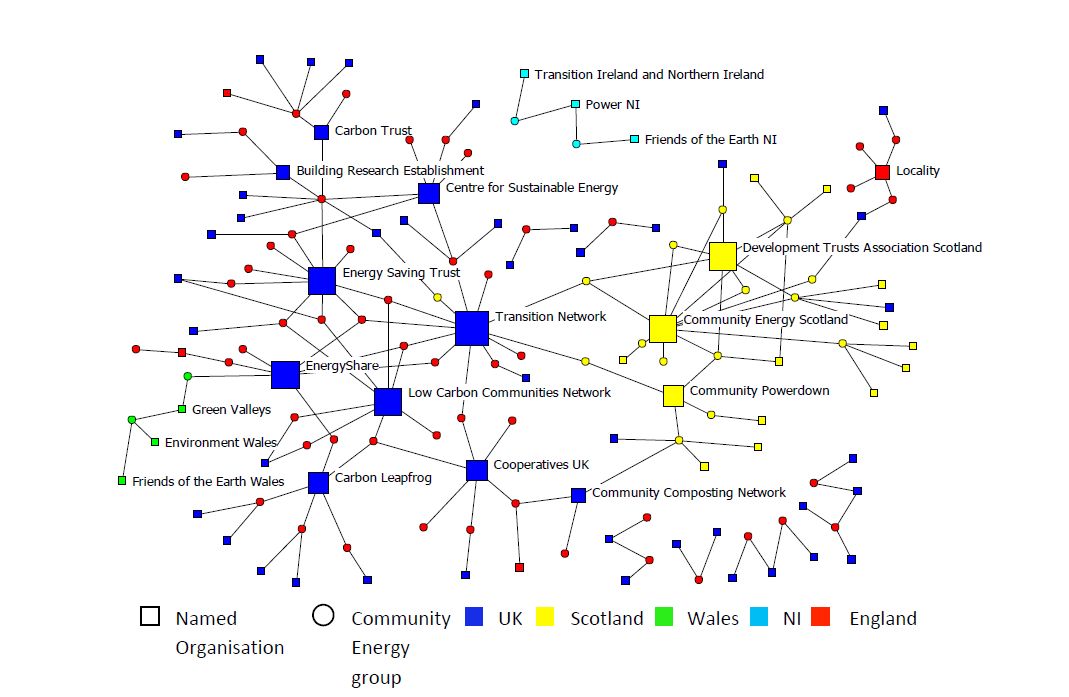
Research on community energy projects in the UK cites Transition Towns as a key player in a network of organizations that support sustainability. The researchers used a 'sociogram' to diagram the linkages and nodes among these organizations:

"The other aspect of networking explored was the links these projects had with intermediary organisations and networks.  This built up a fascinating picture of the web of organisations, from local networks to national networks, national-scale organisations, public sector and third sector organisations and private organisations.  The authors mapped these relationships in what they call a ‘sociogram’ which shows the complexity of these relationships, and who influences who (see below, click to enlarge).
It concludes that “Transition Network was the most commonly named organisation” by respondents, and this is reflected in the sociogram.  Given that it is followed in the list by organisations such as the Energy Savings Trust whose resources and size far outstrip Transition Network’s, this is a fascinating taste of the impact of Transition, and of how it works, being as much an idea, a unifying context and identity, a motivating concept and active network, as it is a provider of tangible support in relation to community energy.  For an organisation that has been around for only a short time, and whose staff consist of less than 10 people, this is really something to celebrate I feel."
From a systems theory approach, I would call Transition Towns' collection of unifying contexts and ideas an attractor around which groups can self-organize. Multiple groups linked by these common ideas form a network to continue sharing, learning and building the network to a new emergent level of social organization, perhaps a regional ecology.